
Advanced Fresh Air w/ CERV2
Make & share a podcast clip
Keep the exact passage and a link to the full episode. Choose up to three minutes, with enough context to be fair to the speaker.
Preview uses this episode’s audio. Browser audio export, when supported, takes the length of the selected clip. Nothing plays until you choose Preview.
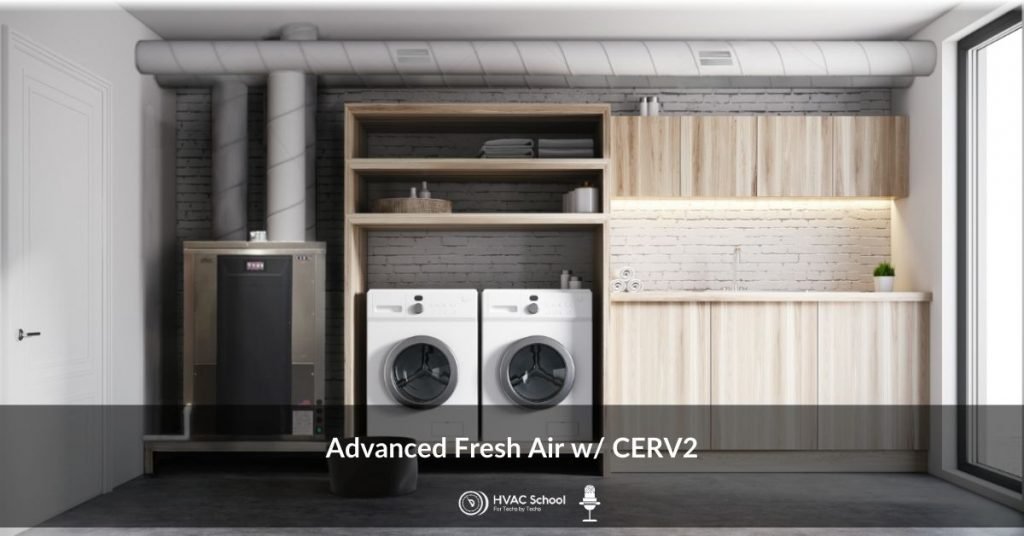
In this podcast episode, Ty Newell from Build Equinox comes on to discuss the CERV2 and how it embodies “advanced fresh air.” The CERV2 is the second-generation version of the CERV.
A basic ERV allows for discharge air leaving the home to pass the intake air. When the airstreams cross through a core, there is an exchange of sensible and latent energy. The ERV may promote dehumidification and cooling of the incoming air. The CERV is a form of ERV technology, but it addresses the issues that may arise from crossing the airstreams. For example, we don’t always want to exchange energy, so sensors can examine the air content and determine when and when not to exchange energy.
The CERV, an advanced fresh air solution, went into development in 2008, and the first unit was built in 2010. The CERV has sensors for carbon dioxide and VOCs; either one of those may dominate the air quality in the home. The CERV also uses a heat pump to exchange energy and help heat or dehumidify fresh air coming in. The CERV also has higher CFM than most ventilation solutions, meaning that it can flush out pollutants effectively. So, the CERV acts as a supplementary heating/cooling source for maximum comfort and indoor air quality.
Build Equinox is a small company, and it has about 400 CERV/CERV2 units spread throughout North America. However, because the market is small, they can examine feedback very closely.
Ty and Bryan also discuss:
- Potential downsides of bringing in outside air
- Dehumidification for CERV
- Recirculation mode
- CERV unit controls
- Using hydrocarbon refrigerants
- Concerns with microchannel coils
- Oil carry, miscibility, and foaming
- Superheat control
- Assessing indoor air quality
- Sensitivity to IAQ threats
- Latent-dominated, sealed residential constructions
- Testing and choosing sensor technology
Check out more at buildequinox.com.
Learn more about Refrigeration Technologies HERE.
If you have an iPhone, subscribe to the podcast HERE, and if you have an Android phone, subscribe HERE.
Highlight a short passage, or bring a question about a specific moment into HVAC No Bull Forum.
Discuss this reference → Related forum discussionsAuthor:











Comments
To leave a comment, you need to log in.
Log In