
Atmospheric Pressure – Short 114
Make & share a podcast clip
Keep the exact passage and a link to the full episode. Choose up to three minutes, with enough context to be fair to the speaker.
Preview uses this episode’s audio. Browser audio export, when supported, takes the length of the selected clip. Nothing plays until you choose Preview.
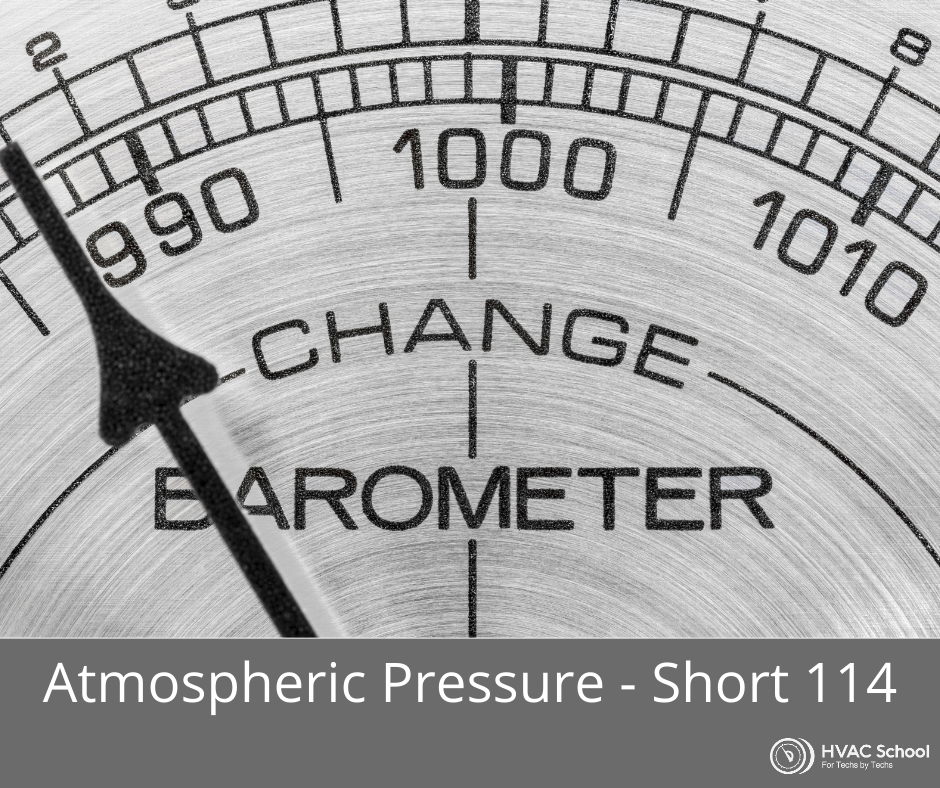
In this short podcast episode, Bryan explains what atmospheric pressure really is, pressure units and conversions, and why those are matter.
Atmospheric pressure is the weight of the air around us pushing down on us. We normally see that value expressed as 14.7 PSI (or 0 PSIG). Before we dive too deep into atmospheric pressure, we should understand some basic pressure units.
We may see pressure expressed in microns when we’re pulling a vacuum; we are trying to pull the atmosphere out of the system, so our goal is to get as close to 0 as possible. Whenever we pull a vacuum, we get liquid water to boil off and remove molecules inside the system. The industry standard is 500 microns. 14.7 PSI(A) is equivalent to about 760,000 microns, so the micron is an extremely small pressure measurement. You may also see the bar scale, which is equivalent to 1 atmosphere (atm). One bar equals just over 14.5 PSIA.
You may also encounter the Pascal unit, which is common on the building science side of our industry. One PSI is equal to 6,894.76 Pascals. When we look at small pressures, such as static pressure or gas pressure, we may use the inch of water column (“wc). One inch of water column is equal to 248.84 Pascals. We also have inches of mercury (“Hg) and the torr (mmHg), which are related to the micron. All units are interrelated, but they have their appropriate applications.
Atmospheric pressure matters when altitude enters the equation. When the pressure changes at a higher altitude, the air density also changes. The air is less dense, so you have less oxygen in the air. When you have less oxygen in the air, combustion is more likely to be incomplete. So, we may need to derate furnaces. We also need to take altitude into account when we calibrate gauges at significant altitudes compared to sea level.
Learn more about Refrigeration Technologies HERE.
If you have an iPhone, subscribe to the podcast HERE, and if you have an Android phone, subscribe HERE.
Highlight a short passage, or bring a question about a specific moment into HVAC No Bull Forum.
Discuss this reference → Related forum discussionsAuthor:











Comments
InHg : Hg is the periodic element name of Mercury.
Report comment
InHg : Hg is the periodic element name of Mercury.
Report comment
To leave a comment, you need to log in.
Log In