
Balancing Evaporators in a Circuit Using the TXV
Make & share a podcast clip
Keep the exact passage and a link to the full episode. Choose up to three minutes, with enough context to be fair to the speaker.
Preview uses this episode’s audio. Browser audio export, when supported, takes the length of the selected clip. Nothing plays until you choose Preview.
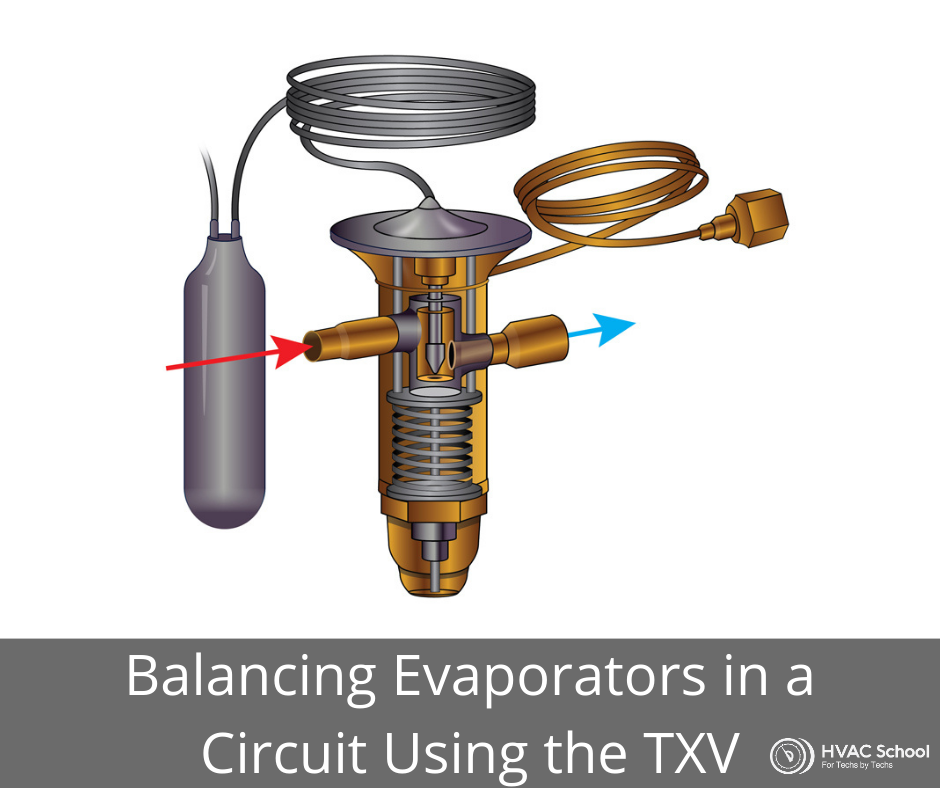
In this podcast episode, Bryan and Nathan discuss balancing evaporators in a multi-coil circuit. They specifically focus on using the TXV to do so.
When we say “balancing evaporators” in a multi-coil circuit, we’re referring to the temperature of the air leaving the system; we are worried about the air keeping the product cool in grocery refrigeration. If everything works correctly, the evaporators on a rack can have different temperatures due to different refrigerant flow rates. That’s when we can turn out attention to the expansion valves, which meter the refrigerant into the evaporator and manage the refrigerant flow.
Balancing evaporators with the TXV is a controversial practice; many people insist that you should balance evaporators with the equivalent line set length only. However, it’s not usually possible to repipe the entire circuit, so using the TXV is much more practical. You essentially run higher superheat on the colder cases by using the TXV to create a restriction.
When you adjust the TXV, you’ll want to do so in quarter-turn increments on the highest and lowest cases and wait for the temperatures to stabilize (about 30 minutes) before making further adjustments.
Tuning on rack refrigerators is another related concept. We don’t see mechanical EPRs very often anymore, so we can rely on the system to make programmatic adjustments. Once the temperature and operation are stable, you can set your superheat. Typically, balancing evaporators will be more important on systems with electronic EPRs than mechanical EPRs.
Bryan and Nathan also discuss:
- Pressure drop associated with fittings
- Where to take superheat
- Flood back risks
- Modern TXVs and EEVs
- Defrost controller considerations
- Discharge air differences
Learn more about Refrigeration Technologies HERE.
If you have an iPhone, subscribe to the podcast HERE, and if you have an Android phone, subscribe HERE.
Highlight a short passage, or bring a question about a specific moment into HVAC No Bull Forum.
Discuss this reference → Related forum discussions










Comments
To leave a comment, you need to log in.
Log In