
EER, SEER and TXVs – Short #165
Make & share a podcast clip
Keep the exact passage and a link to the full episode. Choose up to three minutes, with enough context to be fair to the speaker.
Preview uses this episode’s audio. Browser audio export, when supported, takes the length of the selected clip. Nothing plays until you choose Preview.
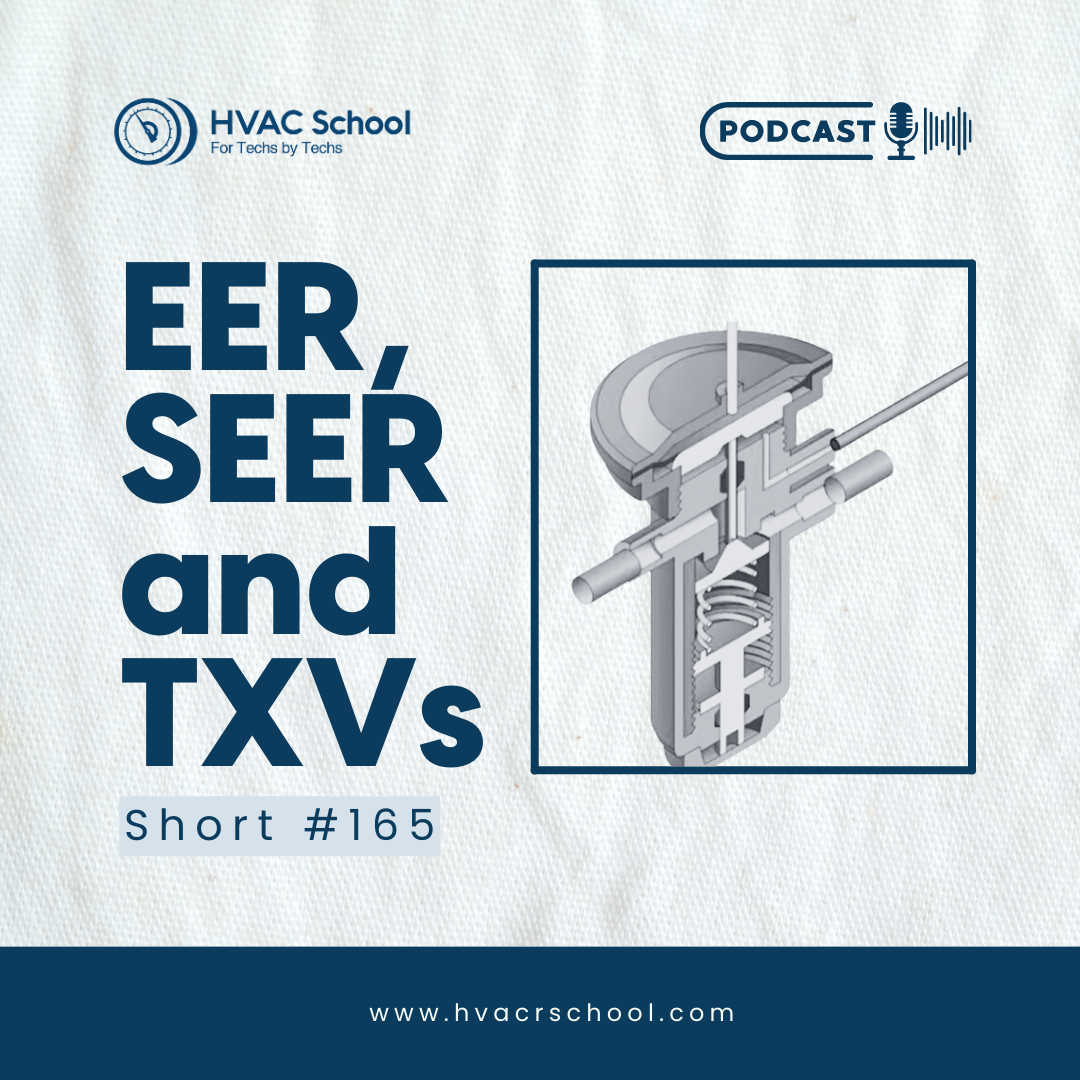
In this short podcast episode, Bryan talks about TXVs and their impacts on energy efficiency ratings (EER and SEER).
EER (Energy Efficiency Ratio) is calculated based on fixed conditions (an outdoor temperature of 95 degrees Fahrenheit and an inside temperature of 80 degrees with 50% RH). EER is a ratio of cooling-only capacity in BTUs per hour to the total electrical input in watts. SEER (Seasonal Energy Efficiency Ratio) is the ratio of an HVAC system’s cooling output during a typical cooling season to the seasonal electrical input in watts.
Both energy efficiency ratios use non-proportional units (BTUs to watts), but SEER is supposed to account for a wide set of conditions (even though the climates of regional markets can vary quite wildly). EER2 and SEER2 are new standards based on updated equipment testing protocols with more realistic static pressures.
TXVs and EEVs can modulate to control the amount of refrigerant going into the evaporator coil. TXVs maintain a set superheat at the evaporator coil outlet, which it detects with a sensing bulb mounted to the suction line. These sorts of modulating metering devices can boost system efficiency by adjusting the amount of refrigerant it feeds into the evaporator coil. Underfeeding can lead to inefficiency, and overfeeding can cause system damage.
Non-bleed TXVs shut tight once the compressor shuts off, which prevents refrigerant migration during the off cycle and pressure equalization, thus protecting the compressor and reducing the cyclic degradation coefficient. The compressor may have to start a little bit harder, but the effects of the hard shutoff can improve the SEER rating by about 0.5. TXV systems are, overall, more efficient than systems fixed-orifice metering devices.
Learn more about the HVACR Training Symposium or buy a virtual ticket today at https://www.hvacrschool.com/symposium.
If you have an iPhone, subscribe to the podcast HERE, and if you have an Android phone, subscribe HERE.
Check out our handy calculators HERE.
Highlight a short passage, or bring a question about a specific moment into HVAC No Bull Forum.
Discuss this reference → Related forum discussions









Comments
To leave a comment, you need to log in.
Log In