
EPA Myths and Recovery Best Practices #LIVE
Make & share a podcast clip
Keep the exact passage and a link to the full episode. Choose up to three minutes, with enough context to be fair to the speaker.
Preview uses this episode’s audio. Browser audio export, when supported, takes the length of the selected clip. Nothing plays until you choose Preview.
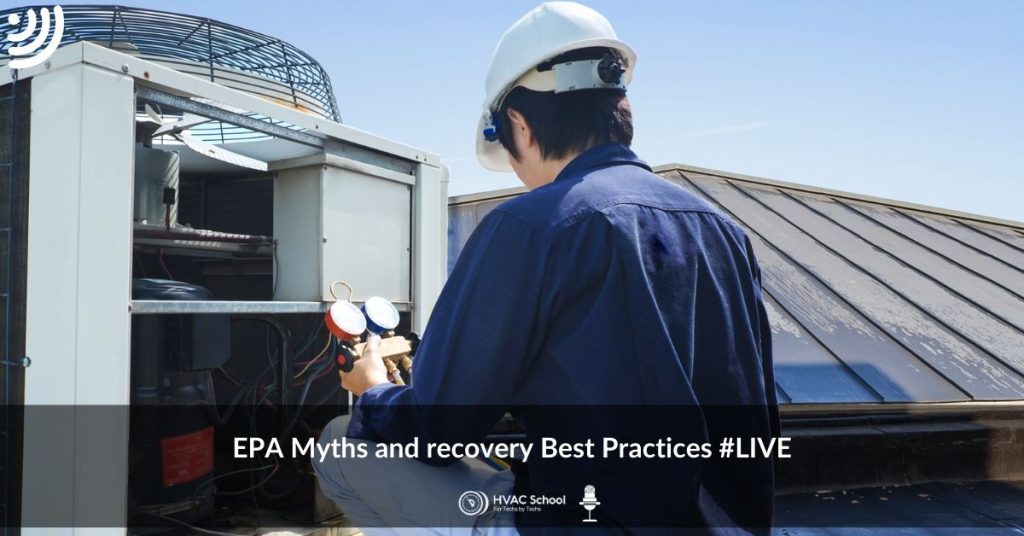
Eric Kaiser comes on the live podcast to talk through some commonly repeated EPA myths. We also discuss how to get the most from your recovery machine and tanks. The EPA exists to interpret broad laws into specific standards, such as by translating climate initiatives into venting guidelines.
One of the most common EPA myths is that you cannot charge a leaking system. If you can repair the leak and get the leak rate below the specified percentage, then you can recharge the system. Not every country allows this procedure.
On the subject of refrigerant losses to leaks, making leaks is also NOT a valid excuse to vent refrigerant; the EPA tries to get us to minimize losses as much as possible. De minimis exemptions exist to allow for us to service a system properly, not to give us loopholes for venting. Overall, it’s best to use probes to take your readings, not manifolds.
R-22 is another controversial subject that gives rise to some EPA myths. R-22 is NOT illegal, but it is no longer being produced or imported. There are limitations based on the amount of charge as well, but recharging a system with R-22 is NOT a crime.
When recovering with a recovery machine, you want to prevent junk from getting inside of it (such as from the recovery tank). To protect your recovery machine, it’s good practice to run the refrigerant through a filter-drier when returning it to a system, though that won’t fully clean the refrigerant.
Eric and Bryan also discuss:
- The ins and outs of new R-22 guidelines
- Pulling down into a vacuum
- Low-loss fittings and refrigerant trapped in hoses
- Whose responsibility is it to keep records?
- Drop-in refrigerants, mixing refrigerants, and topping off
- Recovery tank safety basics and cleanliness
- How recovery machines work
- Recovering in the liquid phase
- Heat transfer in recovery
- PPE
Learn more about Refrigeration Technologies HERE.
Highlight a short passage, or bring a question about a specific moment into HVAC No Bull Forum.
Discuss this reference → Related forum discussionsAuthor:












Comments
To leave a comment, you need to log in.
Log In