
Horizontal Scroll Compressors w/ Trevor
Make & share a podcast clip
Keep the exact passage and a link to the full episode. Choose up to three minutes, with enough context to be fair to the speaker.
Preview uses this episode’s audio. Browser audio export, when supported, takes the length of the selected clip. Nothing plays until you choose Preview.
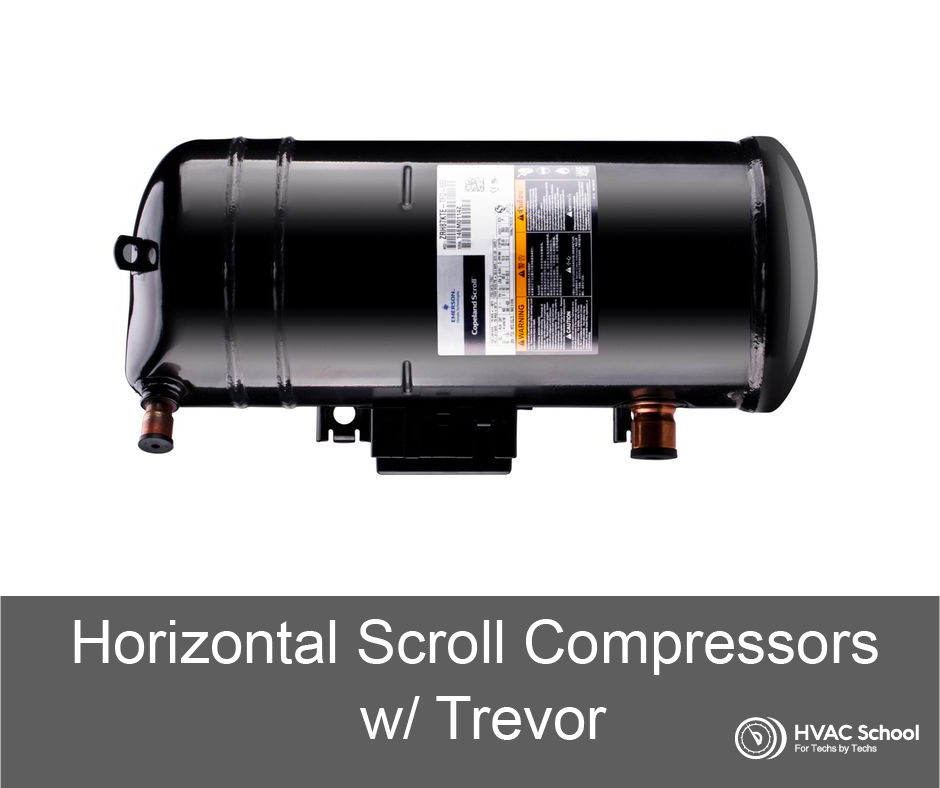
In today’s podcast, Trevor Matthews from Emerson talks about horizontal scroll compressors. Throughout the podcast, we refer to Bulletin AE4-1338 (R3). You can find that bulletin HERE.
Horizontal scroll compressors are common in mobile applications, like buses and trains. They’re shorter in height than other compressors, so they fit into tighter spaces and are ideal for transport refrigeration.
Scroll compressors are particularly susceptible to overheating, and you need some controls to protect your compressor from damage. To prevent overheating, scroll compressors require pressure relief controls. You can typically use an OEM high-pressure control to protect the system. A low-pressure cutout installed in the suction line can help prevent TXV failure and a wide range of restrictions.
Accumulators are especially important for horizontal scrolls in heat-pump applications. However, accumulators have a fine mesh screen that can become clogged easily. So, we highly recommend replacing your accumulator in the case of burnout, not reusing it.
Refrigerant migration prevention is a little more complicated than in refrigeration systems with other compressors. You can use a crankcase heater, but you may also need a check valve in the discharge line and a liquid line solenoid valve. We don’t use pump down cycles for refrigerant migration; we use them to prevent the gas from moving backward and reversing the scroll.
When commissioning a three-phase compressor, you need to put your gauges on before starting the system up. You may also consider using a phase rotation monitor to make sure the scroll compressor is rotating in the correct direction (usually clockwise but not always).
Trevor and Bryan also discuss:
- Variable-speed horizontal scrolls (ZRH vs. ZBH models)
- Superheat requirements
- Floodback and slugging
- Starting and running
- Extreme discharge line temperatures
- Arcing fusite under vacuum
- Functional checks
- Pressure drop in the suction line
- Operation envelopes
- Pressure control set points
Check out Emerson for more information.
If you have an iPhone, subscribe to the podcast HERE, and if you have an Android phone, subscribe HERE.
Check out our handy calculators HERE.
Highlight a short passage, or bring a question about a specific moment into HVAC No Bull Forum.
Discuss this reference → Related forum discussionsAuthor:












Comments
To leave a comment, you need to log in.
Log In