
Inductive Current Myths – Short #158
Make & share a podcast clip
Keep the exact passage and a link to the full episode. Choose up to three minutes, with enough context to be fair to the speaker.
Preview uses this episode’s audio. Browser audio export, when supported, takes the length of the selected clip. Nothing plays until you choose Preview.
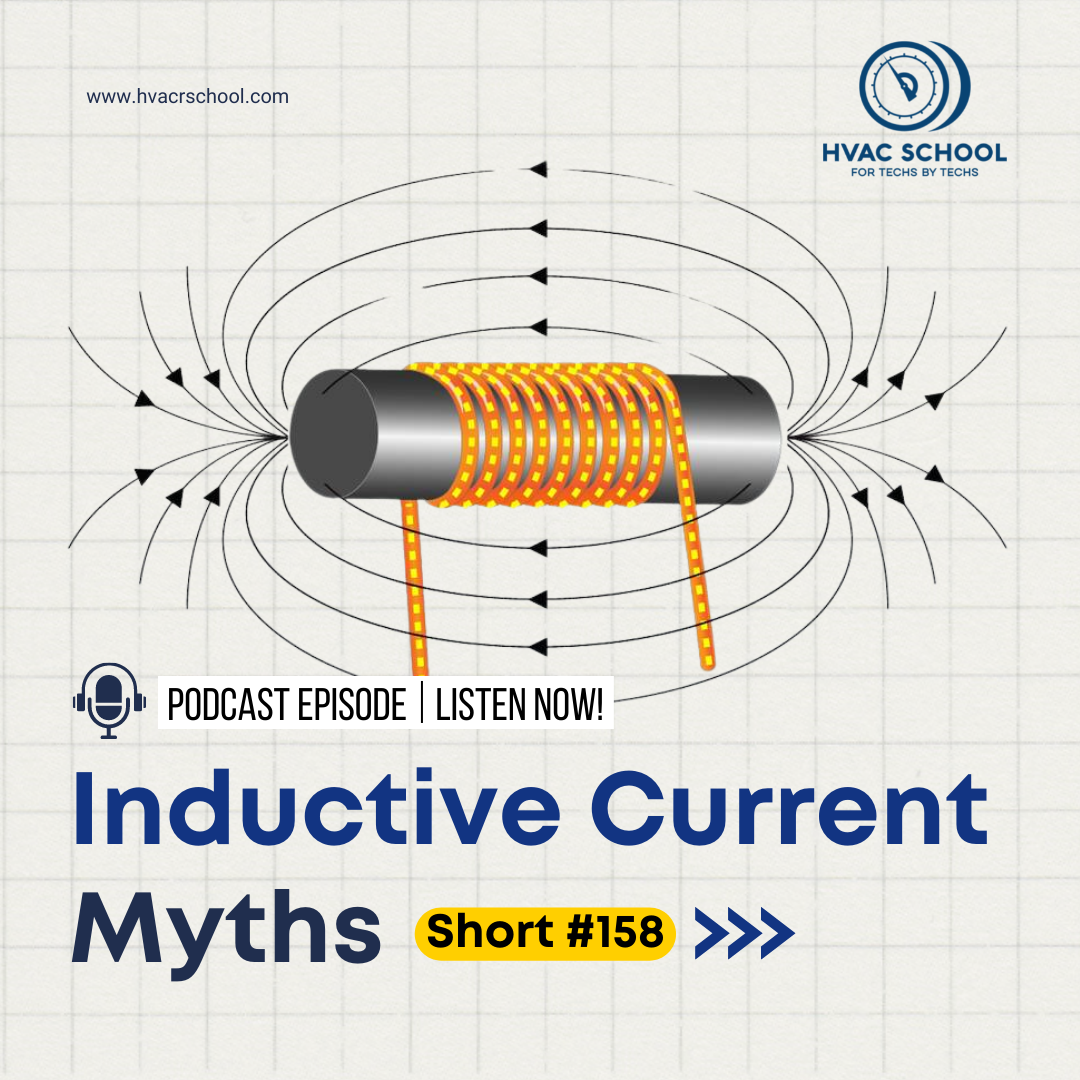
In this short podcast in our electrical myths series, Bryan talks about some inductive current myths.
There is a common myth surrounding voltage drop in inductive loads. When you decrease the voltage in a circuit with a resistive load, you’ll see a relatively proportional drop in resistance (ohms) and current in accordance with Ohm’s law. So, we’ll see a decrease in current, but we have to keep in mind that load temperatures also affect the resistance (and the current, by extension).
Some people will claim that reducing the voltage in an inductive load (like a motor or compressor) will increase the current. That is actually generally a myth; many people believe this myth because the current drop is NOT proportional, unlike in resistive loads. The resistance that shows up in a motor is called inductive reactance, which is an opposing magnetic field that creates back electromotive force (back EMF) and impedes the circuit. Back EMF and inductive reactance contribute to the impedance or total resistance of the circuit. Decreasing the voltage may cause the resistance to increase, as some of the work will start contributing to heat instead of mechanical motion; the motor derates, becomes less efficient, and draws more current than it needs, but it doesn’t actually draw more total current.
However, some variable-speed motors on VFDs may draw more current because the motor module speeds up the motor to make up for the voltage deficiency, static pressure, etc. ECMs also fall into this category and may draw more current if the motor module or VFD calls for it. However, in terms of simple electrical math without VFD logic, the current won’t typically increase if the voltage drops, even in inductive loads.
If you have an iPhone, subscribe to the podcast HERE, and if you have an Android phone, subscribe HERE.
Check out our handy calculators HERE.
Highlight a short passage, or bring a question about a specific moment into HVAC No Bull Forum.
Discuss this reference → Related forum discussions









Comments
To leave a comment, you need to log in.
Log In