
Screw Compressor Talk w/ Vilter
Make & share a podcast clip
Keep the exact passage and a link to the full episode. Choose up to three minutes, with enough context to be fair to the speaker.
Preview uses this episode’s audio. Browser audio export, when supported, takes the length of the selected clip. Nothing plays until you choose Preview.
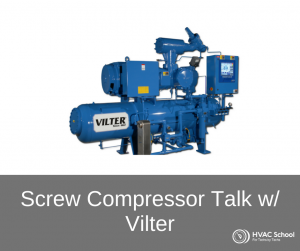
In this podcast episode, Bryan, Trevor Matthews, and Jim Dick of Emerson talk about the screw compressor and how it works. This time, they focus on the Vilter single-screw compressors.
Vilter is an industrial compressor division of Emerson (compare to Copeland). Vilter also makes reciprocating compressors, but the screw compressor is its claim to fame; you may want to consider using a screw compressor when you want greater capacity and control than a reciprocating compressor. Screw compressors also work well for applications with constant loads; they do, however, have microprocessors that can monitor system performance to maximize efficiency.
Vilter uses a compressor with a single screw, whereas most compressors have twin screws. Twin screws have a motor that continuously turns the rotor, which causes the screws to mesh together; the compression happens as gas fits between the screws, and the gas volume decreases as the space between the screws closes. In a single-screw compressor, the gas compresses on the outside of the screw. In any case, we must seal the gas in the flutes, and oil helps us with that. Liquid should not get into either type of screw compressor, as liquid is not compressible and will damage the compressor.
When you service a screw, the oil temperature and discharge pressure will likely be the most important values to watch out for. During maintenance inspections, you’ll also want to pay special attention to the bearings, the four pressure transducers, and oil filtration system.
Jim, Trevor, and Bryan also discuss:
- Microprocessors
- Star rotors
- Oil uses, management, and components
- Motor RPM
- Multiple compressors and added capacity
- Calibrating pressure transducers
- Zeroing vs. calibrating
- Suction screens
- Jim’s interesting findings
- Injecting oil
- Value engineering and consistency
If you have an iPhone, subscribe to the podcast HERE, and if you have an Android phone, subscribe HERE.
Check out our handy calculators HERE.
Highlight a short passage, or bring a question about a specific moment into HVAC No Bull Forum.
Discuss this reference → Related forum discussionsAuthor:












Comments
To leave a comment, you need to log in.
Log In