
Short 13 – 3 things the condenser does (Podcast)
Make & share a podcast clip
Keep the exact passage and a link to the full episode. Choose up to three minutes, with enough context to be fair to the speaker.
Preview uses this episode’s audio. Browser audio export, when supported, takes the length of the selected clip. Nothing plays until you choose Preview.
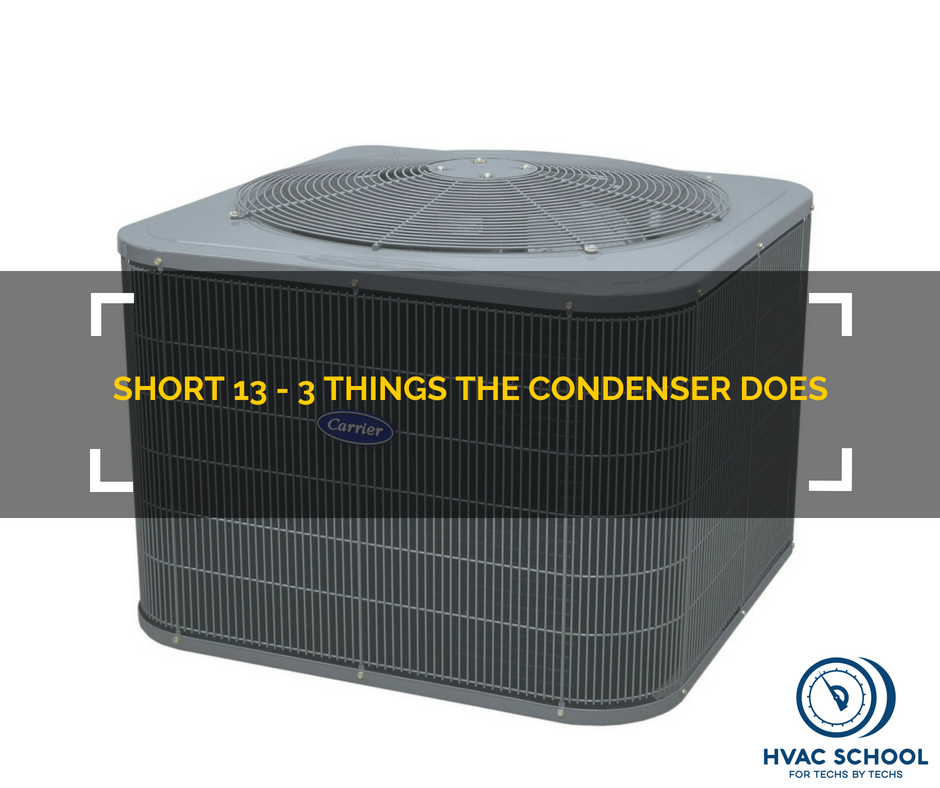
In this short podcast, Bryan covers three things that the condenser does. He also explains where those things happen and what those they mean in terms of system operation.
The evaporator coil does two things: boiling and superheating. However, a condenser does three things: desuperheating, condensing (changing state), and subcooling.
Desuperheating occurs early on in the condenser, at the top. Refrigerant enters the condenser as a highly superheated vapor. Even though we have a few degrees of superheat in the suction line, the discharge line’s superheat is a lot greater. (For context, the suction line will feel cold to the touch, but the discharge line will burn you.) The compressor skyrockets the superheat through the heat of compression and sends that refrigerant to the condenser via the discharge line. So, desuperheating reduces the temperature from 160+ degrees to the saturation temperature, about 100 degrees.
In the middle of the condenser coil, the refrigerant stays at saturation. However, it continues rejecting heat. That is because the refrigerant is undergoing a phase change from vapor to liquid; it rejects heat in the form of latent heat even though the temperature stays the same. Once all of that latent heat has been rejected to the air, the refrigerant becomes fully liquid. Then and only then can the refrigerant start to drop its temperature.
The temperature of the liquid refrigerant drops at the bottom of the condenser coil. We call that process subcooling. Subcooling refers to the temperature of a liquid below the saturation point. For example, if the saturation point is at 100 degrees but the liquid refrigerant is 95 degrees, you will have 5 degrees of subcooling. In general, a common subcooling range is 8-14 degrees.
Learn more about Refrigeration Technologies at refrigtech.com.
If you have an iPhone, subscribe to the podcast HERE, and if you have an Android phone, subscribe HERE.
Highlight a short passage, or bring a question about a specific moment into HVAC No Bull Forum.
Discuss this reference → Related forum discussionsAuthor:











Comments
To leave a comment, you need to log in.
Log In