
Where to Place the Micron Gauge – Short #168
Make & share a podcast clip
Keep the exact passage and a link to the full episode. Choose up to three minutes, with enough context to be fair to the speaker.
Preview uses this episode’s audio. Browser audio export, when supported, takes the length of the selected clip. Nothing plays until you choose Preview.
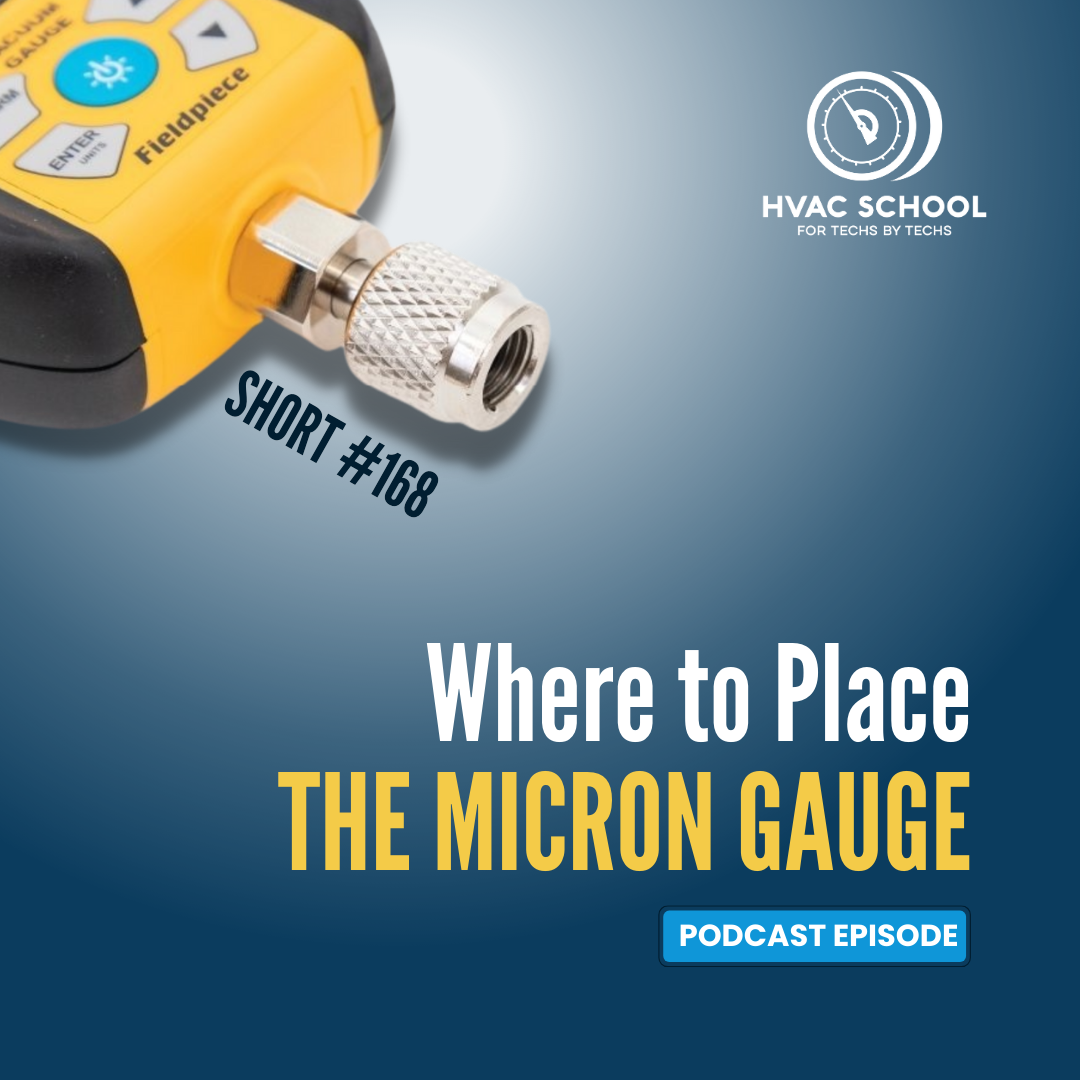
In this short podcast, Bryan talks about where to place the micron gauge during evacuation and how to think about micron gauge positioning.
Evacuation (deep vacuum) doesn’t remove solid contaminants, and vaporizing liquid water is a time-consuming process; its main purpose is to remove water vapor, air, and nitrogen gases from the HVAC/R system. When you pull down below 500 microns and hold that pressure, we can make sure we have a clean, dry, and tight (leak-free) system. As we started using R-410A and POE oil, water in the system became a much bigger issue than it was with mineral oil (it was never to have water in the system, but it breaks down POE oil).
Before we start pulling a vacuum on the system, we need to attach our micron gauge to the pump while it’s isolated to make sure the pump is working. A modern vacuum pump should pull down below 100 microns in 30-60 seconds; if your pump can’t pull down to 100 microns in under a minute when isolated, then you’ll want to change the oil (possibly multiple times). Be sure to change the oil regularly and store it properly.
When you pull a vacuum on a system, you’ll want to attach your micron gauge as far away from the pump as possible to get an accurate indicator of your vacuum. Use core remover tools to isolate the system and make sure the far side of the system is brought below 500 microns during evacuation. The time it takes to pull down a system and the time you’ll hold the vacuum will depend on your application (residential vs. commercial).
Check out Review of Vacuum for Service Engineers (revised by Jim Bergmann and Bryan Orr, 2020) at https://www.trutechtools.com/accutools-review-of-vacuum-for-service-engineers.html.
Learn more about the HVACR Training Symposium or buy a virtual ticket today at https://www.hvacrschool.com/symposium.
If you have an iPhone, subscribe to the podcast HERE, and if you have an Android phone, subscribe HERE.
Check out our handy calculators HERE.
Highlight a short passage, or bring a question about a specific moment into HVAC No Bull Forum.
Discuss this reference → Related forum discussions









Comments
I typically have my guys go a bit deeper into micron level at around 350-400 microns. This takes time however but myu absolute requirement is below the 500 micron mark before they can proceed. A lot of times when we can't get below the 500 microns level, we find typically is because a schrader is leakig and needs tightened. I also tell my guys to check their hoses have good sealing gaskets and are in good shape.
Report comment
I typically have my guys go a bit deeper into micron level at around 350-400 microns. This takes time however but myu absolute requirement is below the 500 micron mark before they can proceed. A lot of times when we can't get below the 500 microns level, we find typically is because a schrader is leakig and needs tightened. I also tell my guys to check their hoses have good sealing gaskets and are in good shape.
Report comment
To leave a comment, you need to log in.
Log In