
Get Tech Tips
Subscribe to get free tech tips.
The Giants We Invent

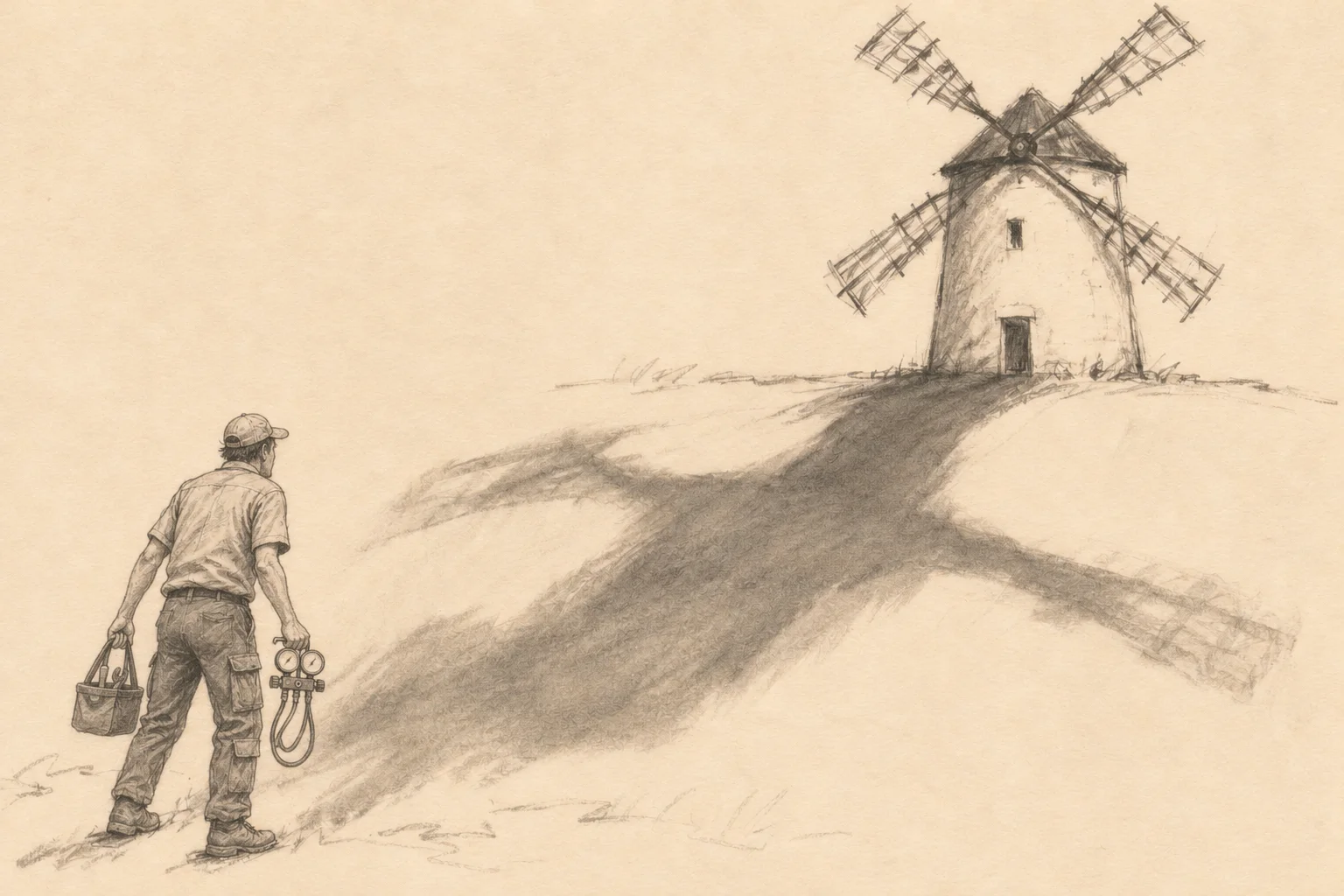
“When we stop solving real problems together, we invent giants that drive us apart.”
I like solving problems. Between my family, Kalos, and HVAC School, I have plenty to choose from. Things break. People need help. Plans need work.
That should be enough. My brain sometimes decides I need a bonus problem.
Someone hasn’t answered a message, so maybe they’re ignoring me or worse… THEY DON’T rEspEcT MEEEE!
An installer makes a “dumb” mistake, so they must not CARE.
Something might go wrong next week, so I can go ahead and get upset about it today. Very efficient.
By then, I’m ready to explain the whole problem to someone. Learning what actually happened would apparently just slow me down.
Which brings us to Don Quixote. Yes, we’re talking about a Spanish knight in an HVAC tech tip. Give me a minute. We’ll get back to the tools.
Quixote is a character in Miguel de Cervantes’ 1600s novel El ingenioso hidalgo don Quijote de la Mancha (The Ingenious Hidalgo Don Quixote of La Mancha, or just Don Quixote for short).
He reads so many stories about knights that he decides to become one. He wants to fix wrongs, protect people, and do something that matters.
Then he sees some windmills and decides they are giants. His companion, Sancho Panza, tells him they’re windmills. Quixote charges anyway and gets knocked down. Afterward, he claims someone used magic to turn the giants into windmills.
He changes the story so he doesn’t have to admit he was wrong.
I can see myself in that. The unanswered question is the windmill. The evil plot against me is the part I added. Now I’m ready to send a strongly worded email to somebody… anybody… everybody.
Meanwhile, they may be the person who could help me most.
That’s part of why an imagined giant can be so hard to beat. I have to see how I helped create it. I also have to let someone question it. Both can be tough when I’ve already decided I’m the hero (or worse, the victim).
Why I keep finding monsters
Pattern recognition is part of how I get through the day. I see something familiar and reach for an answer I already know. That’s useful. The trouble starts when “this reminds me of something” becomes “I already know what this is,” and I skip the check.
My heart gets involved, too. I want to be useful. I want to be respected. I like being the guy who sees the problem before everyone else does. Admitting I might be wrong can feel like giving some of that up. So I start protecting my answer when I should still be checking it.
A quick answer also gives me somewhere to put my worry. If I can name a bad guy, I know who to be upset with. That can feel better than sitting with “I don’t know yet.” The story can make me feel smart, safe, or wronged long before I know whether it’s true.
When everybody sees the same giant
I think we do this as a society, too. We have plenty of real problems. We can still spend hours worked up about a story while doing very little to help the people involved.
Being angry can feel like doing something. Having an enemy can give us a purpose. And other people can (and do) learn to use that.
Cervantes puts that in the book, too. A duke and duchess learn about Quixote’s beliefs and put on fake adventures for their own fun. In one, a wooden horse, blindfolds, bellows, heat, and fireworks make him think he has taken a heroic journey. They know it’s a show. He thinks it’s real.
That bothers me. Someone can take a fear I already have, stoke it, grow it, and tell me it’s the reason for my troubles. Then they can tell me who to blame, what to buy, where to send money, or who deserves my trust.
Someone else can benefit from keeping me scared. I’ve turned a windmill into a monster, and they’re selling monster protection.
Sometimes people plan this. Other times, the story grows because lots of people keep feeding it. One person posts something scary. Others share it. The person who posted it gets attention and makes more of the same. A feed shows it to more people. All that attention starts to look like proof.
A 2024 study found that outrage helped false information spread. On Facebook, links from misinformation sources that drew more angry reactions were also shared more often without being opened first. Another study published in 2025 found that Twitter’s ranking system promoted more angry content aimed at political opponents than a feed that simply showed the newest posts first.
So I can read something, get mad, and help spread it before I’ve checked it. Then I can feel good about being a person who checks things (once my mind and emotions are already made up). That last part is where I need some work.
A group can make the story even harder to question. We see the same giant, so we feel like we belong. If someone doubts the giant, it can feel like they’re turning against us. We make each other more afraid and then use that fear as proof that we’re right.
The fear can be real. The harm can be real. The story causing it can still be wrong.
I have to think about that when I teach or post something. I can help people understand a problem, or I can help keep them worked up about one.
Working together helps when we give each other room to question the story and check something real. A measurement. A record. A conversation with the person involved. A result we can both see. Agreeing that the windmill is a monster doesn’t count as an inspection.
Back to moving refrigerant around
See? We got here.
There’s an old saying that when all you have is a hammer, everything looks like a nail.
When what you’re holding is a suction gauge, everything looks like low refrigerant.
A suction gauge measures pressure. It doesn’t measure how much refrigerant is in the system. “Low suction pressure” is an observation. “Low refrigerant charge” is a diagnosis. There’s some work to do between those two statements.
Low refrigerant charge can cause low suction pressure. So can too little air across the evaporator coil or a restriction that limits refrigerant flow. Those problems need different fixes. One reading doesn’t tell us which fix to make.
Low airflow means less heat is available to boil refrigerant in the evaporator. With the compressor still running at the same capacity, that lower heat load can bring the evaporator’s pressure and boiling temperature down. An undercharged system can also have low suction pressure because the evaporator is low on refrigerant.

Suppose I think it’s undercharged and the other tech suspects low airflow. We can agree on a useful check before deciding who gets to be right. What would we expect to find if each explanation were true? Check the operating conditions, the tool setup, and the airflow.
If we find and correct an airflow problem, we must let the system settle and take the readings again. Then, we check the charge with the related measurements and the manufacturer’s procedure. We end up making the correction the evidence supports and verifying both system operation and the customer’s original complaint.
The job can teach us something if we check the result. If I add refrigerant and leave without verifying the full outcome, I can remember the call as proof that I was right. Being very sure does not count as a second reading. I would save a lot of money on tools if it did.
This is why I like a wide, narrow, wide approach. Start with the customer’s complaint, the call history, and a look over the equipment. Narrow down the fault and look for its cause. Then widen the inspection again so you don’t miss another problem before you wrap up.
If an apprentice asks why we reached a certain answer, we should be able to show them. What did we measure? How does it fit? What should change after the repair? My years in the trade are useful, but they don’t make my first guess a test result. Sometimes the person saying, “That’s a windmill,” is the apprentice.
Do the same thing on a callback. Read the first tech’s notes. Compare the old complaint with the new one. Check what was repaired, what the customer was told, and how the result was checked. Then work with the tech to fix what remains.
If I missed something, I need to own it. If there is more to the story, I need to find it. Blaming the customer, the dispatcher, or the next tech too soon makes it harder to learn anything.
The office has windmills, too
I can make the same mistake while looking at a labor report.
“We used more hours than we estimated” is a fact. “The crew doesn’t care” is a story about why. I need to check the gap between those two.
Was the estimate right? Did the work change? Could the crew get into the work area? Did they have the materials, the plan, and the right people? Talk with the people who were there and look at what happened.
If someone did poor work, address that work. If someone skipped a clear step, address that choice. If the plan left something out, fix the plan. We can hold people responsible for what they actually did.
I have yet to give a speech that makes missing materials appear on a job. Perhaps I just need a longer speech. Please don’t encourage me.
The fix needs to match the cause. Otherwise, we can have a meeting, send an email, create a form, and still leave the crew with the same problem tomorrow. The windmill now has paperwork. The crew still needs the fitting.
This works both ways. A tech can decide the office is out to make life hard. An owner can decide the field is full of excuses. Both can find people who agree with them. Now we have two sides, a lot of talking, and a customer who is still waiting.
Bring it back to the job. What happened? What needs to change? Who will see that change through?
I need to do the same thing at HVAC School. When I teach a complex concept, I should explain what causes it, what to check, and what to do. If all I’ve done is make someone more afraid of their next service call, I still have some teaching to do.
Practice solving something together
Self-awareness is a start. I can know I jump to conclusions and still do it before lunch. I need to practice doing something different.
Pick a real problem and work on it with someone else. A service call, a job that keeps falling behind, or a task at home. Say what you know (not what you think) and what you’re guessing. Let the other person offer another explanation. Agree on one useful next step, do it, and look together at what actually changed.
Give yourselves a result to check. Did we fix the complaint? Did the crew get the missing materials? Did the task get finished? We need to stick around long enough to find out.
When someone catches what I missed, “Good catch. Let’s check it” will do. If I punish people for questioning me, I shouldn’t be surprised when they let me fight the windmill alone.
Then do it again. Each time we check the result, we give ourselves better experience to draw on next time. We get practice being patient, changing our minds, and seeing a problem get solved without having to be the hero.
I want the satisfaction of seeing it work to matter more than being the guy who guessed it first. I also want to remember that someone can disagree with me and still be helping me. That’s a habit worth taking into my family, my business, and the stories I’m asked to believe online.
I’ll start by sending fewer strongly worded emails to windmills.
– Bryan
Highlight a short passage, or bring a question about a specific moment into HVAC No Bull Forum.
Discuss this reference → Related forum discussions Related Tech Tips











Comments
To leave a comment, you need to log in.
Log In