
Ductless and VRF – Good, Bad, & Ugly #LIVE
Make & share a podcast clip
Keep the exact passage and a link to the full episode. Choose up to three minutes, with enough context to be fair to the speaker.
Preview uses this episode’s audio. Browser audio export, when supported, takes the length of the selected clip. Nothing plays until you choose Preview.
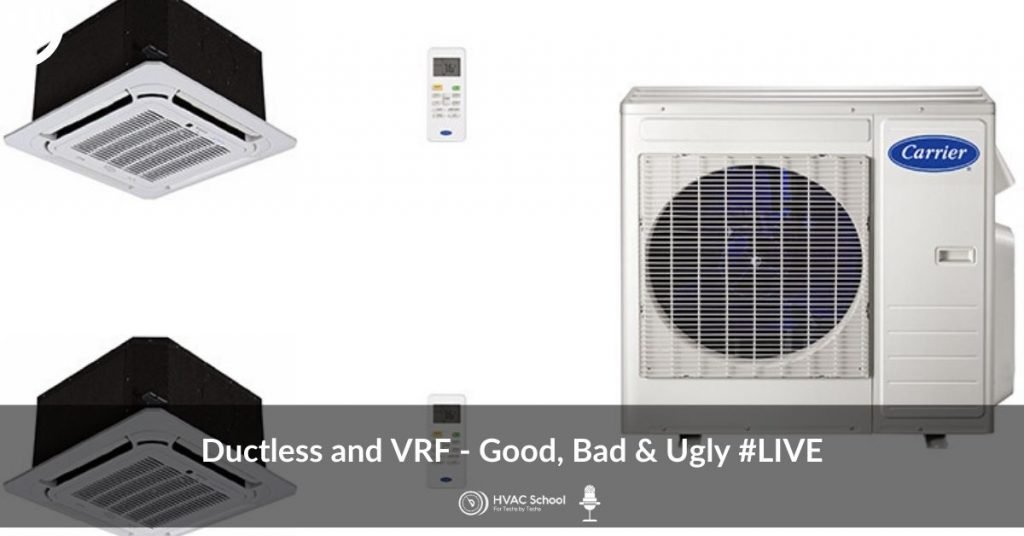
Some great live guests join the podcast to discuss the advantages, disadvantages, and challenges of ductless and VRF equipment.
We started off working on ductless equipment with Mitsubishi, especially installing them in lanais. Sunrooms have large amounts of radiant heat coming in, and the heat load often warrants getting an A/C system just for the sunroom/lanai. We even began oversizing them a bit (which was a lesson learned). We also learned that mini-split ductless systems tend to have filthy blower wheels because moisture tends to build up on them. However, bib kits make cleaning the blower wheel in place an easy process.
High-wall ductless systems also work in houses, not just sunrooms. However, they may have issues dehumidifying effectively. To remove more latent heat, you have to ramp down your blower and ramp up your compressor to get your coil colder. Overall, Bryan is not a large fan of using multi-zone ductless units in residential applications UNLESS they are replacing window units.
VRF systems are typically used in commercial applications. The systems typically use cassette-type units or low-static fan coils, unlike high-wall ductless units. Although VRF and high-wall ductless units tend to have different sets of advantages and disadvantages, both of them struggle a bit with humidity and may need supplemental dehumidification.
Overall, while VRF and ductless systems are desirable because they can control sensible capacity, those modulation capabilities can also lead to serious problems in wet climates.
We also discuss:
- Condensate pumps
- Blower wheel set screw issues
- Ductless and VRF filtration
- Sensible heat ratio (SHR)
- VRF serviceability
- Dehumidification vs. efficiency
- Regional VRF manufacturing practices
- EER vs. SEER
- Daikin dry mode
- What should HVAC systems really control?
- Engineering commercial buildings
- VRF refrigerant loss
- ICM493 controls
Learn more about Refrigeration Technologies HERE.
If you have an iPhone, subscribe to the podcast HERE, and if you have an Android phone, subscribe HERE.
Highlight a short passage, or bring a question about a specific moment into HVAC No Bull Forum.
Discuss this reference → Related forum discussionsAuthor:











Comments
To leave a comment, you need to log in.
Log In