
Light Commercial PM Process
Make & share a podcast clip
Keep the exact passage and a link to the full episode. Choose up to three minutes, with enough context to be fair to the speaker.
Preview uses this episode’s audio. Browser audio export, when supported, takes the length of the selected clip. Nothing plays until you choose Preview.
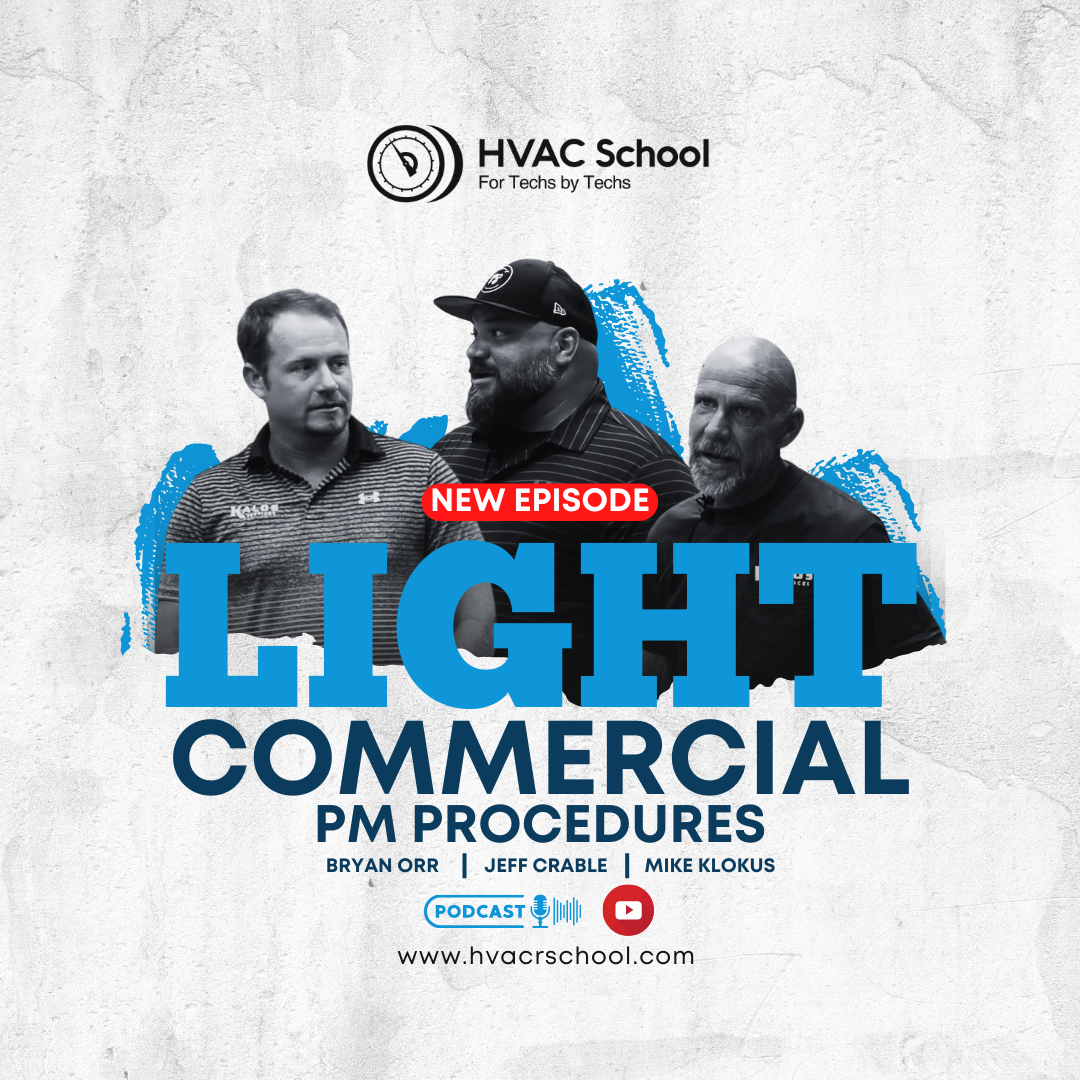
Mike Klokus and Jeff Crable walk us through Kalos Services’ light commercial PM process.
First, we verify that everyone is clear on the agreement. Then, we start the PM with a thorough visual inspection, taking copious notes about things that look concerning.
Once we’ve done a visual inspection, we clean the condensers. We try to use only water when possible, though safe cleaners may be necessary in some cases.
When checking the electrical components, we make sure the wires are neat and have tight connections. We take our electrical readings and check the capacitor.
Then, we check the system’s refrigerant temperatures and pressures. We measure the superheat, subcooling, and pressures throughout the system and record those.
Once we move indoors, we check and replace the filter in accordance with the agreement. We do another visual inspection at the air handler, paying special attention to blower wheel cleanliness, panel insulation, and wire routing and connections.
When cleaning the evaporator, we want to try to stick with water or self-rinse cleaners. We want to make sure that we use very mild chemicals, and any foaming cleaners should be diluted appropriately and rinsed entirely.
Drain cleaning is one of the most critical parts of a PM. We check for double traps and to make sure that the drain lines are properly pitched, trapped, and vented; vents should be uncapped, but cleanouts must be capped.
We finish with a final inspection, making sure all disconnects are back in, cleaning up all trash and tools, and sharing any notes with the customer.
Mike and Jeff also cover:
- Cleaning microchannel and multi-row coils
- Critical electrical readings
- How to replace panels carefully
- Filter replacement
- Modifying ductwork and return boxes for accessibility
- Cleaning drain pans thoroughly
- Pulling and cleaning blower wheels
- Common drains and condensate pumps
- Traps, cleanouts, and vents
- Testing heat strips
- Finishing up calls
If you have an iPhone, subscribe to the podcast HERE, and if you have an Android phone, subscribe HERE.
Check out our handy calculators HERE.
Highlight a short passage, or bring a question about a specific moment into HVAC No Bull Forum.
Discuss this reference → Related forum discussions









Comments
To leave a comment, you need to log in.
Log In