
Low Ambient, Condenser Flooding, and Headmaster Valves
Make & share a podcast clip
Keep the exact passage and a link to the full episode. Choose up to three minutes, with enough context to be fair to the speaker.
Preview uses this episode’s audio. Browser audio export, when supported, takes the length of the selected clip. Nothing plays until you choose Preview.
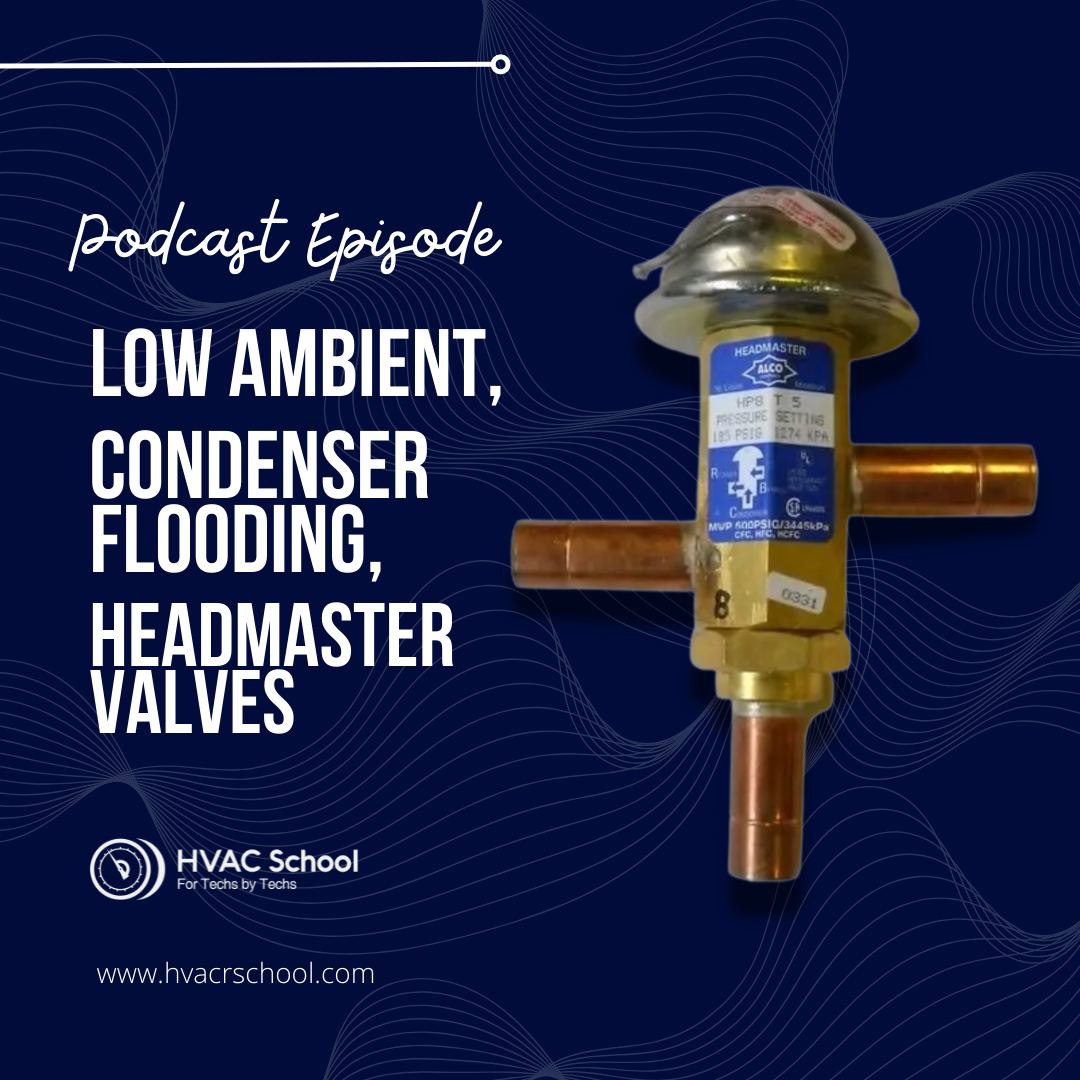
In this podcast episode, Jeremy Smith comes on the podcast to talk about low-ambient controls, headmaster valves, charging, and condenser flooding.
If our head pressure drops too much, we won’t get enough of a pressure drop across the TXV. Pressures dictate the TXV function, so we need to make sure our systems give that valve what it needs to operate correctly. Three pressures operate a TXV: bulb pressure, spring pressure, and evaporator pressure. However, pressures throughout the system can also affect the pressures that act on a TXV.
Condensers are sized for maximum heat rejection at the highest ambient temperatures a unit will experience. Low-ambient controls help get your liquid pressure up by effectively reducing the condenser’s capacity. One common thing we can do is use a fan cycle; a pressure control can turn the fan on and off, but you can see large pressure swings.
We can also use headmasters, which maintain head pressure by backing up liquid in the condenser; it fills the condenser with liquid and shifts some discharge gas to the receiver to maintain the receiver pressure. Headmasters are NOT adjustable in the field. When diagnosing headmasters, try to look for leaks first; Jeremy thinks many headmaster failures could have been misdiagnosed.
Split condensers can shut off parts of themselves to reduce capacity, which can serve as another low-ambient control without bypassing discharge gas or wasting energy.
You may also come across some adjustable controls that allow you to adjust your head pressure by setting receiver pressure and other similar values.
Jeremy and Bryan also discuss:
- Balanced-port TXVs
- Fan cycling in air conditioning
- Using a clear sight glass to charge refrigeration units
- Headmaster part numbers
- Carrier Motormasters
- Parallel rack systems and remote condensers
- Inefficiency and bypassing discharge gas
Read the companion tech tip HERE.
If you have an iPhone, subscribe to the podcast HERE, and if you have an Android phone, subscribe HERE.
Highlight a short passage, or bring a question about a specific moment into HVAC No Bull Forum.
Discuss this reference → Related forum discussions










Comments
When the pressure drop across the expansion valve decreases, superheat is going to tend to increase, not decrease. lower pressure drop = lower mass flow = starved evaporator = higher superheat.
Report comment
When the pressure drop across the expansion valve decreases, superheat is going to tend to increase, not decrease. lower pressure drop = lower mass flow = starved evaporator = higher superheat.
Report comment
To leave a comment, you need to log in.
Log In