
Myth: Path of Least Resistance – Short 154
Make & share a podcast clip
Keep the exact passage and a link to the full episode. Choose up to three minutes, with enough context to be fair to the speaker.
Preview uses this episode’s audio. Browser audio export, when supported, takes the length of the selected clip. Nothing plays until you choose Preview.
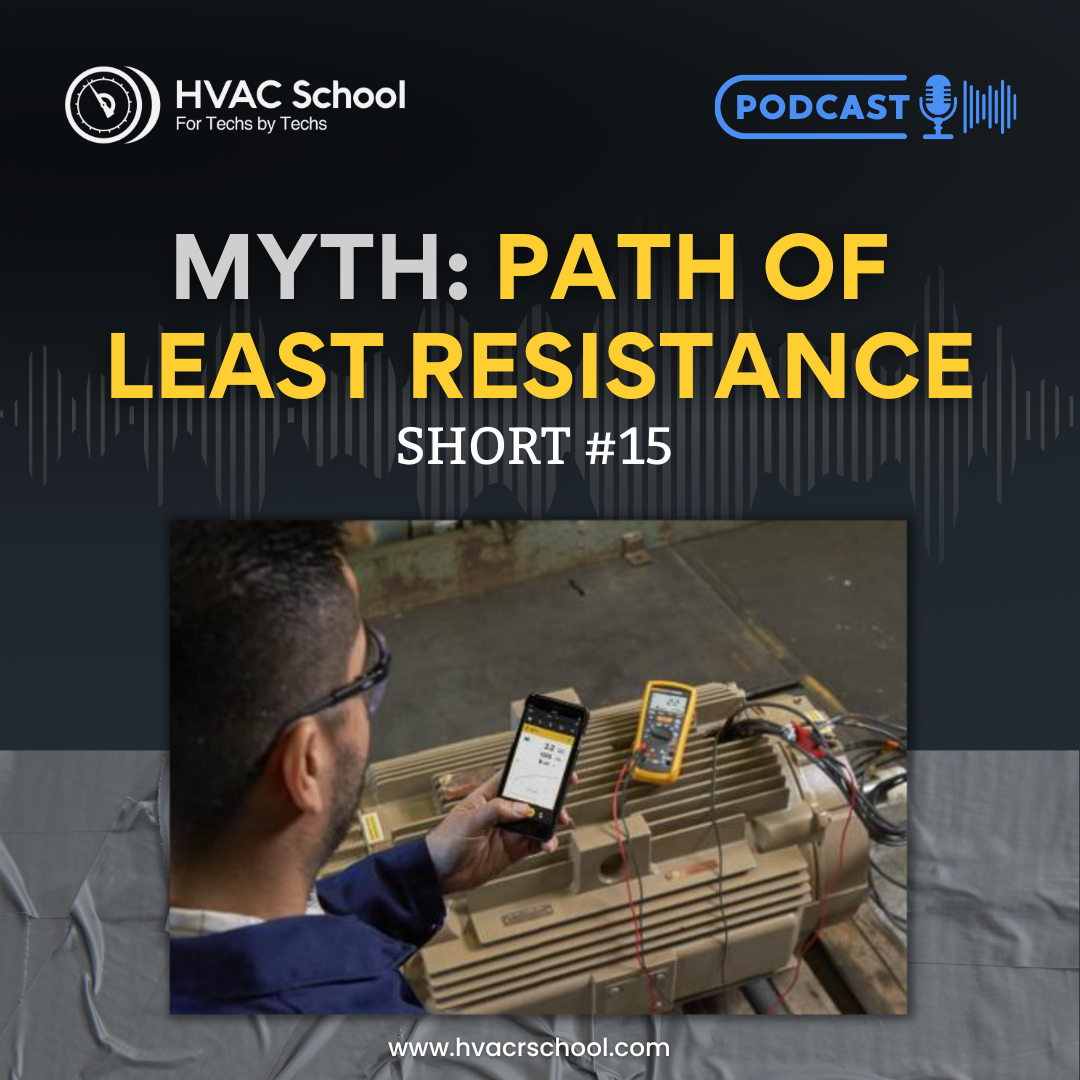
In this short podcast, Bryan debunks the myth that electricity only takes the path of least resistance.
It is true that more current will typically take paths of lower resistance; it’s much easier for more electrons to flow through a path with lower resistance, which is consistent with Ohm’s law. Ohm’s law states that a circuit will have higher current with you have lower resistance so long as the voltage stays the same.
In most cases, the voltage stays relatively constant; transformers don’t often need to limit their currents, so there usually isn’t a voltage drop. When power supplies are regulated, the voltage is usually fixed, not the amperage. As a result, dropping the resistance in a circuit will increase the current.
Ohm’s law holds true for both resistive and inductive loads. Inductive loads, however, are a bit tricky because the resistance isn’t constant. As motors spin faster, they create back EMF or impedance, which is magnetic resistance. The resistance only shows up once a motor, solenoid, or another electromagnetic component is energized; the resistance is much more dynamic.
An electrical current takes ALL parallel paths, not just the path of least resistance. The current also stays proportional to the resistance, even when it takes paths of many different resistance values. Our bodies are also parallel paths, so there’s a risk of electric shock even though our bodies usually have much higher resistance than loads. Wet skin has less resistance than dry skin, so that’s why electricity and water are so dangerous to us; lower resistance means that more current can flow through our bodies.
If electricity ONLY took the path of least resistance, we wouldn’t be able to operate all the appliances and electrical components in our homes. The only prerequisite is an electrical potential (voltage).
If you have an iPhone, subscribe to the podcast HERE, and if you have an Android phone, subscribe HERE.
Check out our handy calculators HERE.
Highlight a short passage, or bring a question about a specific moment into HVAC No Bull Forum.
Discuss this reference → Related forum discussions









Comments
To leave a comment, you need to log in.
Log In