
Pressure Measurement Pro Tips w/ Steve Rogers
Make & share a podcast clip
Keep the exact passage and a link to the full episode. Choose up to three minutes, with enough context to be fair to the speaker.
Preview uses this episode’s audio. Browser audio export, when supported, takes the length of the selected clip. Nothing plays until you choose Preview.
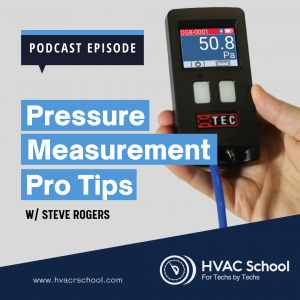
In this podcast, Steve Rogers from The Energy Conservatory explains some pro tips for pressure measurement.
There are three common types of pressure measurements: absolute, gauge, and differential. Absolute pressure is the pressure in a particular space in reference to a complete vacuum. (All absolute measurements use the zero point as a reference.) Gauge pressure uses atmospheric pressure as a reference point (which varies with altitude and location). Differential pressure relies on two connections (one of them is a reference point to the other).
The Energy Conservatory recently designed a manometer (DG-8) that differs from the standard manometers. The purpose of that manometer is to make pressure measurements in a more cost-effective way. Most manometers have similar sensors (diaphragms move with pressure, and the measurement read is the resulting difference in resistance). However, the DG-8’s methodology can help it yield much more accurate measurements.
When dealing with small pressure measurements (like Pascals), the DG-8 is one of the most accurate manometers you will find on the market.
When you look at room pressure, keep in mind that pressurizing one room will depressurize another. Temperature differences also impact the pressure, and the HVAC unit can cause differences in pressure to arise as a result of temperature differences. When you run the kitchen or bathroom exhaust and expel a lot of air in your home, you can also bring the home under negative pressure; that can even cause your water heater to backdraft.
Steve and Bryan also discuss:
- Blower door manometers vs. DG-8 manometers
- Pascal scale
- Room pressures and air paths
- Infiltration and its effect on load calculations
- Dominant duct leakage
- Combustion appliance zone (CAZ) testing
- Mechanical ventilation and pressure
- Orphaned water heaters
- DG-8 and the TrueFlow grid
Learn more about the DG-8 HERE.
If you have an iPhone, subscribe to the podcast HERE, and if you have an Android phone, subscribe HERE.
Check out our handy calculators HERE.
Check out information on the 2022 HVACR Training Symposium at https://www.hvacrschool.com/symposium/.
Highlight a short passage, or bring a question about a specific moment into HVAC No Bull Forum.
Discuss this reference → Related forum discussionsAuthor:












Comments
To leave a comment, you need to log in.
Log In