
Specifically About Heat – Short 131
Make & share a podcast clip
Keep the exact passage and a link to the full episode. Choose up to three minutes, with enough context to be fair to the speaker.
Preview uses this episode’s audio. Browser audio export, when supported, takes the length of the selected clip. Nothing plays until you choose Preview.
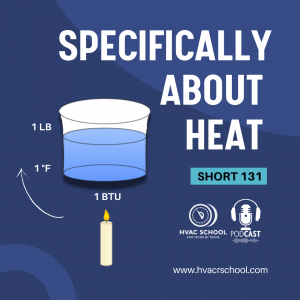
In this short podcast, Bryan goes over energy transfer and heat, specifically specific heat.
BTUs per ton is a common measurement; a BTU (British thermal unit) is the amount of heat it takes to raise the temperature of one pound of water by one degree Fahrenheit. 12,000 BTUs per hour is equal to one ton in heating or cooling technology. It takes one “ton” of heat to melt a ton of ice, but we kept the measurement and terminology as we moved away from using ice in industrial refrigeration.
When it comes to specific heat, we have to remember that one BTU has a different heating or cooling impact on different substances. Most fluids have a specific heat lower than water, meaning that one BTU of heat will result in more heat transfer in that substance than water. Air is one such fluid that has a lower specific heat than water (0.24 vs. 1); it’s easier to heat air than water. However, the specific heat of vapors can change with temperature and pressure.
When we change a refrigerant from a liquid to a vapor in the evaporator coil, it will reach saturation before boiling. As the refrigerant boils, the temperature will stay the same because the absorbed heat will all contribute to the phase change as latent heat. Even though most refrigerants have low specific heat, direct expansion systems can still move a lot of heat because it takes a lot of latent heat to complete a phase change.
In other systems that don’t use direct expansion (using glycol or water instead), specific heat is more integral to the effectiveness of heat transfer because latent heat isn’t a factor in heat capacity.
If you have an iPhone, subscribe to the podcast HERE, and if you have an Android phone, subscribe HERE.
Check out our handy calculators HERE.
Check out information on the 2022 HVACR Training Symposium at https://www.hvacrschool.com/symposium/.
Highlight a short passage, or bring a question about a specific moment into HVAC No Bull Forum.
Discuss this reference → Related forum discussionsAuthor:











Comments
To leave a comment, you need to log in.
Log In