
Q&A – RTU Tips – Short #196
Make & share a podcast clip
Keep the exact passage and a link to the full episode. Choose up to three minutes, with enough context to be fair to the speaker.
Preview uses this episode’s audio. Browser audio export, when supported, takes the length of the selected clip. Nothing plays until you choose Preview.
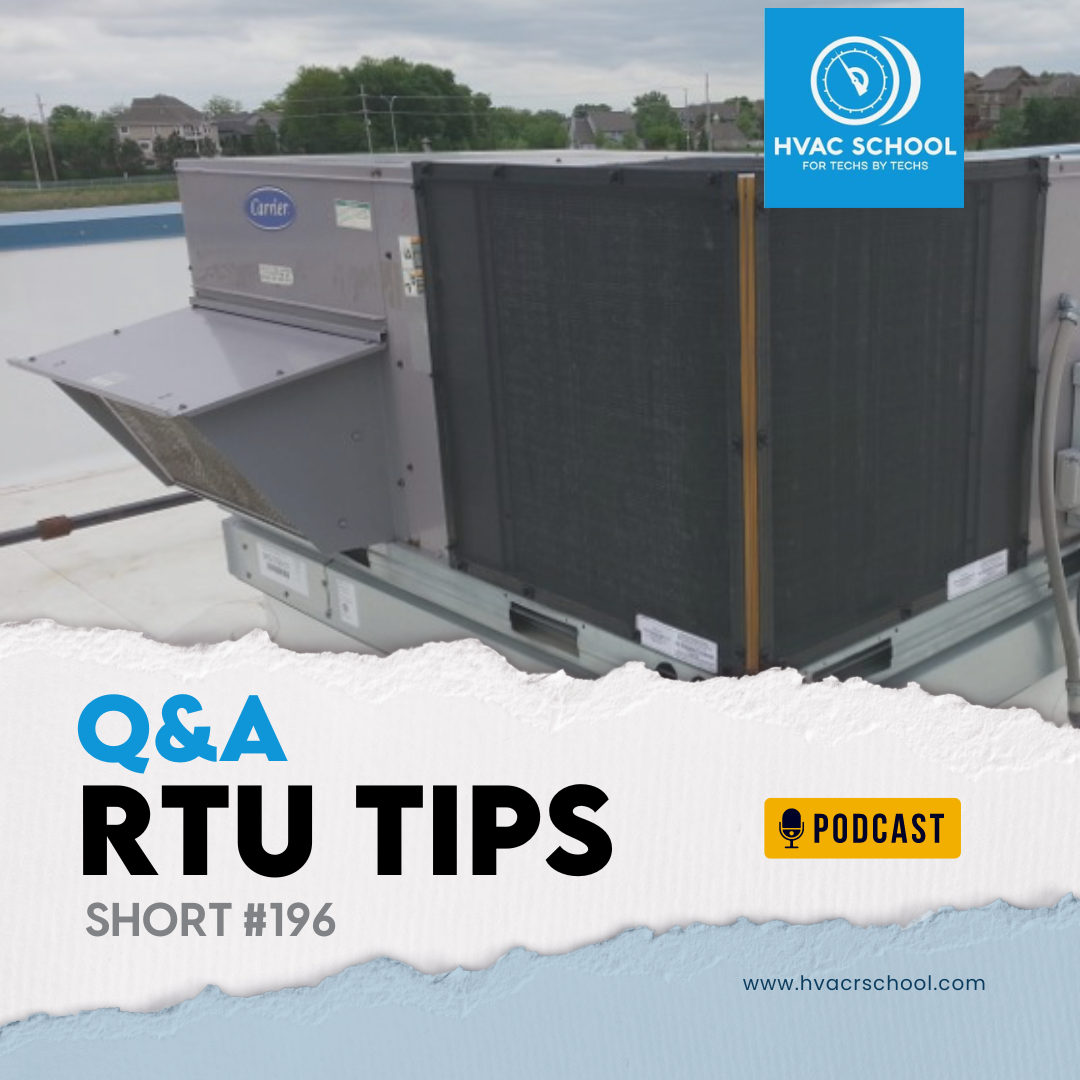
In this short Q&A podcast episode, Bryan answers Jeremy’s question about checking the charge on rooftop units, and he gives some RTU tips.
Rooftop units often come in sets, so you can use a thermal camera to look at all of the RTUs and compare them. A thermal imaging camera may even show you where subcooling begins in the condenser, which can be a useful diagnostic hack. Try to avoid hooking up gauges each time you check the charge on a rooftop; RTUs have a fixed factory charge, and losses from your gauges can add up over time. Your senses will also come in handy; check for odd sights, sounds, and smells.
Checking suction pressure and superheat is less risky and imperfect, but it’ll give you some diagnostic data. You can also check discharge temperatures to check for signs of compressor overheating (remember: 225 stay alive).
Here are some tips for RTUs:
Have a question that you want us to answer on the podcast? Submit your questions at https://www.speakpipe.com/hvacschool.
Purchase your virtual tickets for the 5th Annual HVACR Training Symposium at https://hvacrschool.com/Symposium24.
Subscribe to our podcast on your iPhone or Android.
Subscribe to our YouTube channel.
Check out our handy calculators here or on the HVAC School Mobile App for Apple and Android.
Highlight a short passage, or bring a question about a specific moment into HVAC No Bull Forum.
Discuss this reference → Related forum discussionsAuthor:











Comments
To leave a comment, you need to log in.
Log In