
Q&A System Oversizing – Short #291
Make & share a podcast clip
Keep the exact passage and a link to the full episode. Choose up to three minutes, with enough context to be fair to the speaker.
Preview uses this episode’s audio. Browser audio export, when supported, takes the length of the selected clip. Nothing plays until you choose Preview.
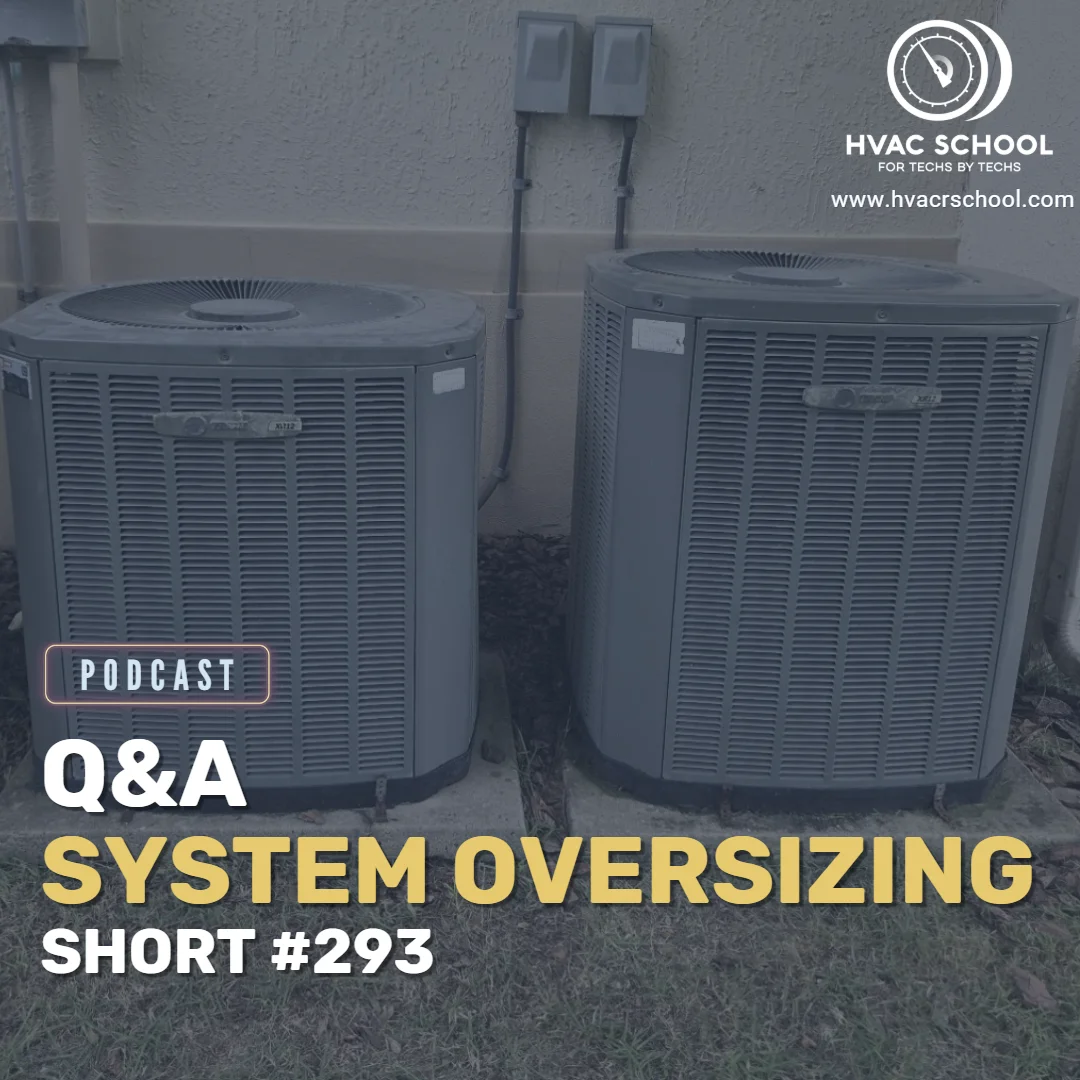
In this short Q&A podcast episode, Bryan answers a question from Evan, a licensed mold assessment consultant, about system oversizing: What can be done to control humidity and keep occupants comfortable when an HVAC system is oversized?
The extent of the problem will depend on how badly the equipment is oversized, whether it has any turn-down or staging, and how the latent capacity is set up. To make the equipment work as best as it can, reducing the airflow to about 350 CFM per ton can help, as well as properly setting up dehumidification modes. The downside to slower airflow is a likely increase in cabinet and duct sweating.
In brand-new houses, it may be possible to swap the condenser (though it may be unlikely with the recent refrigerant change) and then drop airflow at the air handler. You can use AHRI’s data to look for a possible match and then check the manufacturer’s expanded performance data to verify whether a new condenser is a match.
It’s also possible to decouple the latent and sensible loads by installing a dehumidifier. However, completely decoupling the loads is not always practical, as a properly-sized HVAC system is the main source of dehumidification (and the dehumidifier fills in the gaps). Dehumidifiers need to be installed properly (with the supply ducted into the supply duct).
Intentionally derating the equipment’s cooling capacity, such as via reheat, will turn it into a better dehumidifier, but you’re still adding sensible BTUs and need to be aware of the consequences of that, including higher power bills. You can use electric reheat, remove insulation, or remove shades from windows. Using a smaller compressor until the system can be replaced and downsized would achieve a similar effect but comes with other negative consequences.
Right-sizing equipment, load-matching, and managing air movement and heat transfer are ultimately the keys to preventing moisture problems.
Have a question that you want us to answer on the podcast? Submit your questions at https://www.speakpipe.com/hvacschool.
Purchase your tickets or learn more about the 8th Annual HVACR Training Symposium at https://www.hvacrschool.com/symposium.
Subscribe to our podcast on your iPhone or Android.
Subscribe to our YouTube channel.
Check out our handy calculators here or on the HVAC School Mobile App for Apple and Android.
Highlight a short passage, or bring a question about a specific moment into HVAC No Bull Forum.
Discuss this reference → Related forum discussionsAuthor:










Comments
To leave a comment, you need to log in.
Log In