
Get Tech Tips
Subscribe to get free tech tips.
Coil SHR, Ventilation, and Bypass Factor – Advanced Psychrometrics Part 2

 This is the second article in a three-part series where we explore advanced psychrometrics. The source material for each of the articles in this series is ACCA Manual P Sections 3, 4, and 5. This article is based on information found in Section 4.
If you followed the previous advanced psychrometrics article, you now know how to use a psych chart to plot a room sensible heat ratio (RSHR) line and how to calculate design room CFM. (If you haven't read that article, you can access it HERE.) However, if you followed that exercise, you probably noted the absence of real-world variables, such as ventilation and bypass factors. Equipment sensible heat ratios are almost never an exact match to the RSHR. This exercise will account for these variables and walk you through plotting these properties on a psychrometric chart.
It is worth reminding you that this is an exercise to help illustrate the complexities of psychrometry in the real world. This may not always be a practical method utilized in the design process.
When outdoor ventilation air is mixed with return air before the equipment coil, the equipment is exposed to latent and sensible loads beyond just the conditioned space. This characteristic causes the coil sensible heat ratio (CSHR) to alter from the RSHR. Remember, the room design conditions will be met only when the supply air properties fall on the RSHR line. With two different SHRs, we no longer have the luxury of choosing any supply condition we wish. The supply air must be able to cool and dehumidify the space. It also must now compensate for the additional load introduced by the ventilation air. Therefore, the only supply condition that will satisfy the room design condition is the point at which both the RSHR line and CSHR line meet on the psych chart.
Plotting the RSHR line should be a breeze at this point. For a review on that process, and the first part of this article series, CLICK HERE.
The construction of the CSHR line, however, is a bit more involved. There is a little trial and error in the construction of the CSHR line. It’s not impossible, of course. With practice, you get pretty good at nailing it on the first try. Here’s why a trial and error process is required to plot the CSHR line:
This is the second article in a three-part series where we explore advanced psychrometrics. The source material for each of the articles in this series is ACCA Manual P Sections 3, 4, and 5. This article is based on information found in Section 4.
If you followed the previous advanced psychrometrics article, you now know how to use a psych chart to plot a room sensible heat ratio (RSHR) line and how to calculate design room CFM. (If you haven't read that article, you can access it HERE.) However, if you followed that exercise, you probably noted the absence of real-world variables, such as ventilation and bypass factors. Equipment sensible heat ratios are almost never an exact match to the RSHR. This exercise will account for these variables and walk you through plotting these properties on a psychrometric chart.
It is worth reminding you that this is an exercise to help illustrate the complexities of psychrometry in the real world. This may not always be a practical method utilized in the design process.
When outdoor ventilation air is mixed with return air before the equipment coil, the equipment is exposed to latent and sensible loads beyond just the conditioned space. This characteristic causes the coil sensible heat ratio (CSHR) to alter from the RSHR. Remember, the room design conditions will be met only when the supply air properties fall on the RSHR line. With two different SHRs, we no longer have the luxury of choosing any supply condition we wish. The supply air must be able to cool and dehumidify the space. It also must now compensate for the additional load introduced by the ventilation air. Therefore, the only supply condition that will satisfy the room design condition is the point at which both the RSHR line and CSHR line meet on the psych chart.
Plotting the RSHR line should be a breeze at this point. For a review on that process, and the first part of this article series, CLICK HERE.
The construction of the CSHR line, however, is a bit more involved. There is a little trial and error in the construction of the CSHR line. It’s not impossible, of course. With practice, you get pretty good at nailing it on the first try. Here’s why a trial and error process is required to plot the CSHR line:
- The location of the CSHR line is determined by the mixed air condition (MAT) and CSHR.
- The CSHR and the MAT can’t be plotted without knowing the percentage of outdoor air (OA).
- The percentage of OA can be calculated only when the supply CFM is known.
- The supply CFM can be calculated only when the ΔT between the room return and supply is known, determined by the intersection of the CSHR and RSHR lines.
- The CSHR line is the line we are solving for; therefore, it is unavailable.
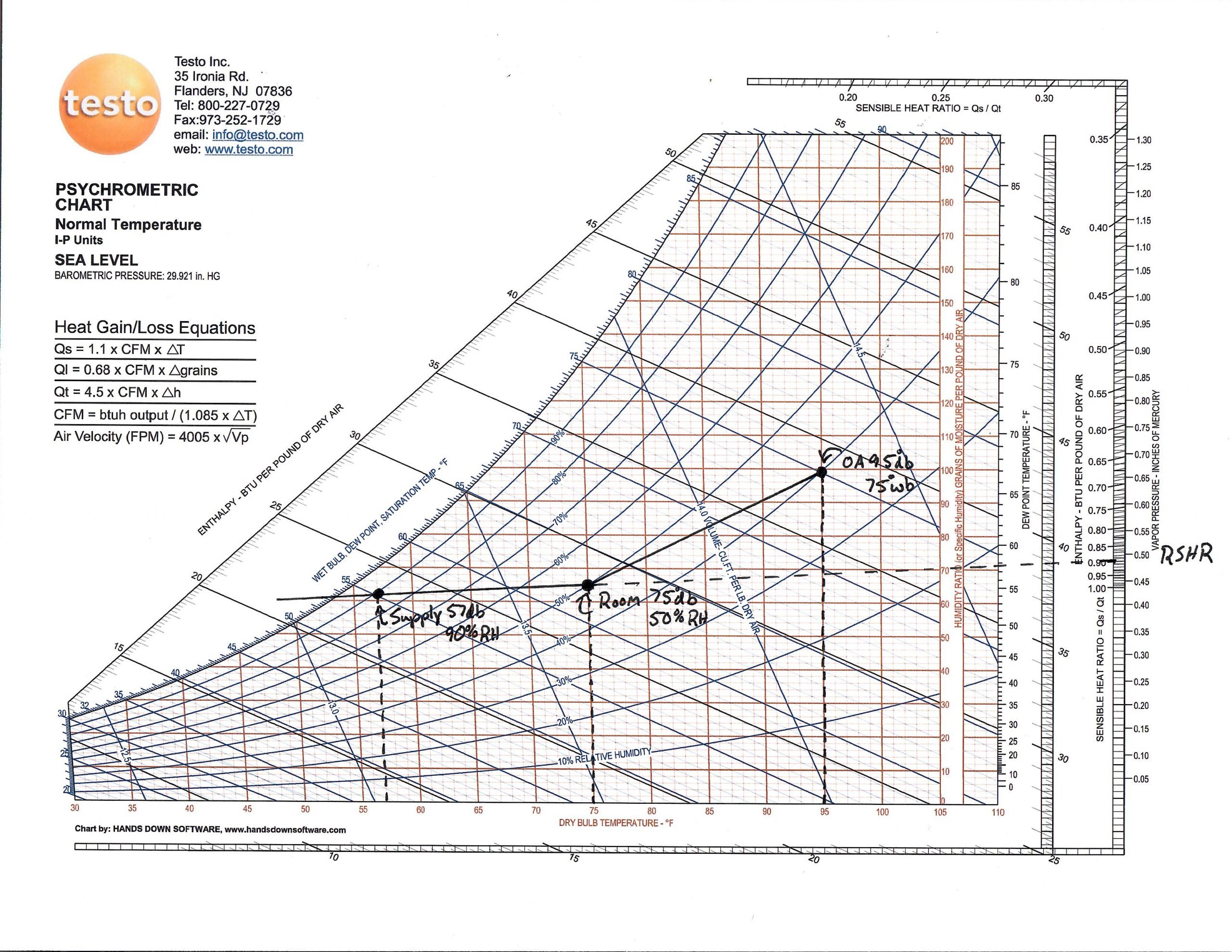
CFM = Room Sensible Load ÷ (1.08 x ΔT)
21,700 ÷ (1.08 x 18) = 1,116 CFM
Now that we know the supply CFM, we can calculate the percentage of ventilation air.Ventilation = 245 CFM ÷ 1,116 CFM
Ventilation = 22%
We have a good bit of information here now, but the math starts to get a little confusing without explanation. We now know that 22% of outdoor air (at 95℉ DB/75℉ WB) will be mixing with the remaining 78% return air (at 75℉ DB/50% RH). To calculate the mixed air condition, complete the following equation:MAT = (0.22 x 95℉) + (0.78 x 75℉)
MAT = 20.9℉ + 58.5℉
MAT = 79.4℉
We can now plot the mixed air condition on the psych chart.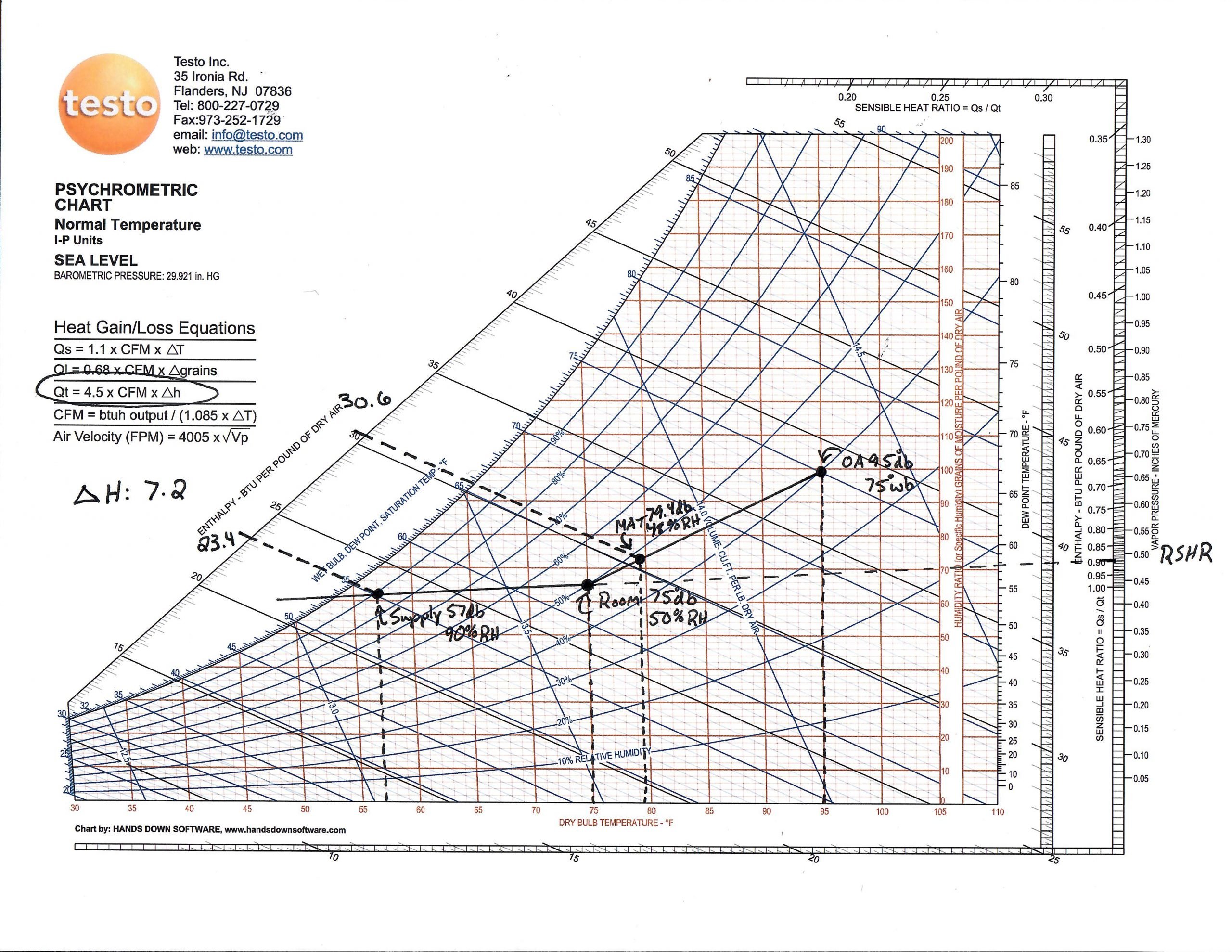
ΔH = 30.6 – 23.4
ΔH = 7.2
Now, let’s plug our ΔH into the total coil heat load calculation (4.5 here is Air Density x Run Time in minutes. 0.075 x 60 = 4.5).Qt = 4.5 x CFM x ΔH
Qt = 4.5 x 1,116 x 7.2
Qt = 36,158 BTU/h
Solve for coil sensible heat load. To do this, make sure you are using the entering air condition the equipment will actually see: MAT.Qs = 1.08 x CFM x ΔT
Qs = 1.08 x 1,116 x 22.5
Qs = 27,119 BTU/h
We can finally solve for coil sensible heat ratio at this point:CSHR = Coil Sensible Load ÷ Total Coil Load
CSHR = 27,119 BTU/h ÷ 36,158 BTU/h
CSHR = 0.75
We can now plot the CSHR line on the psych chart.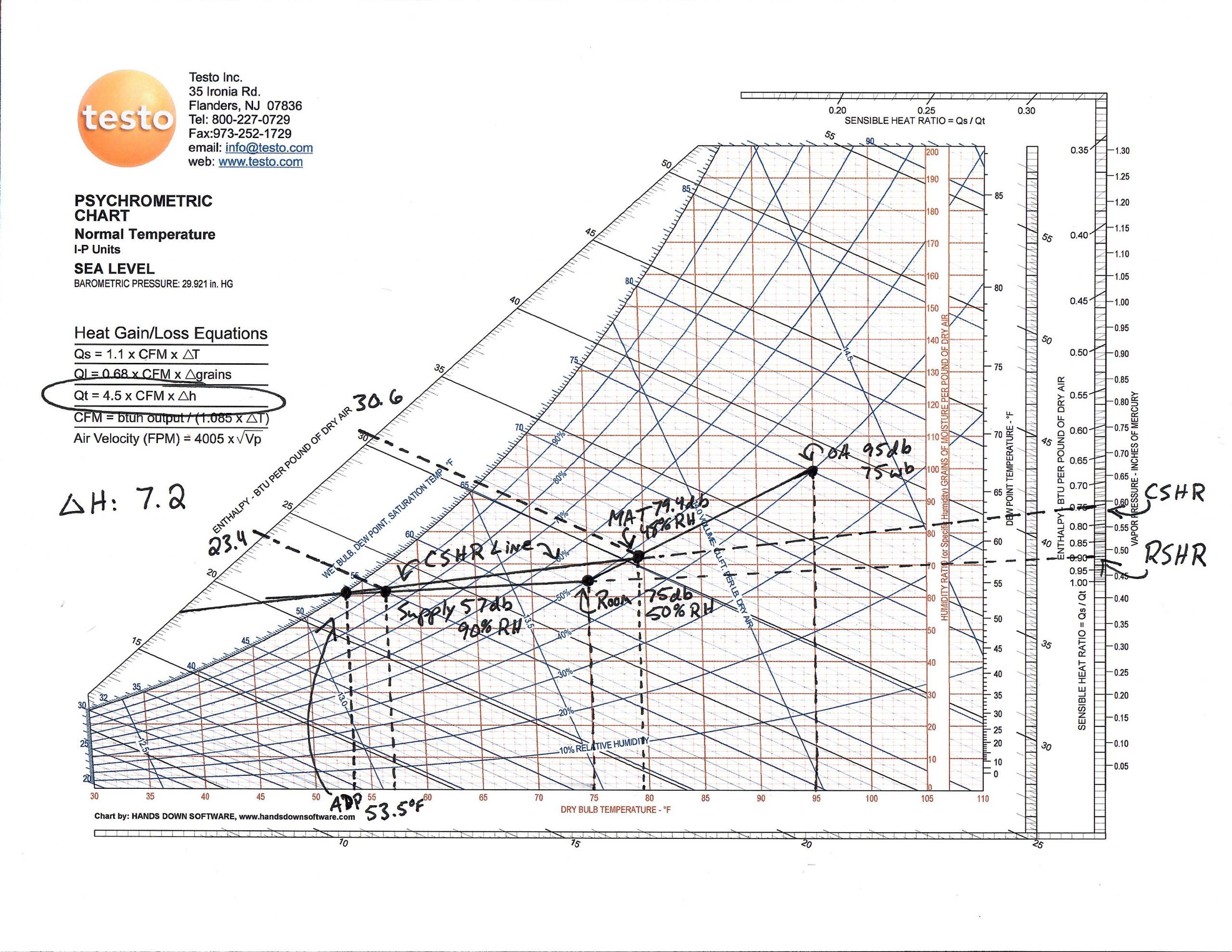
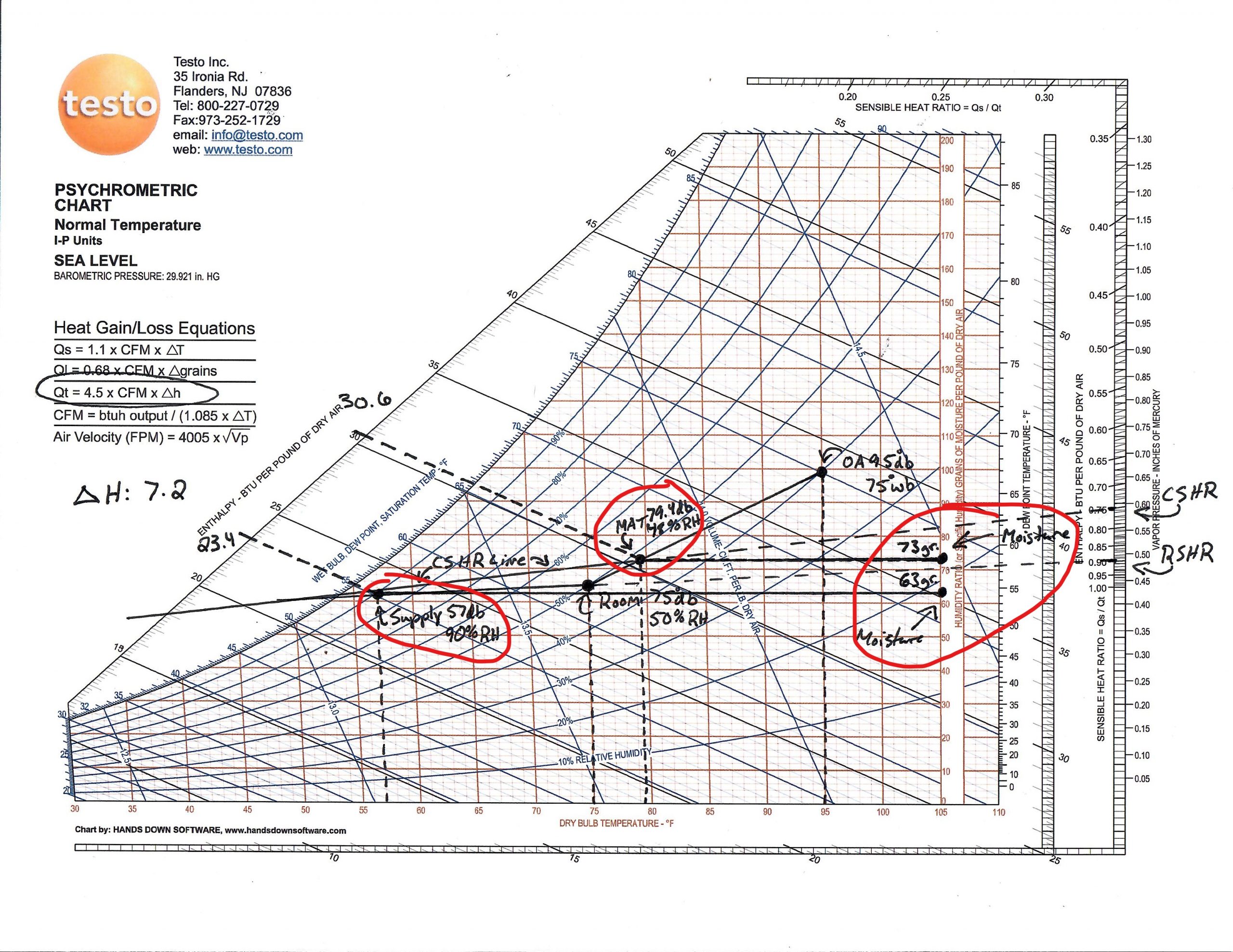
Bypass Factor = (Supply Air Temperature – Apparatus Dew Point) ÷ (Mixed Air Temperature – Apparatus Dew Point)
Bypass Factor = (57 – 53.5) ÷ (79.4 – 53.5)
Bypass Factor = 3.5 ÷ 25.9
Bypass Factor = 0.14
At this point, you would need to look up a manufacturer’s extended performance data for their equipment to ensure that the coil you select will meet a sensible capacity of 27,119 BTU/h and a total capacity of 36,158 BTU/h at 1,116 CFM, with an entering condition of 79.4℉ DB / 65.6℉ WB and an outdoor condition of 95℉ DB/75℉ WB. Let me translate that to something you might actually see on a performance table: Entering Air Condition: 80℉ DB/67℉ WB Outdoor Air Conditions: 95℉ DB/75℉ WB Total Capacity: 36,000 BTU/h Sensible Capacity: 27,000 BTU/h Airflow: 1,100 CFM If you can select a coil that will match these criteria, you will be able to maintain an indoor air condition that is nominally close to your design. To see how this chart would look in another scenario (without going through the step-by-step process), here is a psych chart based on my house and ASHRAE design conditions: Room Sensible Heat: 16,800 BTU/h Room Latent Heat: 7,200 BTU/h Room Total Heat: 24,000 BTU/h RSHR: 0.70 Room Design Conditions: 75℉ DB/50% RH Outdoor Design Conditions: 90℉ DB/80℉ WB Ventilation Requirement: 46 CFM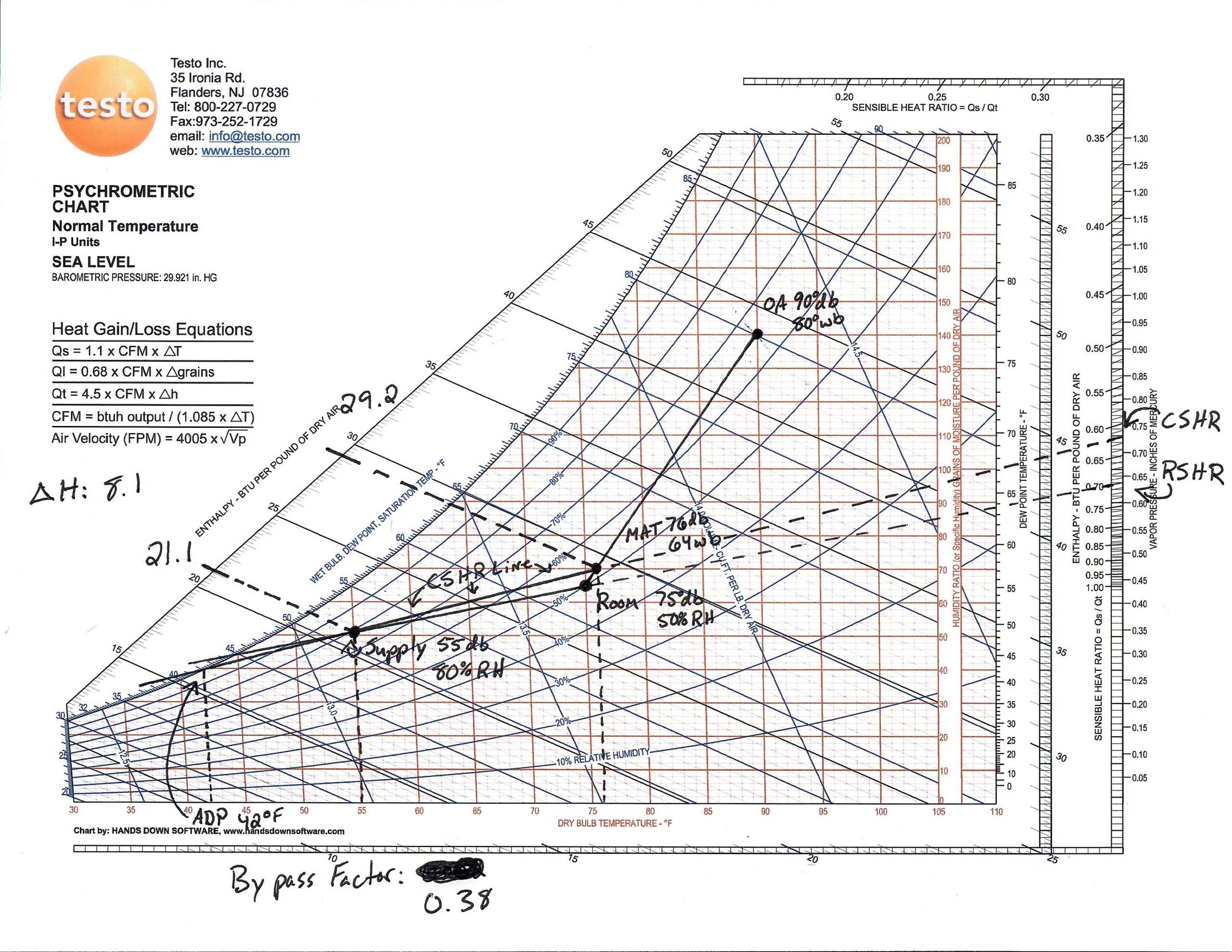
Work through this with the trade.
Highlight a short passage, or bring a question about a specific moment into HVAC No Bull Forum.
Discuss this reference → Related forum discussions Related Tech Tips











Comments
Hi,
you drew CSHR directly without making a parallel line.
Me, I have drawn a line of 0.75 CSHR to the index point, and then a parallel line from mixing point,….that’s logic, no?
The surprise, the intersection is in our supply point.
So, what happen?!!
thank you for this interested article.
Report comment
Hi,
you drew CSHR directly without making a parallel line.
Me, I have drawn a line of 0.75 CSHR to the index point, and then a parallel line from mixing point,….that’s logic, no?
The surprise, the intersection is in our supply point.
So, what happen?!!
thank you for this interested article.
Report comment
To leave a comment, you need to log in.
Log In