
Analog vs. Digital Sine – Short #179
Make & share a podcast clip
Keep the exact passage and a link to the full episode. Choose up to three minutes, with enough context to be fair to the speaker.
Preview uses this episode’s audio. Browser audio export, when supported, takes the length of the selected clip. Nothing plays until you choose Preview.
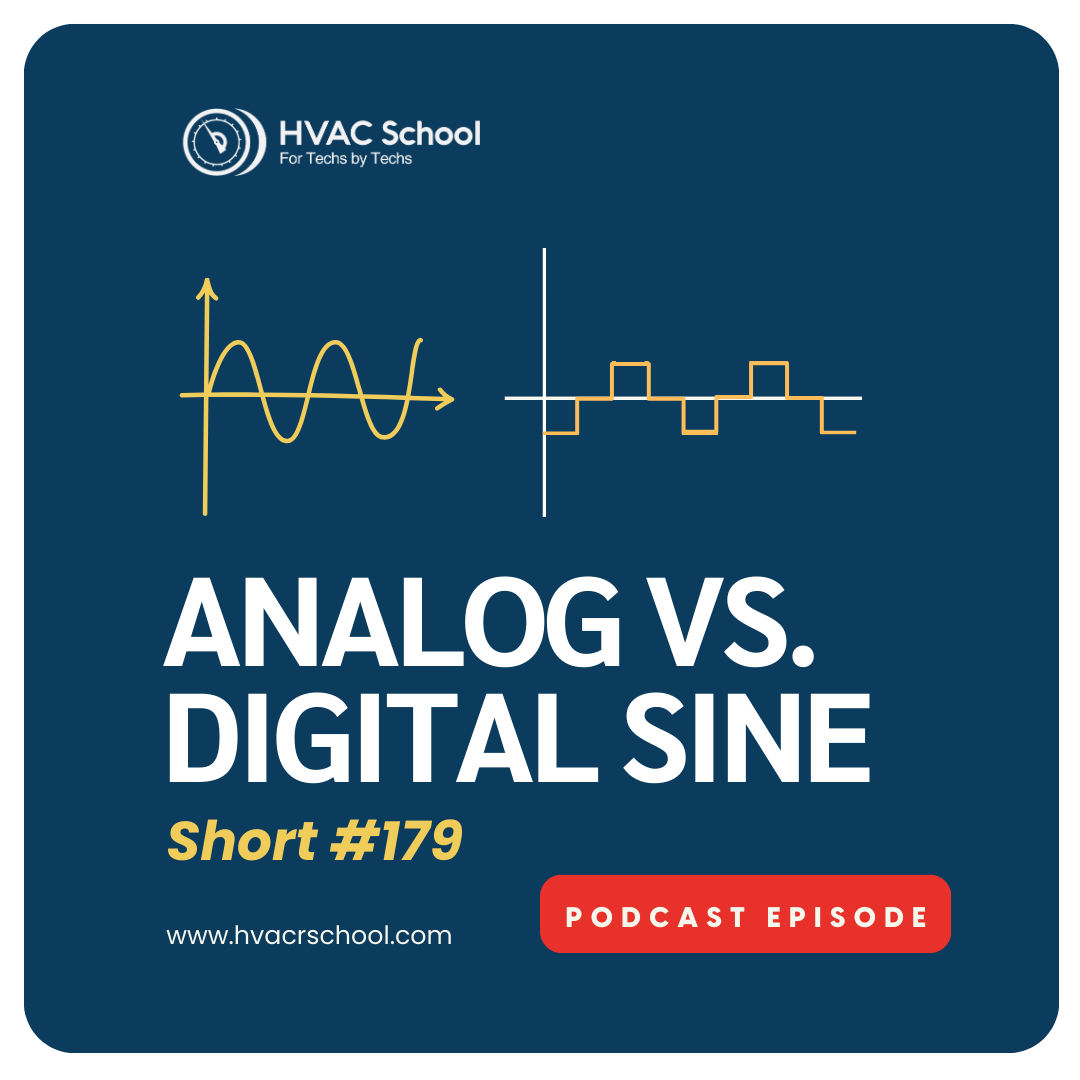
In this short podcast, Bryan breaks down the differences between analog and digital sine waves.
Analog readings deal with an unlimited number of values; they are very precise and can have any number of decimals. As a result, the alternating current (AC) analog sine readings have very smooth curves when we read them on an oscilloscope (in the US, we see 60 peak-and-valley cycles per second because the frequency is 60 hertz).
Variable frequency drives (VFDs) and ECMs work with digital outputs instead. The alternating current (AC) input is flattened out and then replicated as a direct current (DC) digital output that mimics an analog sine wave using technologies like pulse-width modulation (PWM). Digital outputs appear as a series of steps on an oscilloscope, but PWM doesn’t output different “steps” of voltage. PWM just changes the length and frequency according to the duty cycle (percentage of the time energized or unenergized). Digital scrolls turn on and off very often, and the time they spend “on” is the duty cycle, which determines how it stages up and down.
While ECM motor modules usually won’t work with regular motors, VFDs can run with typical motors and modify sine waves. These sine waves don’t have a smooth curve, but the digital waves can be smoothed out while voltage and current are modified. If VFD-driven motors aren’t designed or shaft-grounded properly, electrical discharge machining (EDM) can happen with high-frequency voltage spikes, which can damage the shaft and bearings.
Learn more about the 5th Annual HVACR Training Symposium at https://hvacrschool.com/Symposium24.
If you have an iPhone, subscribe to the podcast HERE, and if you have an Android phone, subscribe HERE.”
Subscribe to our YouTube channel at https://www.youtube.com/@HVACS.
Check out our handy calculators HERE or on the HVAC School Mobile App (Google Play Store or App Store).
Highlight a short passage, or bring a question about a specific moment into HVAC No Bull Forum.
Discuss this reference → Related forum discussionsAuthor:











Comments
To leave a comment, you need to log in.
Log In