
Codes and Failed Inspections #LIVE
Make & share a podcast clip
Keep the exact passage and a link to the full episode. Choose up to three minutes, with enough context to be fair to the speaker.
Preview uses this episode’s audio. Browser audio export, when supported, takes the length of the selected clip. Nothing plays until you choose Preview.
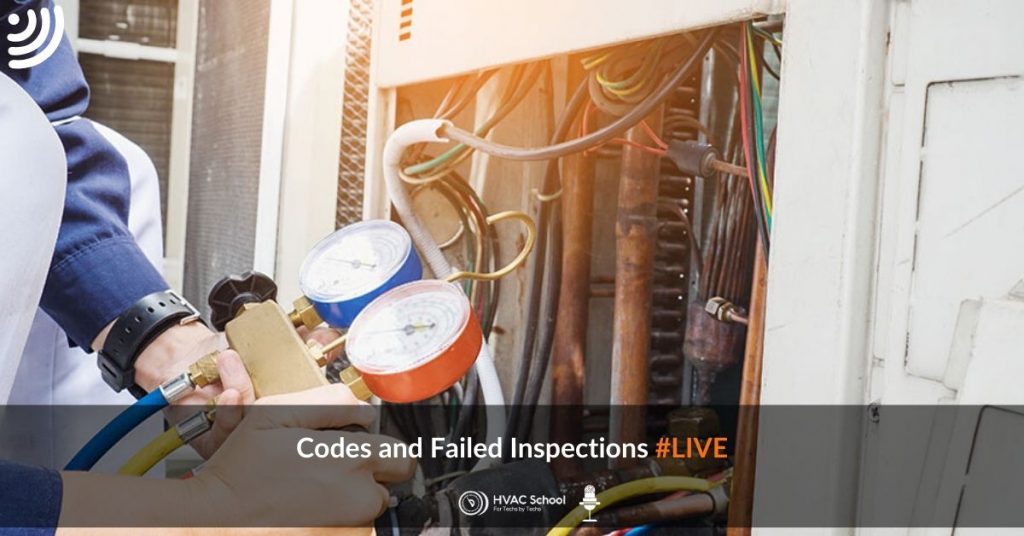
In this live podcast from the Castbox app, we talk about codes and common causes for failed inspections. We talk about these topics both broadly and with some specifics.
Many of the places where we fail to meet codes are on the electrical side. Electrical components have fire and electrical shock hazards, and codes are stringent for arc and ground fault protection. Leaking current to ground can shock someone, and arcs can cause damage to property and human life. We commonly see failed inspections due to improper marking on the air handler.
In the HVAC industry, we have specific wire and breaker-sizing codes for our trade (440 in the NEC). Inspection failures are common in this area, as it’s easy to leave the incorrect breaker in place. You also must have a disconnect or easily accessible circuit breaker that can function as a disconnect. In our market, we must also insulate drains and show proper attention to strapping, pitch, float switches, and cleanouts; otherwise, the drains may fail inspection (though it’s rare).
Clearances also come up quite often and are especially relevant to safety in our industry, as we don’t want condensers blocking panels. Obstructed rooms or lack of egress are also common code violations related to safety. Anchorage is another safety-related code category, and there are special requirements in locations that are prone to high winds (like Florida) or earthquakes (California). You can’t assume that units installed on rooftops have been anchored correctly, so be sure to check the anchorage.
We also discuss:
- Pulling permits
- CO detectors
- PVC primer on condensate drains
- National Electrical Code (NEC) vs. AHJ
- Catwalks in attics
- Duct sealing and mastic vs. metal tape
- Florida Energy Conservation, Mechanical, and Building Codes
- Customer complaints
- Furnace venting and GAMA tables
- Smoke detectors
- Locking caps
- Wire protection
- Sealing boots
Learn more about Refrigeration Technologies HERE.
Highlight a short passage, or bring a question about a specific moment into HVAC No Bull Forum.
Discuss this reference → Related forum discussionsAuthor:











Comments
On our inspection we always have to color the white wire that goes into the service disconnect from the breaker black. Inspection tells us that we should not rely on color codes. My thought is if it on the line side of the disconnect no one would think it’s a common wire.
Report comment
On our inspection we always have to color the white wire that goes into the service disconnect from the breaker black. Inspection tells us that we should not rely on color codes. My thought is if it on the line side of the disconnect no one would think it’s a common wire.
Report comment
To leave a comment, you need to log in.
Log In