
Delta T Talk w/ JD Kelly
Make & share a podcast clip
Keep the exact passage and a link to the full episode. Choose up to three minutes, with enough context to be fair to the speaker.
Preview uses this episode’s audio. Browser audio export, when supported, takes the length of the selected clip. Nothing plays until you choose Preview.
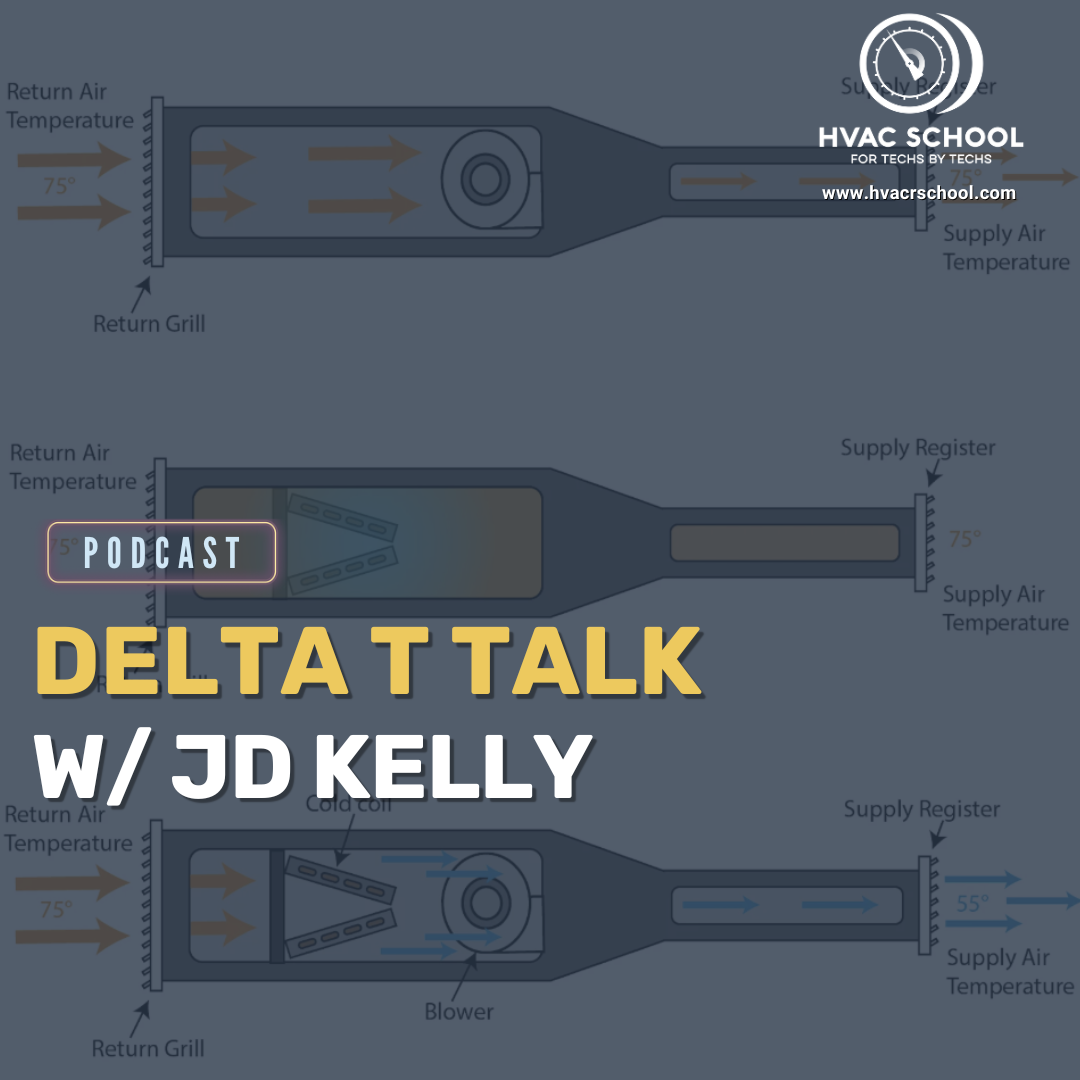
Bryan from HVAC School interviews JD Kelly, known as “student of HVAC” on Instagram, about Delta T measurements in HVAC systems. This episode dives into the fundamentals of Delta T, common misconceptions, and proper measurement techniques.
JD explains that Delta T is simply a temperature difference between two points of the same medium, which is often misunderstood in the industry. Many technicians are taught to measure between return grills and supply registers, but this approach can lead to inaccurate readings due to external factors like duct leakage or heat gain from attics. The proper measurement should be taken directly at the equipment to evaluate how the evaporator coil is performing.
Humidity plays a significant role in Delta T measurements, which JD discovered when researching the fundamentals. Bryan elaborates on this point, explaining that in high-humidity environments (like Florida), more energy goes toward removing moisture (latent heat) rather than cooling the air (sensible heat), resulting in lower Delta T readings. This is why a newly repaired unit in a humid house might initially show lower readings but improve as the home dries out. The discussion highlights why the common “20-degree Delta T” rule of thumb isn’t universally applicable and requires context.
Key Topics Covered:
- Definition of Delta T: Temperature difference between two points of the same medium
- Difference between Delta T and TD (temperature difference)
- Proper probe placement for accurate Delta T readings
- Impact of humidity on Delta T measurements
- How regional differences affect expected Delta T values
- Relationship between CFM (airflow) per ton and Delta T readings
- Common mistakes: Adjusting equipment based solely on Delta T readings
- Challenges of applying Delta T in heat pump heating mode
- How temperature dead spots can affect readings
- Why Delta T readings must be considered alongside other diagnostic tests
- The danger of making unnecessary adjustments to HVAC systems
- Why high Delta T isn’t always good and low Delta T isn’t always bad
JD’s Delta T tech tip: https://hvacrschool.com/solving-delta-t/
Have a question that you want us to answer on the podcast? Submit your questions at https://www.speakpipe.com/hvacschool.
Purchase your tickets or learn more about the 6th Annual HVACR Training Symposium at https://www.hvacrschool.com/symposium.
Subscribe to our podcast on your iPhone or Android.
Subscribe to our YouTube channel.
Check out our handy calculators here or on the HVAC School Mobile App for Apple and Android
Highlight a short passage, or bring a question about a specific moment into HVAC No Bull Forum.
Discuss this reference → Related forum discussions










Comments
To leave a comment, you need to log in.
Log In