
Nitrogen Pressures do Change with Temperature – the Basic Gas Laws (Podcast)
Make & share a podcast clip
Keep the exact passage and a link to the full episode. Choose up to three minutes, with enough context to be fair to the speaker.
Preview uses this episode’s audio. Browser audio export, when supported, takes the length of the selected clip. Nothing plays until you choose Preview.
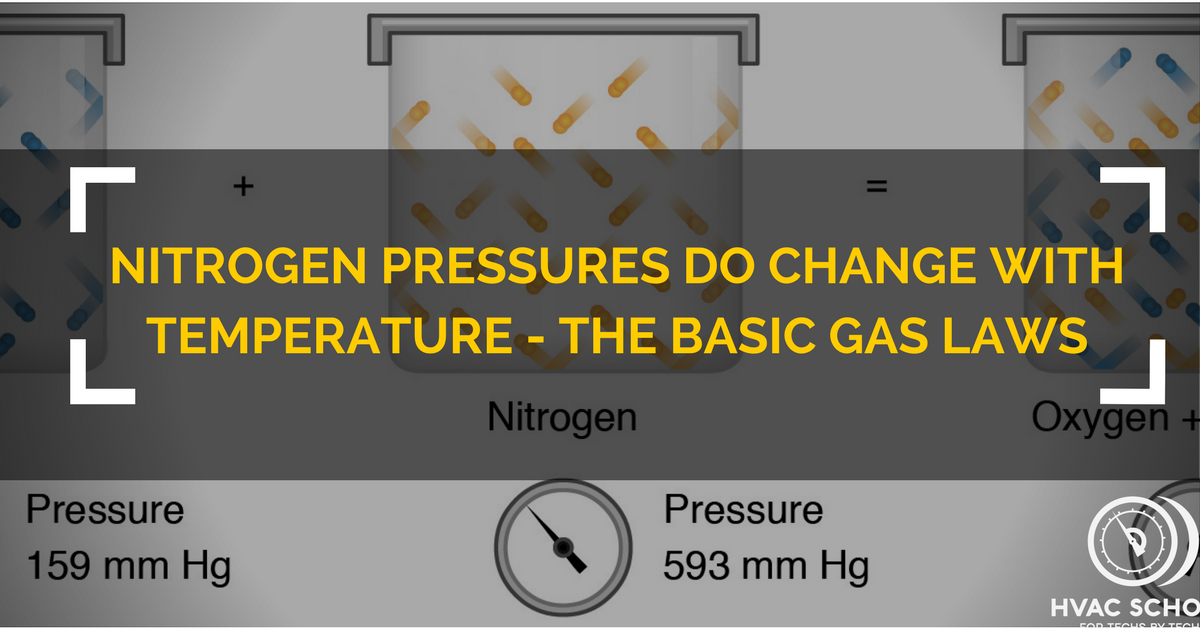
In today’s podcast, Bryan covers the four basic gas laws and how they apply to you as an HVAC technician in the field, not just in theory. Remember, when dealing with pressure, you must convert the units to PSIA, not just PSIG. To do that, you merely add 14.7 to your gauge pressure.
In every equation, the “1” indicates an original value, and the “2” indicates a new value.
The simplest of the gas laws was discovered first, Boyle’s law. The law states that there is an inverse relationship between absolute pressure and volume. When a gas’s pressure increases (such as via compression), you decrease its volume. Inversely, when you decrease a gas’s pressure, that gas will expand, and its volume will increase. Mathematically, the law looks like this:
P1 x V1 = P2 x V2
Charles’s law focuses on volume and temperature. This gas law states that volume and temperature rise or fall together so long as the pressure stays the same. You can mathematically describe the law with the following equation:
V1 / T1 = V2 / T2
The general law of a perfect gas combines Boyle’s and Charles’s laws. You can mathematically describe the law like this:
(P1 x V1) / T1 = (P2 x V2) / T2
As HVAC technicians, we should care about the gas laws because our pressures and volumes will change as temperature changes throughout the day, such as when doing a standing pressure test with nitrogen. Nitrogen is a relatively non-reactive gas, so it will follow the gas laws and won’t condense to a liquid or react with other chemicals.
Dalton’s law is the final law, and it states that the combined pressure of all gases in a closed space is equal to the sum of the individual gas pressures.
If you have an iPhone, subscribe to the podcast HERE, and if you have an Android phone, subscribe HERE.
Highlight a short passage, or bring a question about a specific moment into HVAC No Bull Forum.
Discuss this reference → Related forum discussionsAuthor:











Comments
To leave a comment, you need to log in.
Log In