
Q&A – Condensating Vents – Short #208
Make & share a podcast clip
Keep the exact passage and a link to the full episode. Choose up to three minutes, with enough context to be fair to the speaker.
Preview uses this episode’s audio. Browser audio export, when supported, takes the length of the selected clip. Nothing plays until you choose Preview.
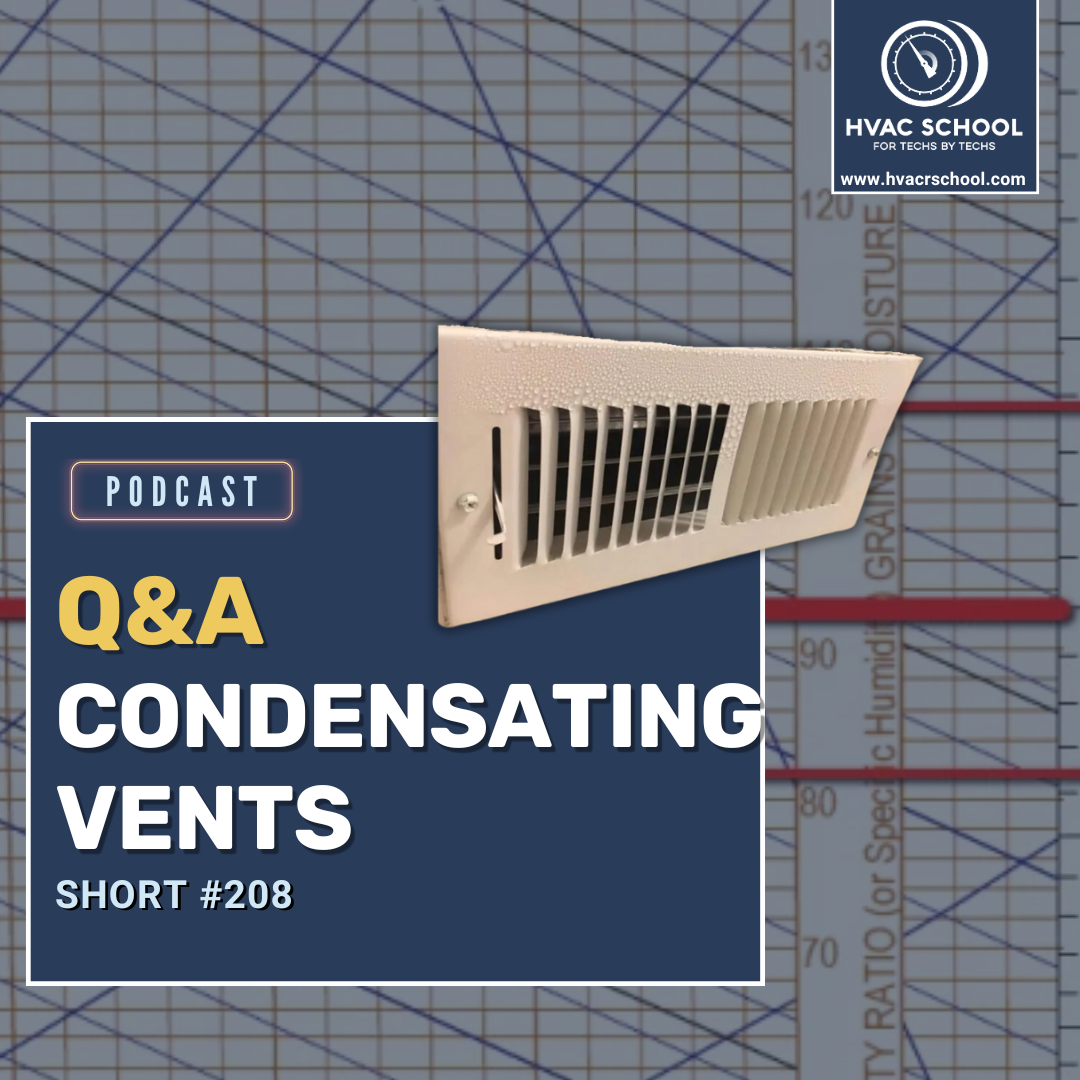
In this short Q&A podcast episode, Bryan answers Kenton’s question about how to stop vents from condensating, especially when sealing and insulation don’t do the trick.
When approaching a condensation problem, we have to consider the source of moisture and where the condensation is happening. Moisture that builds up on top of the vent comes from attics with a high dew point. (It’s not because hot meets cold! Relative humidity and dew point are a lot more important, though hot air is able to hold more moisture.) Warm, moist air with a high dew point hits a colder surface when there is improper sealing and insulation where the duct attaches to the boot.
People often attempt to solve condensation issues by adding insulation, which actually has the opposite effect because it reduces the surface temperature; condensation worsens. Some people also increase attic ventilation, but that may cause pressure imbalances that drive moist air into the conditioned space.
The best way to control attic conditions is to seal and then dehumidify the attic, though it is an expensive and time-consuming measure. Exhaust vents that end in the attic also add moisture to the attic. Sealing vents and other areas where attic air can seep into the space is another best practice, as is deploying a humidity control strategy. Reducing humidity can happen with a dehumidifier and proper sizing so that the HVAC equipment has long runtimes with a cold evaporator coil (achieved with lower system airflow).
Have a question that you want us to answer on the podcast? Submit your questions at https://www.speakpipe.com/hvacschool.
Purchase your tickets or learn more about the 6th Annual HVACR Training Symposium at https://www.hvacrschool.com/symposium.
Subscribe to our podcast on your iPhone or Android.
Subscribe to our YouTube channel.
Check out our handy calculators here or on the HVAC School Mobile App for Apple and Android.
Highlight a short passage, or bring a question about a specific moment into HVAC No Bull Forum.
Discuss this reference → Related forum discussionsAuthor:











Comments
To leave a comment, you need to log in.
Log In