
Standing Pilot – Short #228
Make & share a podcast clip
Keep the exact passage and a link to the full episode. Choose up to three minutes, with enough context to be fair to the speaker.
Preview uses this episode’s audio. Browser audio export, when supported, takes the length of the selected clip. Nothing plays until you choose Preview.
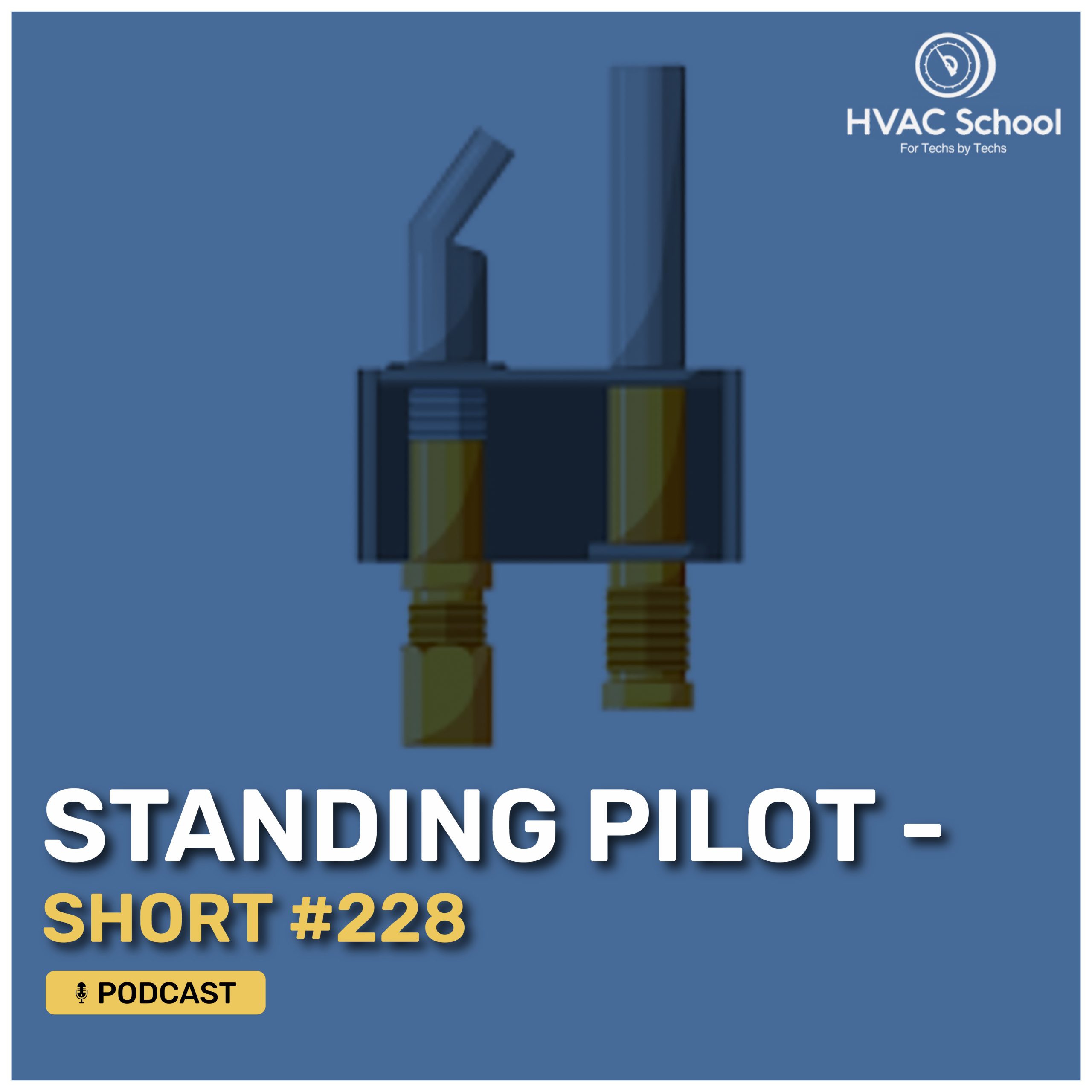
In this short podcast episode, Bryan talks about the standing pilot gas systems and the ignition strategy in gas-fired appliances.
Standing pilots are very simple devices that are common in fuel logs, water heaters, and some pool heaters. These devices have a thermocouple or thermopile; in a thermocouple, two dissimilar metals are connected at one end, and there is an electron flow between the metals when one is heated up. A thermopile is a collection of thermocouples in series or parallel to generate more millivolt signals. (Both of these can be damaged if cleaned; don’t mistake these for the flame rod! Flame rods can be cleaned with a delicate material.)
To use a standing pilot, turn the dial to the pilot mode and press it in, which allows gas to come through the pilot. Then, you can light the gas (with a lighter or spark mechanism) and keep the dial depressed until there is enough heat generated on top of the thermocouple or thermopile, which allows it to lock in and keep the pilot lit (and pass the entire safety circuit). Then, you turn the gas valve on and let the main burner take over.
If one safety is open, the entire circuit breaks to prevent unspent fuel from accumulating and causing a dangerous condition. One of the main challenges with standing pilots is that they are prone and very sensitive to corrosion due to the low voltage and current. Clean and tight connections can mitigate these risks.
Have a question that you want us to answer on the podcast? Submit your questions at https://www.speakpipe.com/hvacschool.
Purchase your tickets or learn more about the 6th Annual HVACR Training Symposium at https://www.hvacrschool.com/symposium.
Subscribe to our podcast on your iPhone or Android.
Subscribe to our YouTube channel.
Check out our handy calculators here or on the HVAC School Mobile App for Apple and Android
Highlight a short passage, or bring a question about a specific moment into HVAC No Bull Forum.
Discuss this reference → Related forum discussionsAuthor:











Comments
To leave a comment, you need to log in.
Log In