
Superheat Talk w/ JD Kelly
Make & share a podcast clip
Keep the exact passage and a link to the full episode. Choose up to three minutes, with enough context to be fair to the speaker.
Preview uses this episode’s audio. Browser audio export, when supported, takes the length of the selected clip. Nothing plays until you choose Preview.
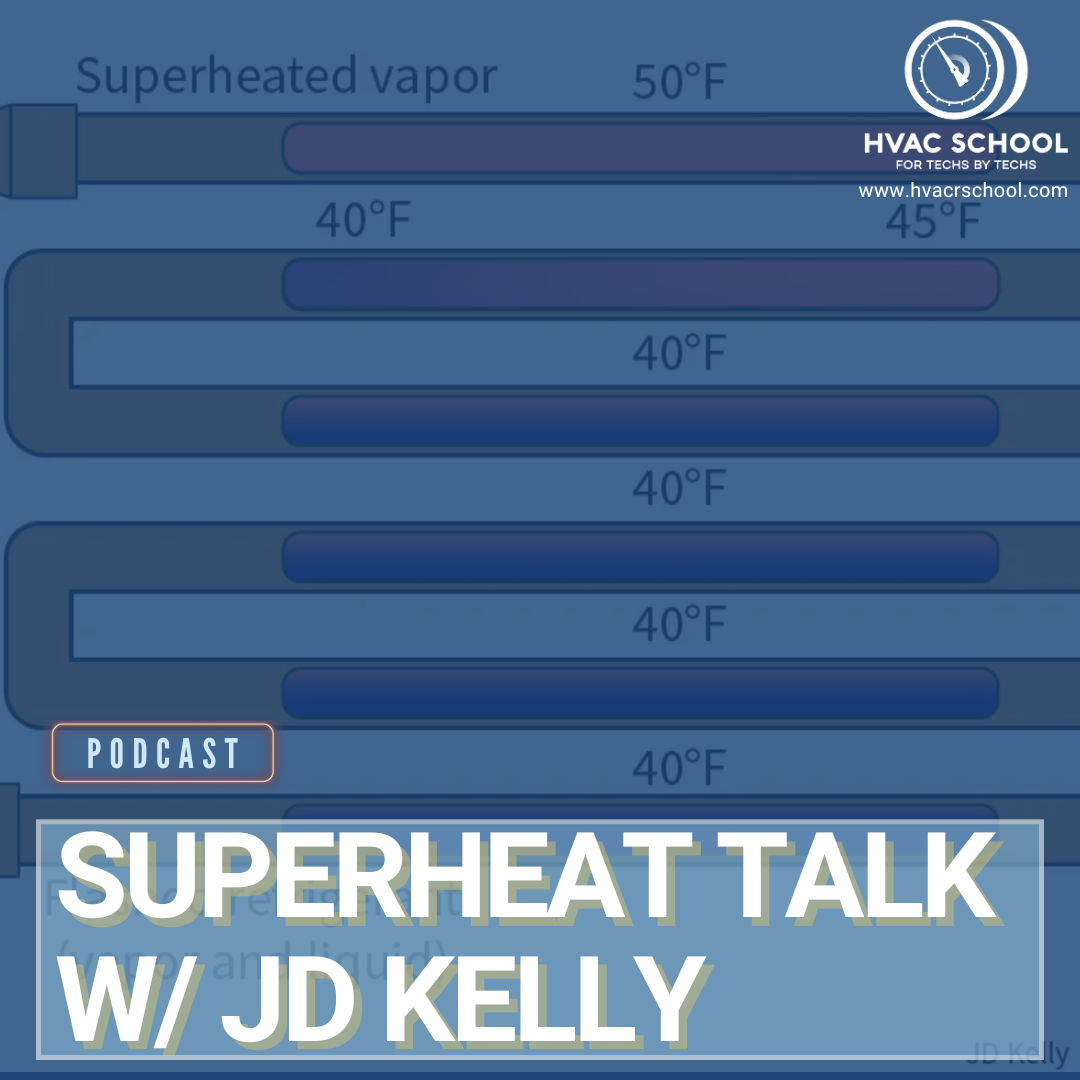
In this episode of the HVAC School podcast, host Bryan discusses superheat with guest JD, who recently co-authored an article on the topic with Ty Branaman. The conversation explores the often misunderstood concept of superheat, its importance in HVAC diagnostics, and common misconceptions technicians have when measuring and interpreting it.
Bryan begins by sharing how superheat was initially taught to technicians in the late 1990s and early 2000s, primarily as a method for charging fixed metering device systems. He explains how this limited view led to problems, as technicians would often add or remove refrigerant based solely on superheat readings without considering other system factors or giving the system time to stabilize. JD points out how the industry shifted when TXVs (Thermostatic Expansion Valves) became standard, with many technicians abandoning superheat measurements altogether in favor of subcooling measurements, missing crucial diagnostic information in the process.
The discussion then evolves into a more sophisticated understanding of superheat as an indicator of evaporator coil “fullness.” Bryan explains that lower superheat indicates a fuller evaporator coil, while higher superheat suggests a starved coil. They discuss the importance of measuring superheat in the correct location, noting that TXVs control superheat at the evaporator outlet, not at the condensing unit where technicians often measure. This misunderstanding leads to many incorrect diagnoses of “bad TXVs” when the real issues might be related to airflow, heat pickup in line sets, or other factors. Both experts emphasize the value of measuring superheat both inside at the evaporator outlet and outside at the condensing unit to get a complete picture of system operation.
Key Topics Covered:
- Definition of superheat and its importance in HVAC diagnostics
- How superheat indicates evaporator coil “fullness” (flooded vs. starved conditions)
- The distinction between charging by superheat and using superheat as a diagnostic tool
- Common misconceptions about superheat measurement on TXV systems
- Why measuring superheat location matters (evaporator outlet vs. condensing unit)
- How to properly diagnose TXV issues using superheat measurements
- The relationship between airflow problems and superheat readings
- Normal superheat ranges for residential systems (7-14 degrees at evaporator outlet)
- How superheat affects both system capacity and compressor safety
- “Exercising” TXVs as a troubleshooting technique
- How line set conditions and installation factors can impact superheat readings
- System behavior during “hot pull down” conditions when starting with high indoor temperatures
JD and Ty’s superheat tech tip and worksheet: https://hvacrschool.com/solving-superheat/
Have a question that you want us to answer on the podcast? Submit your questions at https://www.speakpipe.com/hvacschool.
Purchase your tickets or learn more about the 6th Annual HVACR Training Symposium at https://www.hvacrschool.com/symposium.
Subscribe to our podcast on your iPhone or Android.
Subscribe to our YouTube channel.
Check out our handy calculators here or on the HVAC School Mobile App for Apple and Android
Highlight a short passage, or bring a question about a specific moment into HVAC No Bull Forum.
Discuss this reference → Related forum discussions










Comments
To leave a comment, you need to log in.
Log In