
Systems Thinking – HV / LV / Condensate
Make & share a podcast clip
Keep the exact passage and a link to the full episode. Choose up to three minutes, with enough context to be fair to the speaker.
Preview uses this episode’s audio. Browser audio export, when supported, takes the length of the selected clip. Nothing plays until you choose Preview.
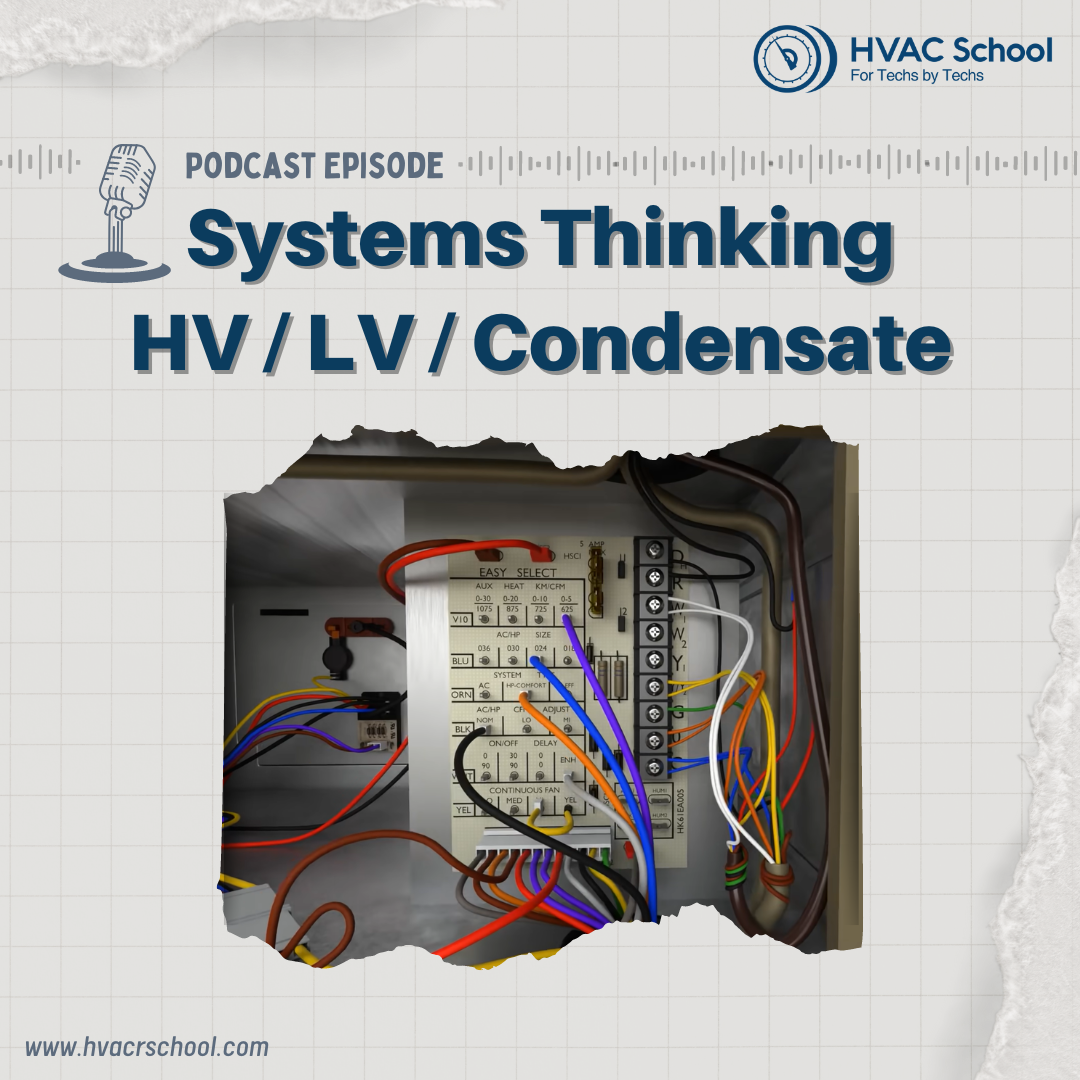
Eric Kaiser returns to the podcast to discuss high-voltage wiring, low-voltage wiring, and condensate assemblies as they relate to systems thinking.
On the high-voltage side, the disconnect should be in a secure location, and it should be able to keep water out. The wires should be appropriately sized, have an appropriate level of tension, and should not be vulnerable to chafing or abrasion. Overall, best practices include using proper grommets and ensuring that you have a solid connection. Do not run high voltage wiring in parallel with low-voltage or control wiring. It’s also worth noting that double-lugging is a poor practice that is against code.
On the low-voltage side, you also need to be careful of where you route your wires to avoid induction, contact with hot surfaces, or abrasion. The insulation ratings also need to be appropriate.
We can think of the condensate assembly as its own system. Condensate drains have uphills and downhills, and they may have traps, vents, and cleanouts throughout. Cleanouts and vents may be confused for each other, but cleanouts allow the technician to access and clean the drain. Cleanouts are also capped when in use, but vents are not. The location of a vent can help equalize the siphoning effects of pressurization.
Condensate systems also consist of pans and switches. In those cases, redundancy is desirable to prevent overflowing. Secondary drain pans should be large enough to overlap with the primary pan, especially in horizontal air handlers.
Eric and Bryan also discuss:
- Conductor length best practices
- Connecting stranded to solid wire
- Lug torquing
- Variation in wire sizing
- Testing low-voltage wires
- Cleanout tees
- Single vs. multiple drains with other appliances
- Drain pitch and if there could be “too much fall”
If you have an iPhone, subscribe to the podcast HERE, and if you have an Android phone, subscribe HERE.
Check out our handy calculators HERE.
Highlight a short passage, or bring a question about a specific moment into HVAC No Bull Forum.
Discuss this reference → Related forum discussionsAuthor:












Comments
To leave a comment, you need to log in.
Log In