
Water Source – The Water Side w/ Eric Mele (Podcast)
Make & share a podcast clip
Keep the exact passage and a link to the full episode. Choose up to three minutes, with enough context to be fair to the speaker.
Preview uses this episode’s audio. Browser audio export, when supported, takes the length of the selected clip. Nothing plays until you choose Preview.
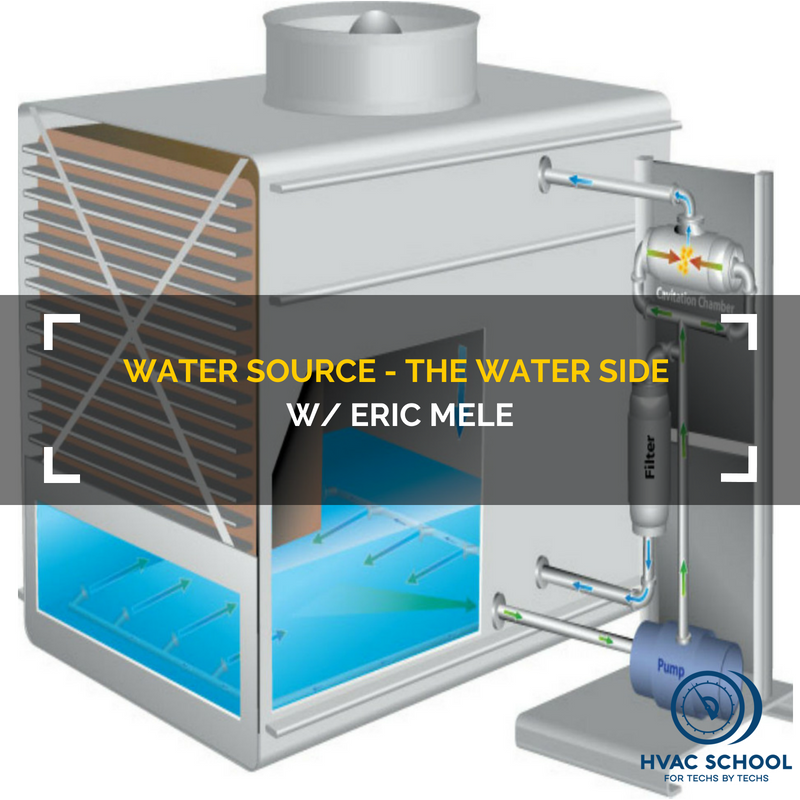
In this episode, Eric Mele dives into the world of pumps, controls, cooling towers, and everything else related to the water side of a water source heating and cooling system. Many of these systems are water-to-water setups that use heat exchanges for heat transfer. You can listen to an introduction to water source heat pumps HERE.
A cooling tower is where we reject the heat that we put into water loops. Most of these towers are of the induced-draft variety, meaning that they have fans drawing/blowing air through them. Some cooling towers are “wet” towers, where water is open to the fluid you’re working with, so some of that water is lost to evaporation. Contamination can be an issue with the wet open-type towers, but strainers, chemicals, and proper planning (for location) can prevent contamination. Dry towers do not need constant refilling and need fewer precautions against contamination.
These water-to-water systems use centrifugal pumps to push water through the system. These circulate water molecules, NOT compress them. Water source heat pumps get their heat from boilers, not the outdoor air in most air source heat pumps. When you have gas boilers, you have to think about your typical furnace concerns, including combustion air and carbon monoxide.
Air can sometimes circulate with the water, and you’ll want to minimize that as much as possible, such as via air bleeds. These air bleeds may have ball valves that you can use to purge a lot of air. Other systems may not have air bleeds, but you will still need to get air out of the system.
Eric and Bryan also discuss:
- Makeup water float assemblies
- Strainers and cleaning procedures
- Heat exchanger configurations
- Water sources and quality control
- Water treatment
- Couplings and alignment
- Boiler configuration
- Bypass valves
- Expansion tanks
- Water source heat pump controls
- Variable frequency drives
- Aquastats
Learn more about Refrigeration Technologies HERE.
Highlight a short passage, or bring a question about a specific moment into HVAC No Bull Forum.
Discuss this reference → Related forum discussions









Comments
To leave a comment, you need to log in.
Log In