
Locked Compressors and Hard Starts – Short #175
Make & share a podcast clip
Keep the exact passage and a link to the full episode. Choose up to three minutes, with enough context to be fair to the speaker.
Preview uses this episode’s audio. Browser audio export, when supported, takes the length of the selected clip. Nothing plays until you choose Preview.
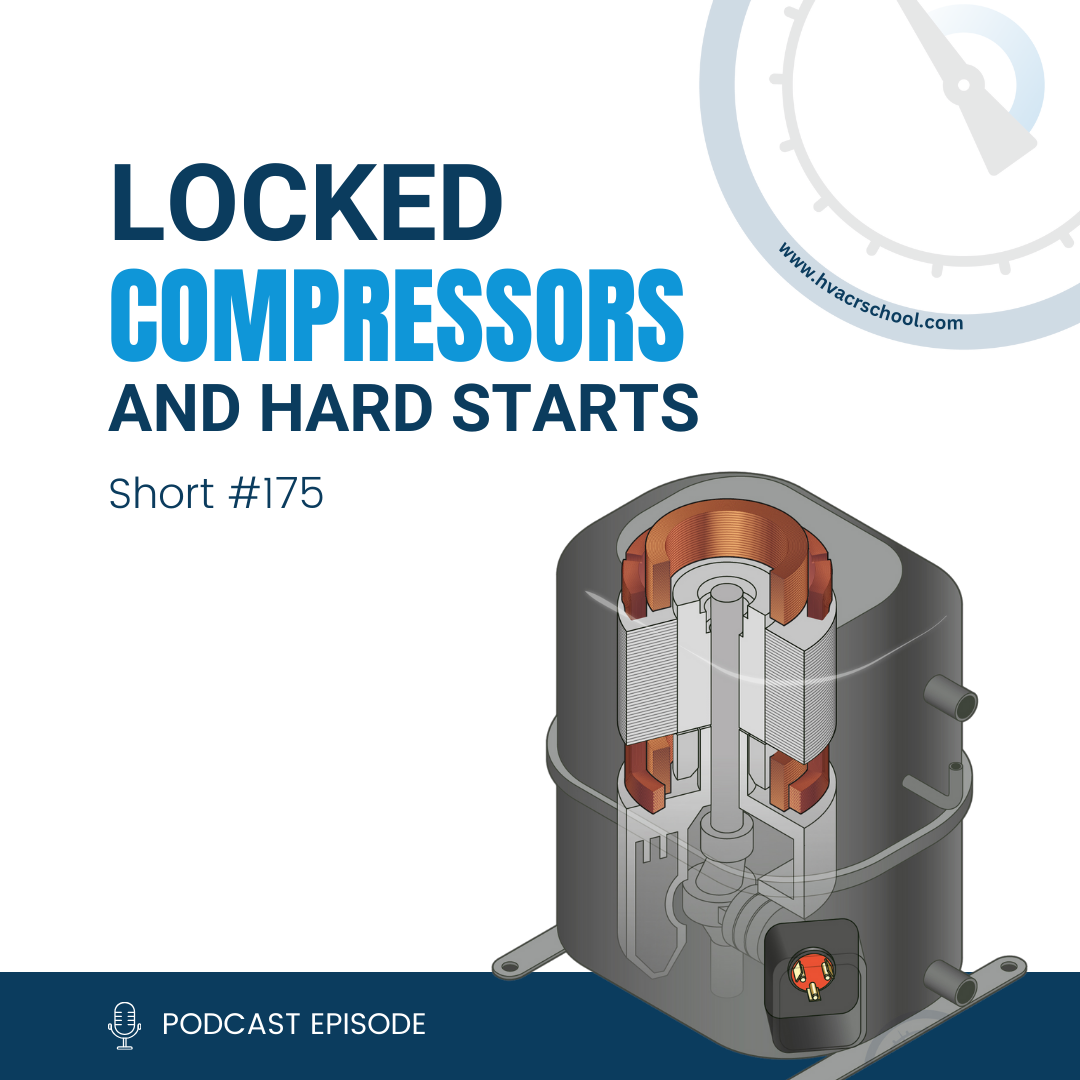
In this short podcast episode, Bryan talks about locked compressors and hard starts. He explains what actually happens when a compressor locks and covers when and how to use hard starts appropriately.
Locked compressors are compressors that trip on overload during startup; they’re considered “locked” because the rotor doesn’t turn inside the stator and generates heat instead. The overload opens, but the compressor shell typically does not heat up very much when the overload opens.
When you have a locked compressor, you need to start investigating the root cause with a thorough visual inspection. Then, check the run capacitor. A hard start kit helps you get the equipment working, but we should make sure we’ve addressed underlying electrical issues or installation conditions before installing a hard start kit. If the unit is old, then we may use a hard start as a temporary solution until the customer can purchase a new unit. In any case, it’s best to use a factory hard start if the system requires it, but it’s okay to use an aftermarket hard start kit to get an old system to run.
Hard start kits consist of a start capacitor in series with the start winding, which moves more current into the start winding and decreases the time it takes to start the compressor; lower current readings indicate a faster amperage drop, as most ammeters read timed average values. The potential relay needs to open to take the start capacitor out of the circuit so that we don’t continuously apply additional current to the start winding, which hurts the compressor over time. The hard start kit is not a silver bullet that solves all problems, and we need to know when to use them and how to use them appropriately.
Learn more about the 5th Annual HVACR Training Symposium at https://hvacrschool.com/Symposium24.
If you have an iPhone, subscribe to the podcast HERE, and if you have an Android phone, subscribe HERE.
Check out our handy calculators HERE.
Highlight a short passage, or bring a question about a specific moment into HVAC No Bull Forum.
Discuss this reference → Related forum discussionsAuthor:











Comments
To leave a comment, you need to log in.
Log In