
Single-Phase, 3-Phase, and Split-Phase Explained (Podcast)
Make & share a podcast clip
Keep the exact passage and a link to the full episode. Choose up to three minutes, with enough context to be fair to the speaker.
Preview uses this episode’s audio. Browser audio export, when supported, takes the length of the selected clip. Nothing plays until you choose Preview.
In this podcast episode, we discuss power distribution and some practical tips about three-phase, single-phase, and split-phase power.
The power company generates three-phase power; a power pole transformer typically has three current-carrying conductors. Each phase of power runs at 60 Hz and generates a sine wave. That sine wave peaks and valleys in a wavy formation. Power is generated in a rotating magnetic field, so it is helpful to think of a sine wave as a variation of a circle.
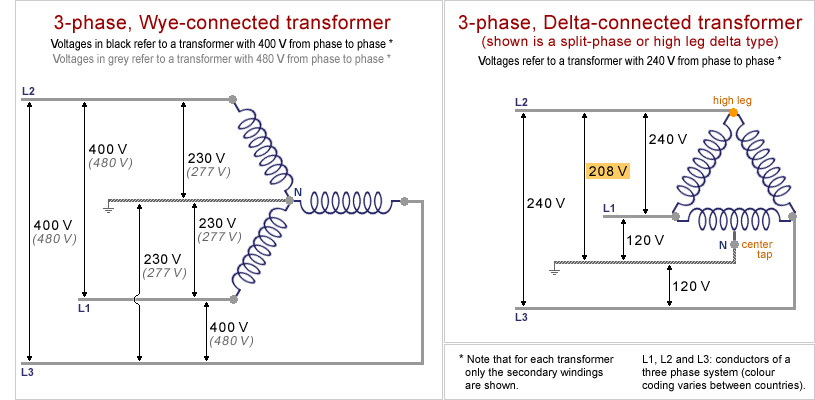
Transformers take high voltage and bring it down to 120V split-phase via a winding on the left, a winding on the right, and a neutral tap. The split sine waves are exactly 180 degrees out of phase; they are direct opposites, and they will intersect and both be “off” at the same time. The center is neutral. This 120V split-phase power results in 240V total; therefore, we can use them in 240V applications. Split single-phase motors require a capacitor.
Three-phase power uses all three legs of power, and the sine waves are 120 degrees out of phase with each other. In three-phase power, only one wave will be “off” at any point in time. Three-phase power is a more efficient means of running motors; split single-phase power is relatively inefficient and requires a capacitor. However, reverse-phasing is a possibility and may run motors backward, causing damage. The most common type of three-phase transformer uses the wye configuration and works for 208V applications.
Bryan also discusses:
- Wye vs. delta configuration
- Delta configuration high leg
- Start assistance and capacitors
- Residential vs. commercial applications
- Capacitor failure
- 277V and 480V applications
- Replacing single-phase with three-phase power or vice versa
- Three-phase condensers with single-phase air handlers
If you have an iPhone, subscribe to the podcast HERE, and if you have an Android phone, subscribe HERE.
Highlight a short passage, or bring a question about a specific moment into HVAC No Bull Forum.
Discuss this reference → Related forum discussionsAuthor:











Comments
To leave a comment, you need to log in.
Log In