
Leak-Free Systems w/ Bill Johnson (Podcast)
Make & share a podcast clip
Keep the exact passage and a link to the full episode. Choose up to three minutes, with enough context to be fair to the speaker.
Preview uses this episode’s audio. Browser audio export, when supported, takes the length of the selected clip. Nothing plays until you choose Preview.
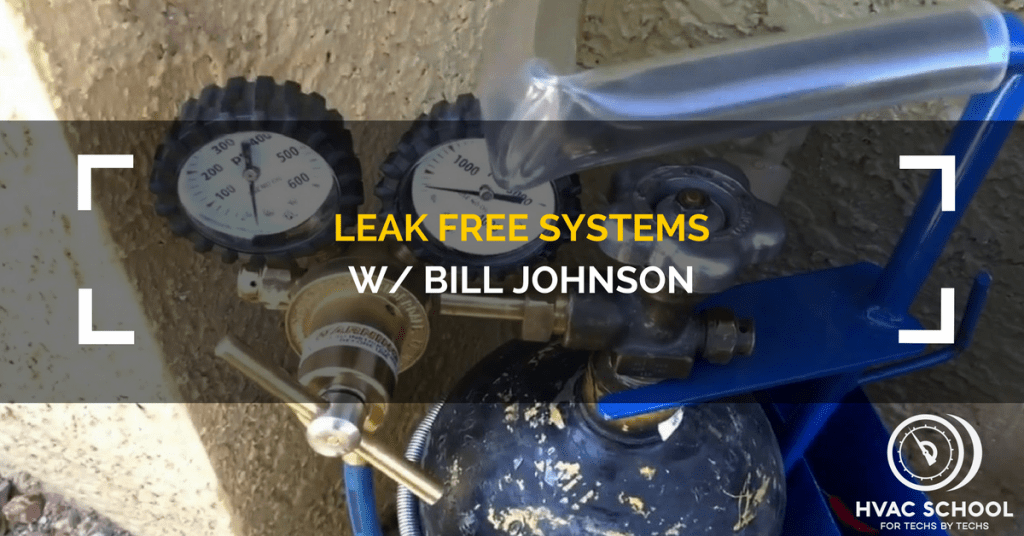
Bill Johnson is one of the great educators and writers of our time in HVAC/R. In this podcast episode, he shares some information about his career and some of his top tips on keeping systems leak-free.
Bill began his work on leak-free solutions by using Glyptal on centrifugal compressors. The Glyptal would harden around leaks and seal them up. Nowadays, this is an ineffective approach to sealing leaks in higher-pressure systems.
Bill got the idea to start manipulating pressures to minimize leaks with a standing pressure test for 24 hours at the highest test pressure recommended by the manufacturer. That is Bill’s best practice, though it is not always feasible. Bill’s rationale is that leaks become much more evident under those testing conditions. (Remember, pressurize the line set. Pressurizing the system can be a bad idea.)
On top of that, Bill recommends pulling a deep vacuum and performing a standing vacuum check according to the manufacturer’s guidelines. Fitting inspections are also critical; fittings may be sealed imperfectly, and they are common leak points. Check fittings with a mirror and a good light to look for imperfections and cracks.
Leaks generally occur in piping, not the equipment itself. Moreover, vibrations and corrosion generally cause leaks.
Begin a leak inspection by leak-checking the gauge ports BEFORE attaching gauges. In general, inspect the entirety of the equipment with your senses before attaching gauges. When leak-testing with soap bubbles, make sure to use one that doesn’t need to be washed with water, as water can lead to corrosion. (We recommend Refrigeration Technologies Big Blu.)
Most of all, don’t leave a job until you find a leak or confirm that the system is leak-free!
Bill also discusses:
- Being an HVAC teacher
- Critical charge leak detection
- Pressurizing with nitrogen
- Misleading leak detection equipment
- Torque wrenches
If you have an iPhone, subscribe to the podcast HERE, and if you have an Android phone, subscribe HERE.
Highlight a short passage, or bring a question about a specific moment into HVAC No Bull Forum.
Discuss this reference → Related forum discussionsAuthor:











Comments
We are a jujitsu dealer and yes they recommend a 500psi pressure test on new install however the tag has a max working pressure of 250. The proper procedure is on new install your pressure test should be 500.
There shouldn’t be a need to ever pressure test the outdoor unit, even on service you front seat the “hold back valves” and pressure test your lines at and head. But let’s go back a step. If you suspect a leak, you should be inspecting the system, doing an electronic leak check and then pulling the charge (weighing out) if your charge doesn’t match the tag you have a leak or have lost it through service. So if your lines and head hold your test you can pressure test the entire system to the max working pressure on the tag and front seat your valves let it sit then open the valves and look for a small drop in pressure (I normally crack them at the 30 min mark) if nothing shows then leave it for 24 hours. Still nothing shows. The last few guys went using low Loss fitting or short hoses and charge that sucker back up.
I use mantooth with low Loss 5/16 and never run in heat when removing “gages” there is almost no loss (whatever vapor is in the tip of the probe)
Report comment
We are a jujitsu dealer and yes they recommend a 500psi pressure test on new install however the tag has a max working pressure of 250. The proper procedure is on new install your pressure test should be 500.
There shouldn’t be a need to ever pressure test the outdoor unit, even on service you front seat the “hold back valves” and pressure test your lines at and head. But let’s go back a step. If you suspect a leak, you should be inspecting the system, doing an electronic leak check and then pulling the charge (weighing out) if your charge doesn’t match the tag you have a leak or have lost it through service. So if your lines and head hold your test you can pressure test the entire system to the max working pressure on the tag and front seat your valves let it sit then open the valves and look for a small drop in pressure (I normally crack them at the 30 min mark) if nothing shows then leave it for 24 hours. Still nothing shows. The last few guys went using low Loss fitting or short hoses and charge that sucker back up.
I use mantooth with low Loss 5/16 and never run in heat when removing “gages” there is almost no loss (whatever vapor is in the tip of the probe)
Report comment
To leave a comment, you need to log in.
Log In