
Superheat and Subcooling Basics
Make & share a podcast clip
Keep the exact passage and a link to the full episode. Choose up to three minutes, with enough context to be fair to the speaker.
Preview uses this episode’s audio. Browser audio export, when supported, takes the length of the selected clip. Nothing plays until you choose Preview.
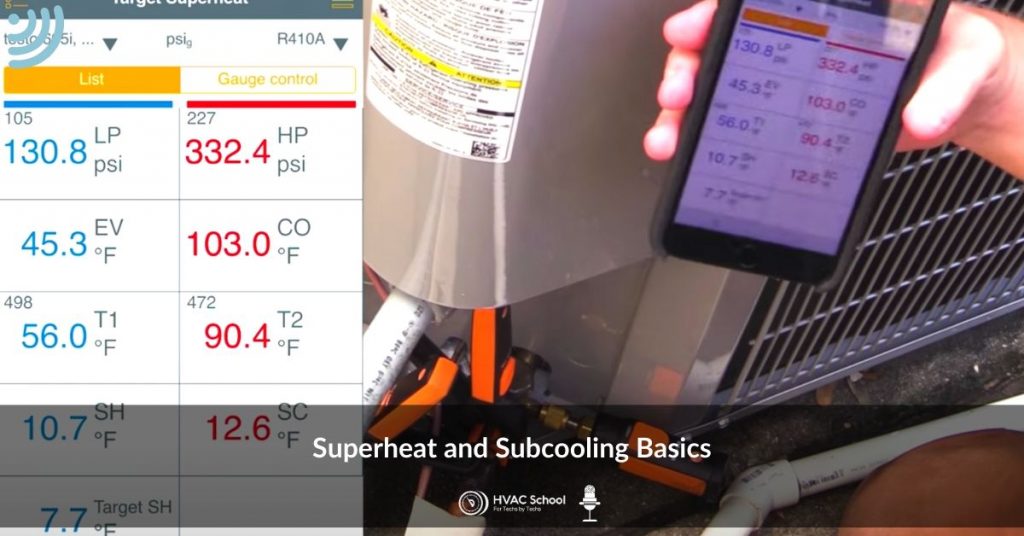
In this podcast episode, we ONCE AGAIN talk about superheat and subcooling. This episode is a recap to help people who struggle with the concept.
You get superheat when you have 100% vapor, and you have subcooling when you have 100% liquid; any liquid-vapor mixtures are in a saturated state.
We usually measure superheat outside at the suction or vapor line. It’s best to take the superheat reading as close to the port as possible. Anything in the saturated state is boiling; you can only get the mixture at the boiling point of a refrigerant. Anything above the boiling point is all vapor, and it’s superheated. Very high superheat indicates that the refrigerant boiled off very early in the evaporator, meaning that the system could be low on charge. On fixed-orifice systems, you charge a system via superheat. Zero superheat indicates that you have liquid in the suction line. When you have liquid in the suction line, you can cause compressor slugging, which leads to failure.
You will usually only measure subcooling at the liquid line, usually right at the outlet of the condenser. When you read a higher level of subcooling, that means the system has more liquid stacked in the condenser. Any refrigerant below the condensing temperature is subcooled. In many heavy commercial/refrigeration equipment, you will have a sight glass instead of taking subcooling readings. Excess subcooling indicates that too much refrigerant has stacked up in the condenser, so you will likely also see an undesirable rise in head pressure.
Bryan and Kaleb also discuss:
- Superman and submarine analogies
- Problems with the pot of water boiling analogy
- What really is steam?
- Sensible vs. latent heat
- Metering devices
- Superheat and subcooling targets vs. measured superheat/subcooling
- Adjusting charge
- Condenser as a desuperheating component
- Evaporative effect on the condenser
Learn more about Refrigeration Technologies HERE.
If you have an iPhone, subscribe to the podcast HERE, and if you have an Android phone, subscribe HERE.
Highlight a short passage, or bring a question about a specific moment into HVAC No Bull Forum.
Discuss this reference → Related forum discussionsAuthor:











Comments
To leave a comment, you need to log in.
Log In