
Traps, Vents & Drains – Short #177
Make & share a podcast clip
Keep the exact passage and a link to the full episode. Choose up to three minutes, with enough context to be fair to the speaker.
Preview uses this episode’s audio. Browser audio export, when supported, takes the length of the selected clip. Nothing plays until you choose Preview.
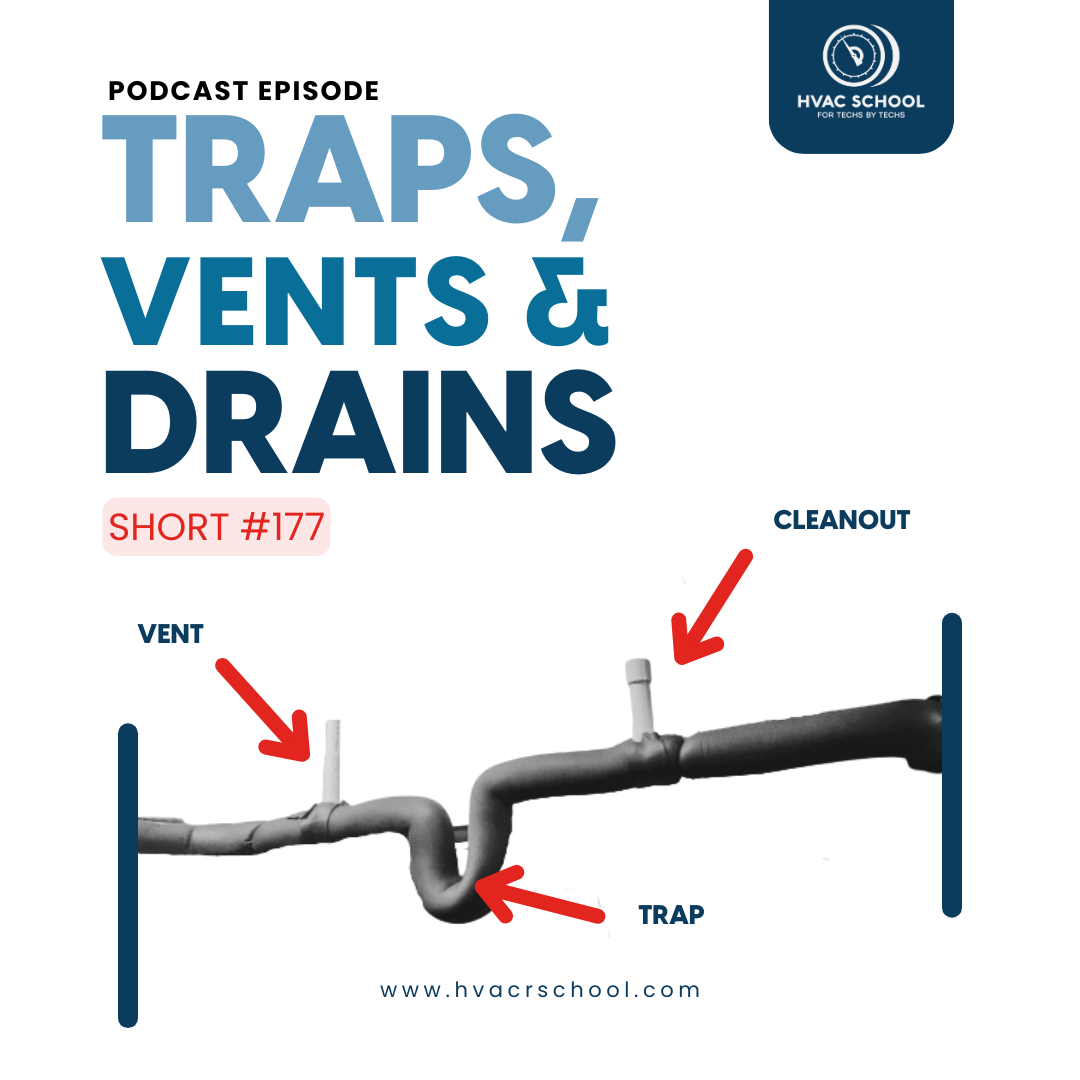
In this short episode, Bryan covers traps, vents, and drains. He explains some common misconceptions and best practices for fabricating drains, especially in residential and light commercial structures in Florida.
Cleanouts and vents are commonly confused with each other, and people often cap vents and leave cleanouts open. However, cleanouts (which must be capped) will always be before the trap, and vents come after the trap. When you have an indoor air handler, furnace, or fan coil, vents must be higher than the drain pan to allow the float switch to trip when the drain backs up. (Rooftop units have shorter vents.) Vents should stay open. We use static pressure to determine the trap depth, and the trap outlet must be shorter than the inlet.
The best practice for drain pitch is to have 1/4″ of fall for every foot of horizontal run, and we must avoid making double traps where air can get trapped between them. Vents prevent air bubbles from forming in drains with multiple traps. Double traps often form when drains are not supported properly and sag over time; using proper support in your installations is the best way to prevent that from happening.
In Florida, we often use only one trap and still get drainage. A typical installation has a cleanout, a trap, and a vent higher than the drain pan, all on a downward pitch. However, we also get severe condensation on our drains, and we must insulate the horizontal PVC runs to prevent sweating. In multi-family applications with common drains, each individual needs a trap and then a vent before the main drain.
Learn more about the 5th Annual HVACR Training Symposium at https://hvacrschool.com/Symposium24.
If you have an iPhone, subscribe to the podcast HERE, and if you have an Android phone, subscribe HERE.
Check out our handy calculators HERE.
Highlight a short passage, or bring a question about a specific moment into HVAC No Bull Forum.
Discuss this reference → Related forum discussionsAuthor:











Comments
To leave a comment, you need to log in.
Log In