
Fundamentals & Science

We may not realize it, but heat transfer inside our homes keeps the HVAC industry afloat. Without air conditioning in the summer, our buildings would remain stuffy, miserable places. That’s because heat can come from the outdoors, indoor objects (such as cooking appliances), and our bodies. So, this article will cover the three main types […]
Read more

When someone says there is no such thing as “cold,” only the absence of heat, you can point out that while cold is the absence of heat… absolute zero is the definition of COLD. The third law of thermodynamics addresses the absence of heat and what that means for entropy. It implies that absolute zero […]
Read more

The second law of thermodynamics puts the first law into context and establishes entropy as a concept. We can simply define entropy as a state of disorder that can only increase or remain the same in natural processes. Processes in which entropy remains the same are reversible, but ones that result in an entropy […]
Read more

The first law of thermodynamics is an extension of the law of energy conservation. The latter states that energy can be neither created nor destroyed but converts from one form to another. Thermodynamics is the study of heat’s relationship with mechanical work, and it establishes heat as a form of energy that can be neither […]
Read more

Heat is a byproduct of mechanical energy that presents itself as a temperature increase. French physicist James Prescott Joule aimed to equate heat to mechanical energy. Early experiments used paddle-like structures to stir water within a container and raise its temperature. The paddles would move and agitate the water whenever a mass on a pulley […]
Read more

Pioneers of refrigeration The modern world is impossible to imagine without refrigeration. The Internet, food transportation, medical imaging, and vaccine research all rely on refrigeration to function. Even the sprawl of cities across the American south in the 1950s was inconceivable without refrigeration and air conditioning. So, if you like vacationing in Vegas or taking […]
Read more
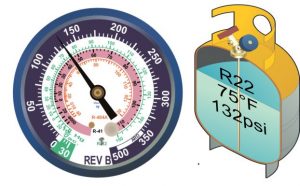
In HVAC systems, liquid and vapor will exist at the same time and place. We call that condition saturation, or we say that the refrigerant is “at saturation.” Phase changes occur in the evaporator and condenser, so these are spots where liquid and vapor coexist while the system is running. Saturated conditions occur whenever liquid […]
Read more
As HVAC/R Technicians, we use tools and instruments to take measurements every day. In fact, 90% of our job could not be done efficiently without some kind of measurement. “How do we measure?” “With what instruments?” “How accurate are these measurements?” These are all questions a thoughtful technician should ask before spending money on a […]
Read more
Most of the laws we refer to in air conditioning and refrigeration are pretty obvious and practical. Dalton’s law of partial pressures is no exception. John Dalton observed that the air pressure was equal to the added pressures of each gas that make up air. That means that the pressure and density of air can […]
Read more