
Refrigeration Circuit, Charging & Diagnosis
The most common—and often most frustrating—questions that trainers and senior techs get asked sound something like this: “What should my ______ be?” or “My _____ is at ______. Does that sound right?” Usually, when the conversation is over, both the senior and junior techs walk away feeling frustrated because the junior tech just wanted […]
Read more

Delta T is the difference in temperature between two points of the same medium. It is commonly used by scientists and engineers to analyze the amount of heat transfer in a system. In general HVAC terms, it is the measurable change in temperature between an air input and air output. However, it could also be […]
Read more

You may have noticed that 3/8″ liquid lines are generally the norm in equipment 5 tons and under. We went to a job where the system had a 1/2″ liquid line, and it got me thinking about liquid line sizing and the ramifications of going larger or smaller on the liquid line. Liquid Line Basics […]
Read more

In residential, most techs and installers size the suction (vapor) and liquid lines to the stubs on the equipment. In larger built-up systems, sizing the suction and liquid lines is rarely the responsibility of the technician. But what happens if we show up to a job where the lines cannot be (reasonably) replaced because the […]
Read more
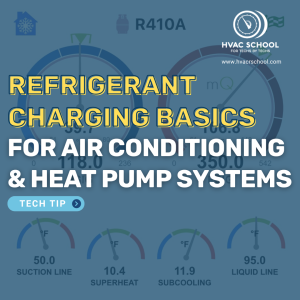
Before I start on this one… At HVAC School, we focus on a wide range of topics. Many of them are very basic. My experience as a trainer for over 20 years has taught me that no matter what I assume others SHOULD know, it doesn’t change the fact that they often do not. This […]
Read more

In this article, we’ll discuss solving superheat using this diagnostic sheet to help us better understand how it is calculated and from where it is derived. I want to thank Ty Branaman for helping me develop these sheets that will hopefully aid in a better understanding of some of the basic HVAC measurements that both […]
Read more
Let’s start with the basics. Water freezes at 32° Fahrenheit (0° Celsius) at sea level and at atmospheric pressure. When any surface is below that temperature, and the air around it contains moisture, ice/frost will form. You can see how water freezes at the molecular level in the GIF below: In some situations, ice […]
Read more
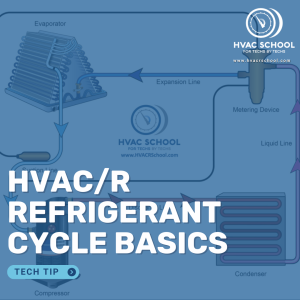
This is a basic overview of the HVAC/R refrigerant cycle (and refrigeration circuit) and how it works. It isn’t a COMPLETE description by any means, but it is designed to assist a new technician or HVAC/R apprentice in understanding the fundamentals. First, let’s address some areas of possible confusion: 1. The word “condenser” can mean […]
Read more
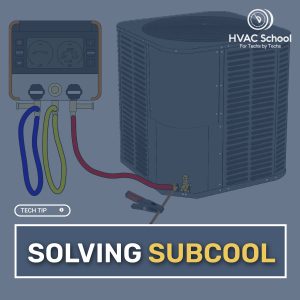
I teamed up with Ty Branaman to design an intuitive way for techs to solve some of the “what should it be?” questions in the HVAC field. The topic for this sheet is subcooling (or subcool). Subcooling is a measurement of the temperature DECREASE of a liquid below its saturation (mixed liquid/vapor) temperature at a […]
Read more