
How to Size Dehums w/ Tim De Stasio
Make & share a podcast clip
Keep the exact passage and a link to the full episode. Choose up to three minutes, with enough context to be fair to the speaker.
Preview uses this episode’s audio. Browser audio export, when supported, takes the length of the selected clip. Nothing plays until you choose Preview.
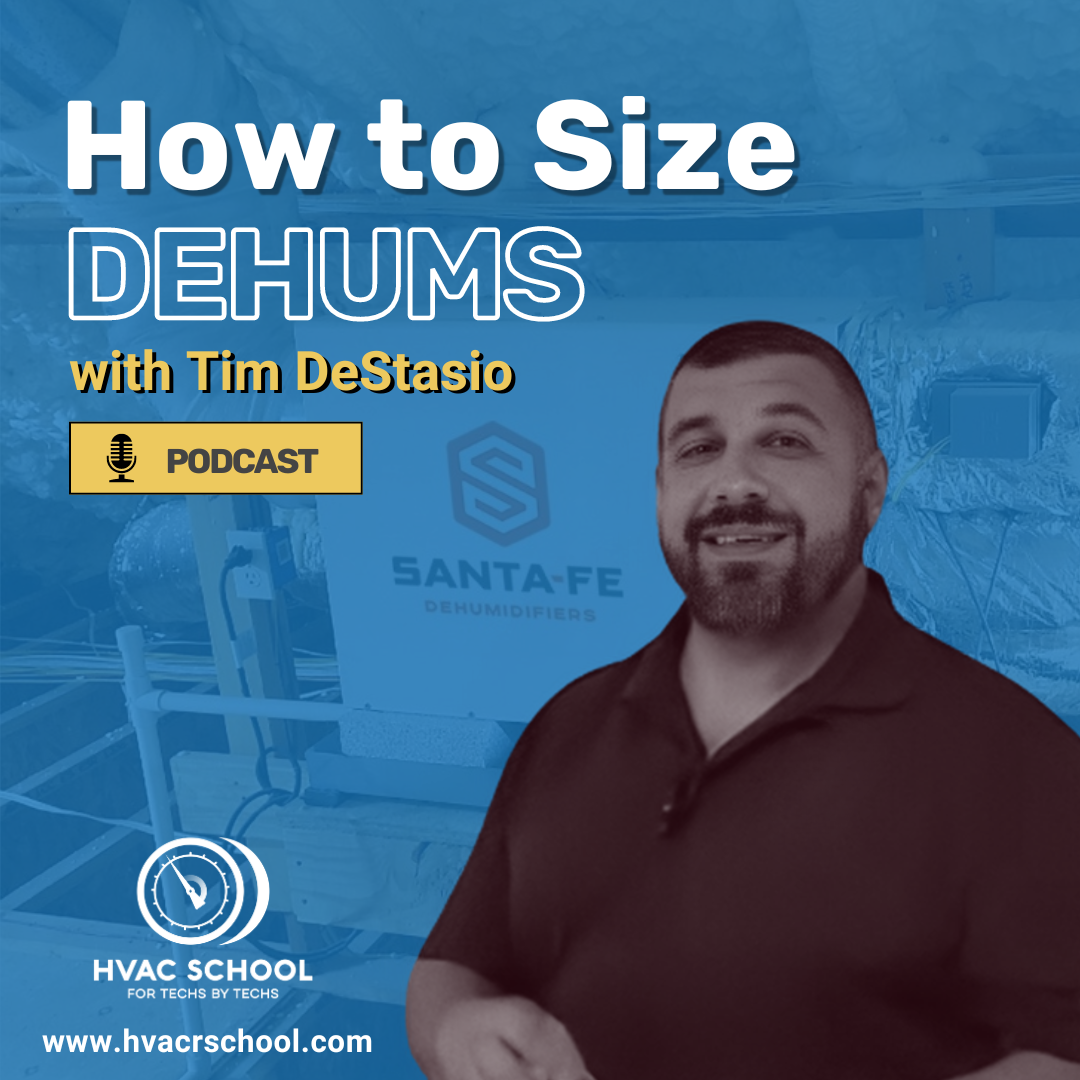
In this episode of the HVAC School podcast, host Bryan Orr interviews Tim De Stasio, an experienced HVAC practitioner and consultant. Tim shares his journey in the HVAC industry, from his early days in vocational school to running his own contracting business for 12 years. He now focuses on consulting, design, and contractor training, allowing him to pursue his passion for HVAC while sharing his knowledge with others.
The conversation delves deep into the world of dehumidifiers, exploring their importance in modern HVAC systems, especially in humid climates. Tim emphasizes the need for supplementary dehumidification in many homes, particularly during part-load conditions when air conditioning systems may not effectively control humidity. He explains the process of selecting and sizing dehumidifiers, stressing the importance of considering factors such as peak latent load conditions, actual dehumidifier performance under real-world conditions, and static pressure effects on output capacity.
The discussion also covers the critical role of proper envelope sealing and ductwork in managing humidity. Tim advocates for addressing these issues before installing a dehumidifier, highlighting the importance of blower door testing and fixing any leaks. The podcast concludes with insights on dehumidifier control strategies, the limitations of ERVs in humidity control, and the potential risks associated with uncontrolled outdoor air introduction into HVAC systems.
Key topics covered in the podcast:
Have a question that you want us to answer on the podcast? Submit your questions at https://www.speakpipe.com/hvacschool.
Learn more about the 6th Annual HVACR Training Symposium at https://hvacrschool.com/Symposium.
Subscribe to our podcast on your iPhone or Android.
Subscribe to our YouTube channel.
Check out our handy calculators here or on the HVAC School Mobile App for Apple and Android.
Highlight a short passage, or bring a question about a specific moment into HVAC No Bull Forum.
Discuss this reference → Related forum discussionsAuthor:












Comments
To leave a comment, you need to log in.
Log In