
Run Capacitor Facts You May Not Know (Podcast)
Make & share a podcast clip
Keep the exact passage and a link to the full episode. Choose up to three minutes, with enough context to be fair to the speaker.
Preview uses this episode’s audio. Browser audio export, when supported, takes the length of the selected clip. Nothing plays until you choose Preview.
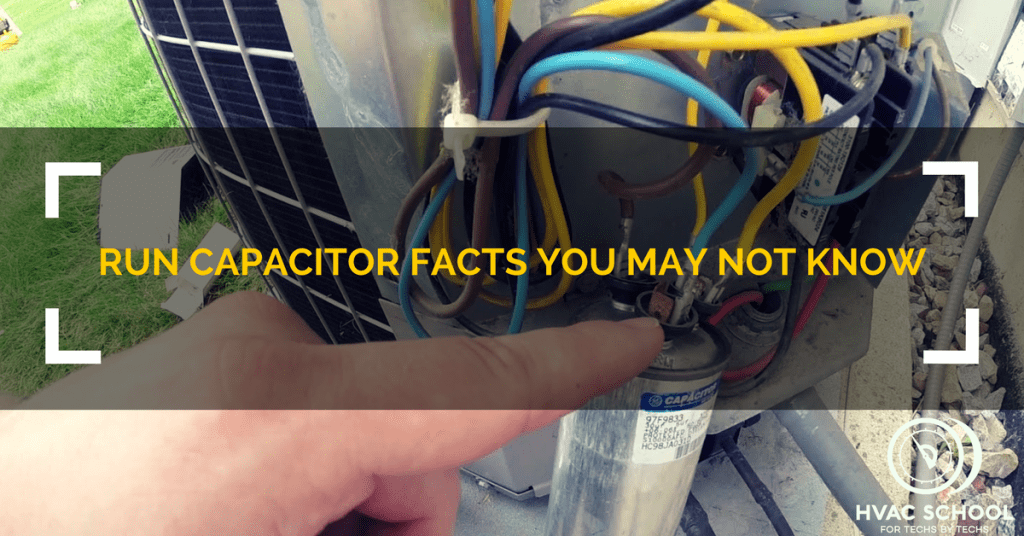
In this episode, we cover some common misconceptions about run capacitors, some easy ways to test them, and some tips on working with them.
A run capacitor is a power storage device; it contains oil to dissipate heat and some thin metal plates wrapped in a spiral. Capacitors also contain plastic insulation between the metal plates to keep the power separate; electrons should NOT cross the insulation, and there should be a charge difference between the plates. Current also does NOT flow through the capacitor; capacitors merely store and discharge power.
Capacitors also do NOT boost voltage. You may notice higher voltage between terminals, but the capacitor is not involved in that voltage boost. You see that voltage increase because of the inductive motor’s back EMF. Back EMF only occurs on systems with a running motor.
On a single-phase PSC application, the run winding is the primary, and the start winding is the secondary. A run capacitor that is too large will draw more current on the start winding. You may see a slight drop in overall amperage on the common wire, but large capacitors increase the current on the secondary winding. The start winding is not designed to carry excess current.
Connecting capacitors in series REDUCES capacitance. Therefore, most of the time, we connect capacitors in parallel. Many electrical circuits nowadays are connected in parallel (compare to Christmas lights, which are connected in series).
Bryan also covers:
- Capacitor basics (terminals, microfarads, etc.)
- “Common” confusion
- Capacitance and current relationship
- Start capacitors and potential relays
- Hard start kits
- PTCR products
- Series vs. parallel capacitors
- Testing capacitors (in the circuit, under load, with a capacitor tester, etc.)
- Calculating capacitance and evaluating capacitance ratings
If you have an iPhone, subscribe to the podcast HERE, and if you have an Android phone, subscribe HERE.
Highlight a short passage, or bring a question about a specific moment into HVAC No Bull Forum.
Discuss this reference → Related forum discussionsAuthor:











Comments
Why is it a bad thing for electricity to plastic Insulator and suppose to stay in its terminal?
Report comment
Why is it a bad thing for electricity to plastic Insulator and suppose to stay in its terminal?
Report comment
The difference between a capacitor and a duel capacitor?
Report comment
The difference between a capacitor and a duel capacitor?
Report comment
Did not know that you can charge a 9V battery to a run capacitor and it actually takes the 9V power to show a reading of 9V
Report comment
Did not know that you can charge a 9V battery to a run capacitor and it actually takes the 9V power to show a reading of 9V
Report comment
Good assessment Mr. Billeci
Report comment
Good assessment Mr. Billeci
Report comment
To leave a comment, you need to log in.
Log In