
Short #75 – Stop Duct & Unit Sweating
Make & share a podcast clip
Keep the exact passage and a link to the full episode. Choose up to three minutes, with enough context to be fair to the speaker.
Preview uses this episode’s audio. Browser audio export, when supported, takes the length of the selected clip. Nothing plays until you choose Preview.
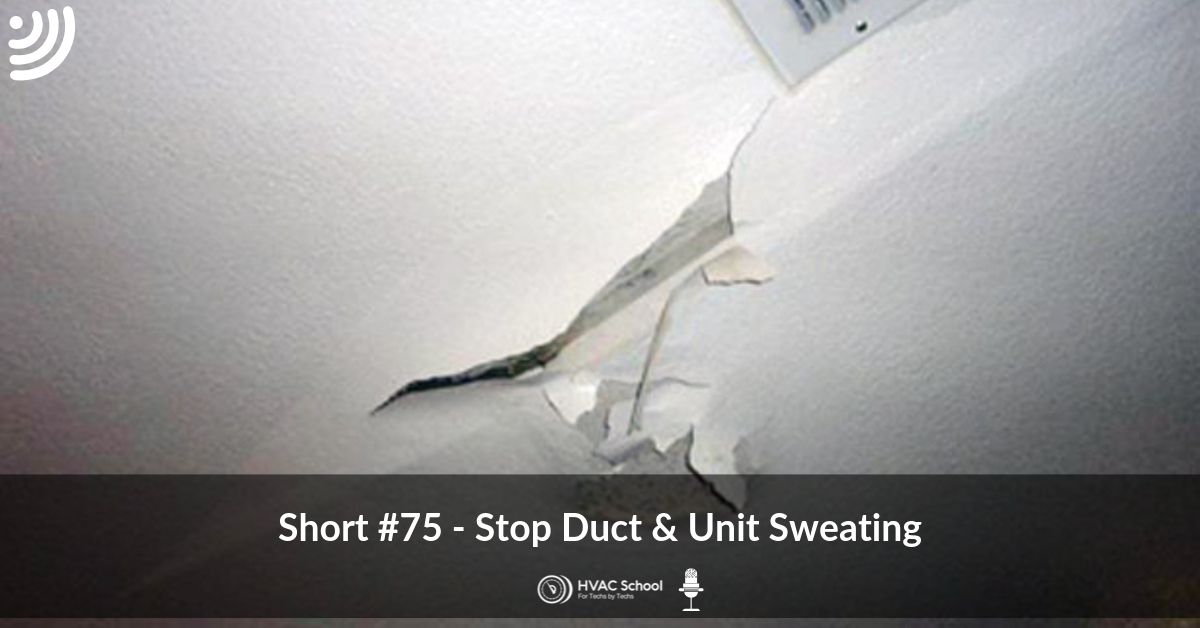
Duct and air handler (unit) sweating is a common issue in humid climates. Bryan talks about what causes it and what to do about it.
Many people try to keep their ducts and equipment either very cool or very warm to prevent sweating. Despite the good intentions, neither of those methods is great for sweat prevention. If a ceiling grille is sweating, people try to insulate the top of the boot to stop the sweating. The real reason why the grille continues to sweat is that those sweating areas have hit the dew point.
If anything reaches the dew point or lower, you WILL see condensation. Another potential cause is that air with a higher dew point is going into the lower-dew-point space. In the latter case, sealing the ducts and cracks near the boot should help that higher-dew-point air from infiltrating; insulation does very little to address leakage, so air sealing is the real solution. Attics often have air with a higher dew point than the conditioned space.
Equipment sizing is also important. Oversized equipment leads to shorter run times, meaning that the evaporator coil can’t get cold enough to remove moisture. When you have a low latent capacity, you won’t have proper moisture removal in the home.
We will almost surely encounter sweating when we have air handlers and ducts in unconditioned spaces. To address duct and unit sweating, some technicians increase the air velocity to prevent ducts from sweating, as the higher temperature should prevent the duct jacket from being below the dew point. However, as with oversized equipment, excessive airflow will negatively impact the latent capacity. So, you will have less moisture removal. The best solution is to decrease the attic dew point or increase duct insulation. Reheat solutions are also worth considering on some systems.
Learn more about Refrigeration Technologies HERE.
If you have an iPhone, subscribe to the podcast HERE, and if you have an Android phone, subscribe HERE.
Highlight a short passage, or bring a question about a specific moment into HVAC No Bull Forum.
Discuss this reference → Related forum discussionsAuthor:











Comments
To leave a comment, you need to log in.
Log In