
Short #38 – Low Ambient Cooling (Podcast)
Make & share a podcast clip
Keep the exact passage and a link to the full episode. Choose up to three minutes, with enough context to be fair to the speaker.
Preview uses this episode’s audio. Browser audio export, when supported, takes the length of the selected clip. Nothing plays until you choose Preview.
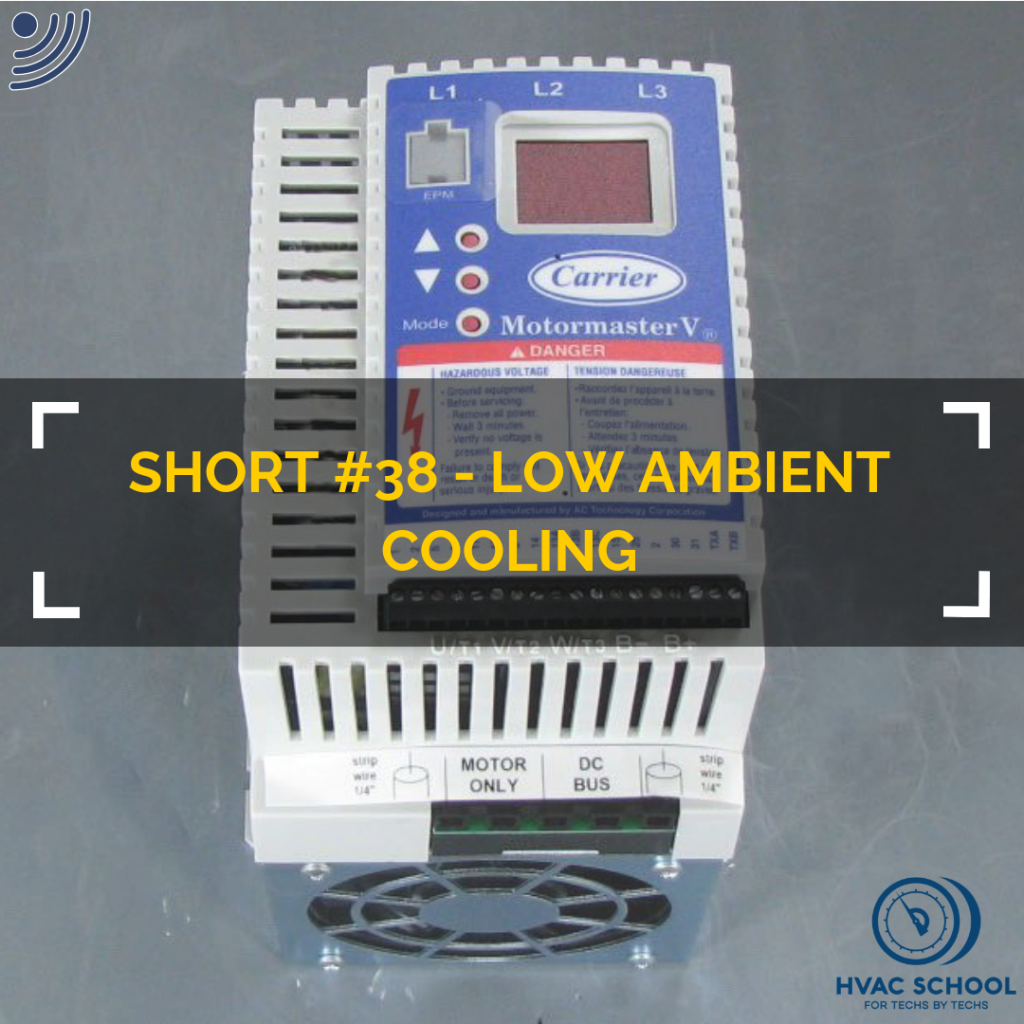
This short podcast episode covers the why and the how of low ambient cooling and refrigeration.
Low ambient cooling refers to operating A/C equipment during low outdoor ambient conditions. Typically, the cap of operation is around 55 or 60 degrees. However, some commercial facilities need cooling when the outdoor temperature is cold. For example, those facilities may have to cool electronics or large volumes of people. In buildings that don’t have economizers, running the A/C in cold ambient conditions may be the only option. The same applies to restaurants, which always need to run freezers and coolers.
When the outdoor ambient temperature drops, the condenser rejects more heat to the outdoors. Head pressure drops, and there may be an insufficient pressure drop across the metering device. We also can’t run A/C evaporator coils below 32 degrees, as there is no defrost mechanism in straight-cool A/C systems. So, the strategy to get around those issues is to focus on raising the head pressure by modulating the condenser fan motor.
A fan cycling control can turn the condenser fan on and off based on pressure. So, we try to maintain a fixed pressure in the condenser by allowing that control to shut off the fan when the pressure drops too much. However, fan cycling can be a bit jarring for the system.
Motor master controls help modulate the motor by decreasing voltage to the motor. However, that fluctuating voltage isn’t necessarily good for the motor. In those cases, you must have a ball-bearing motor. Unlike the motor master, a refrigeration headmaster is a valve that allows discharge gas to enter the drop leg.
Variable frequency drives can work with a three-phase motor to vary the speed of the motor. When the speed can vary easily, you can manipulate the pressure.
Learn more about Refrigeration Technologies HERE.
Highlight a short passage, or bring a question about a specific moment into HVAC No Bull Forum.
Discuss this reference → Related forum discussionsAuthor:











Comments
To leave a comment, you need to log in.
Log In