
What Is DX? – Short #185
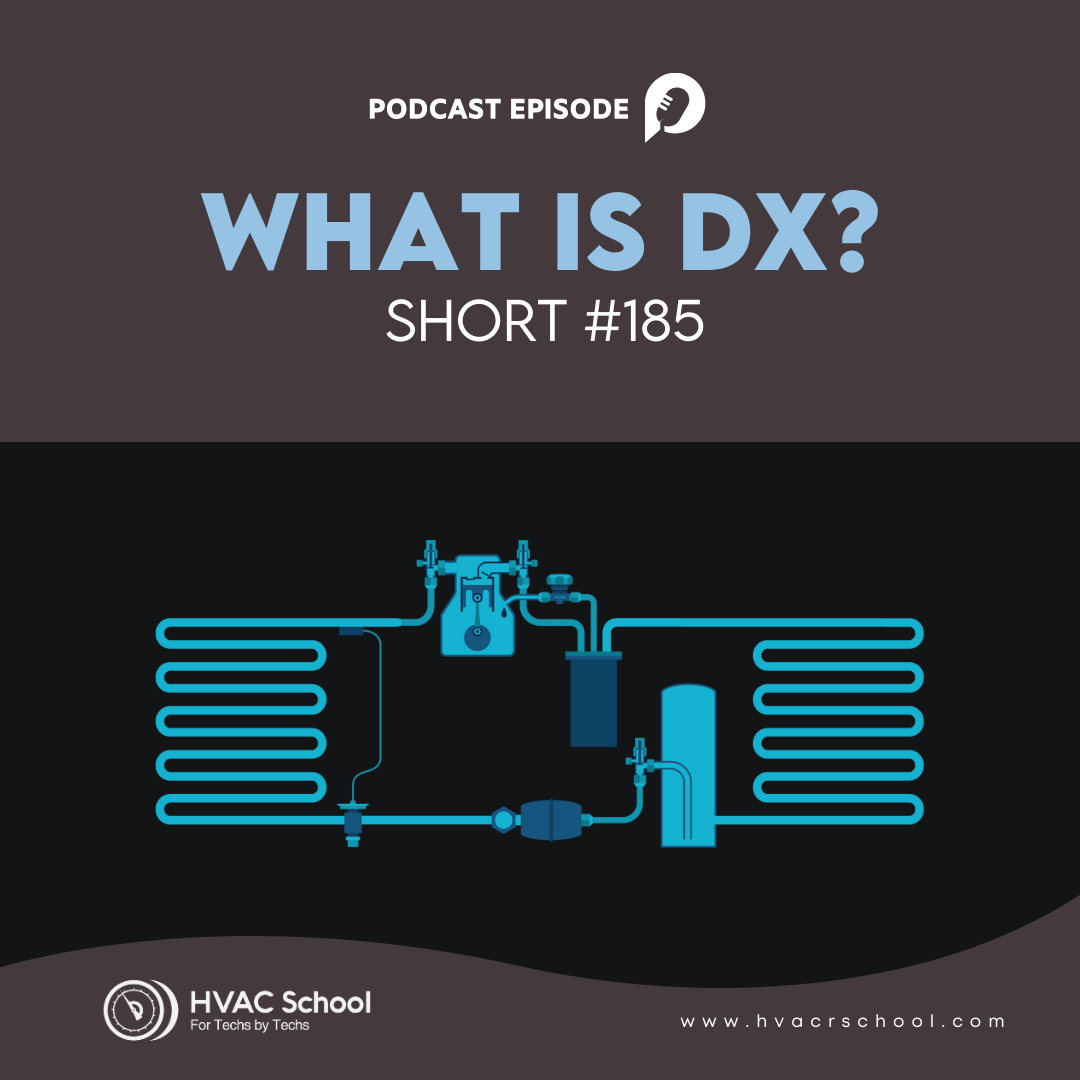
In this short podcast episode, Bryan tackles the following question: What is DX?
In short, DX stands for “direct expansion,” which means that you cool the end product via the refrigeration cycle. We blow air over an evaporator coil, which allows the refrigerant to take up heat from the air and directly expand. Chillers, boilers, and chilled water systems are NOT direct expansion systems; they use a secondary fluid like water or glycol to move the heat throughout the structure, not an evaporator to take up heat directly. They also have heat exchangers to move heat from the refrigerant to the secondary fluid.
DX systems tend to be smaller, and chillers and boilers tend to be larger. Chillers are advantageous in cases where we’re working with toxic or flammable refrigerants or large refrigerant charges; we can keep the refrigerant charge away from the structure and space or product(s) needing to be heated or cooled.
Learn more about the 5th Annual HVACR Training Symposium at https://hvacrschool.com/Symposium24.
If you have an iPhone, subscribe to the podcast HERE, and if you have an Android phone, subscribe HERE.”
Subscribe to our YouTube channel at https://www.youtube.com/@HVACS.
Check out our handy calculators HERE or on the HVAC School Mobile App (Google Play Store or App Store).
Author:










Comments
To leave a comment, you need to log in.
Log In