
Get Tech Tips
Subscribe to get free tech tips.
What’s the Scoop on PM10 and PM2.5 Particles?

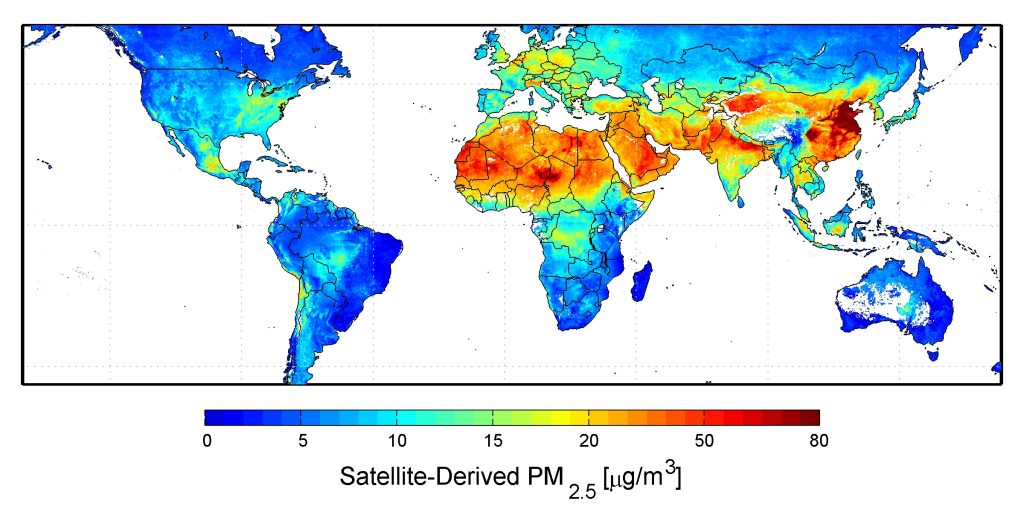
MATLAB Handle Graphics
It was December 5th, 1952, only seven years after the end of WWII, in London, England, when the “Great Smog” settled across the city.
The “great smog” was the result of a meteorological anomaly combined with unchecked industrial pollution. Still, even once it settled on the city, bringing business to a screeching halt, everyone thought it would pass quickly.
It didn't.
Four days later, the smog finally lifted, and the death toll rose to 4,000. Many modern statisticians place the number of deaths caused by the Great Smog closer to 10,000. While the world knew the dangers of particles in the air before, we've developed a keener understanding of what pollution in our air can do to us since that time.
Nowadays, you will hear the terms PM2.5 and PM10 thrown around, and you may never stop to think about what they mean.
PM10 (Particulate Matter <10 Microns)
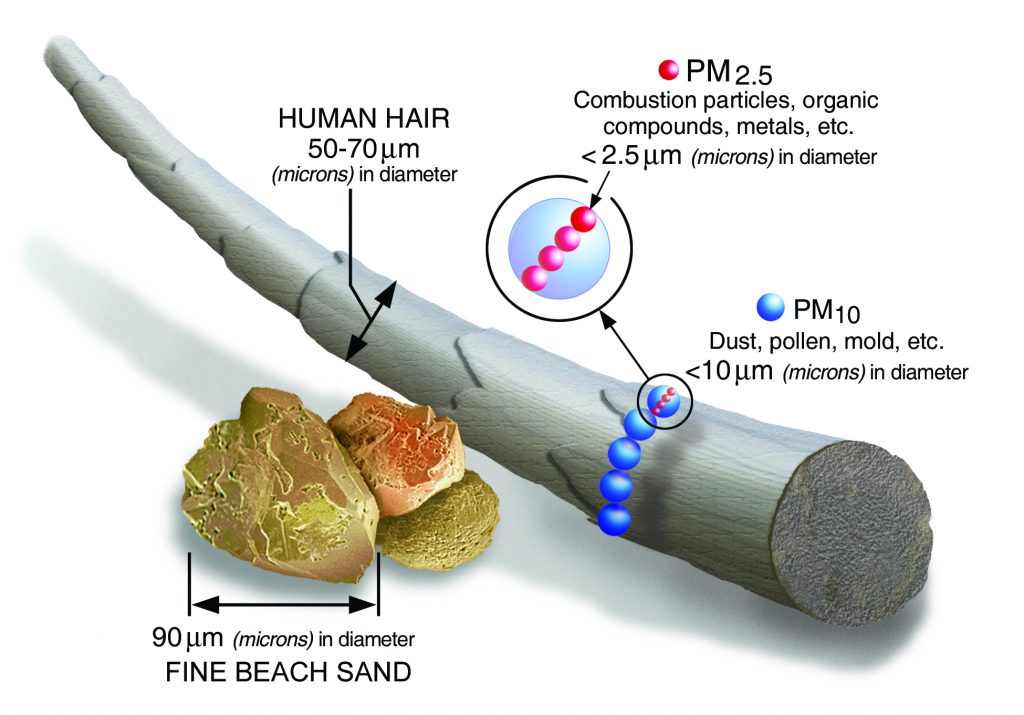
This term refers to particles with a diameter smaller than 10 microns. For some perspective, a human hair is about 50-70 microns across, and a micron—often called a micrometer—is one-millionth of a meter. While a PM10 particle is tiny, it's still pretty coarse by particle standards; PM10 particles typically consist of things like dust, dander, and pollen. These are allergens and can get lodged in our upper respiratory tracts, but they are generally not the most dangerous particles because they can't get much farther than that.
PM2.5 (Particulate Matter <2.5 Microns)
These are particles less than 2.5 microns in diameter and often consist of things like ammonia, carbon, lead, and mold. Both chemically and biologically toxic particles generally fall into this smaller 2.5 microns or less size range.

The graph below shows the results of the % of PM2.5-sized particles that passed through various tested filters. The study showed that typical MERV 6-8 filters failed to do a good job of capturing a large percentage of these particles. However, it also showed that the efficiency of the filters varied from brand to brand, as shown in MERV12(#1) and MERV12 (#2).
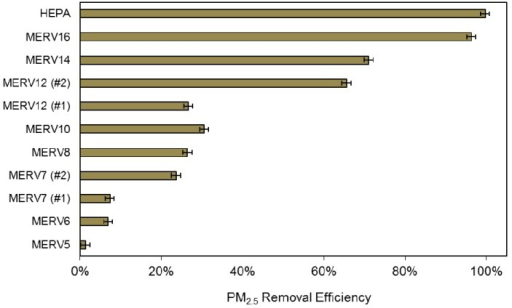
Zhao D, Azimi P, Stephens B – Int J Environ Res Public Health (2015)
Indoor/Outdoor
There is a clear link between pollution outdoors and pollution indoors. It stands to reason that if the air outside is dirty, then the air inside will also tend to have more particles in it, which means that an outdoor PM2.5 to indoor PM2.5 comparison can be a better way to compare one space to another.
The EPA has tested and found that indoor air can be significantly more polluted with VOCs (volatile organic compounds), often 2 to 5 times more than outdoors.
But hang on…
VOCs are gaseous and are not the same as PM2.5 particles. They shouldn't be confused with them.
From a technician's perspective, you need to be aware that typical air filtration will only effectively deal with the PM10 and larger particles. For PM2.5, you will need high MERV or HEPA filtration or other types of active filtration.
For VOCs, you can ventilate better, use carbon filtration, or encourage the customer to store paints and cleaning products outside the conditioned space or in a sealed container. We have a tech tip all about VOCs and VOC control if you want to learn more.
Best Practices
Testing for what exactly is in the air is a trickier business than I initially thought. It gets even more challenging as the particles get smaller. Even today, it is virtually impossible to “test” for specific live fungi, bacteria, and VOCs in the field. You can count particles and get in the ballpark of the issue, but nailing down all the details can be challenging without sending samples off to a lab.
That said, we do have access to some interesting and helpful IAQ technologies. If you want to learn more about IAQ sensors and instruments, check out a deep-dive podcast about IAQ with Aeroqual HERE. We also had interesting discussions with the folks at HAVEN IAQ, which you can listen to HERE.
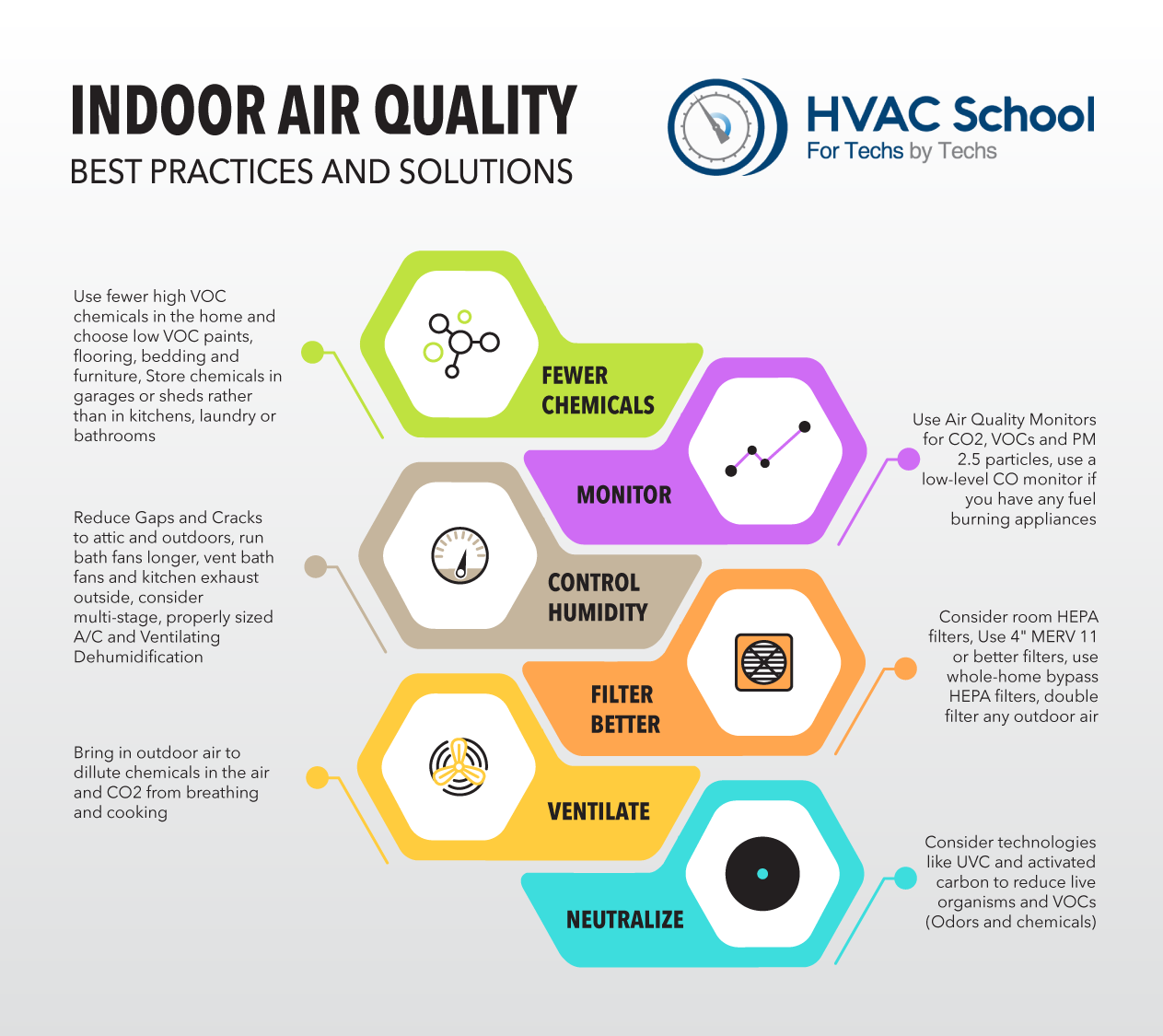
In addition to a good particle counter or IAQ monitor, we are best off following some good, solid practices to help our customers:
- Encourage your customers to use good-quality filters; when possible, install MERV12 or better.
- Make sure the unit isn't pulling air around the filter or through the panels.
- Ensure that ducts are well-sealed so that the return isn't drawing in air from an unconditioned space (like an attic).
- Keep the indoor relative humidity between 30-55%.
- Address any localized moisture issues that may result in organic growth.
- Add in well-filtered ventilation air for VOC reduction.
- Make sure the evaporator, blower wheel, and drain pan are kept clean.
- Research quality IAQ products; recommend them based on your customers' needs and desires.
- Bring in fewer VOCs by using indoor products that are more natural and have had more time to off-gas, or store products away from the conditioned space or in a sealed container.
The most dangerous things in the air are chemicals, tiny particles, and live organisms caused by moisture issues. Knowing this will make you a better tech and more capable of advising your customers well.
—Bryan
P.S. – Neil Comparetto wrote an article about particulate matter, ventilation, and IAQ monitoring that might interest you. You can check it out HERE. We also have a 3D animation about IAQ basics that includes information about PM2.5, PM10, VOCs, and other IAQ concerns.
 Related Tech Tips










Comments
To leave a comment, you need to log in.
Log In