
Motors, Capacitors & Starting Components


Fundamentally, three-phase, alternating current (AC) motors are about as simple as a motor gets. The power company produces three phases by spinning magnets. Then, on the other end, we produce electromagnets that spin the motor according to the same 60 cycles per second frequency (60hz). All three phases are 120 degrees out of phase from […]
Read more

Our HVAC equipment can’t run without the contactor coil, but contactors can develop problems with age and during high-voltage electrical events. Contact pitting is unmistakable, and it’s unfortunately all too common in areas where bugs can get into the coil and fry on the contacts. Factor in problems with the utility, such as brownouts and […]
Read more

In a previous article, I talked about wiring permanent split capacitor (PSC) condenser fan motors. While researching the topic, I realized that there isn’t as much information available on condenser motors as there is on their counterpart—the indoor blower motor. I had never really given it much thought, as I assumed that the condenser motor […]
Read more

First, let’s cover the basics. X13 is a brand name for the Regal Beloit/Genteq brand of constant torque motors; there are other manufacturers that make them, but the term “X13” has become pretty much synonymous with the fractional horsepower HVAC constant torque motor. Also, this article specifically discusses common residential/light commercial motors. There are other […]
Read more
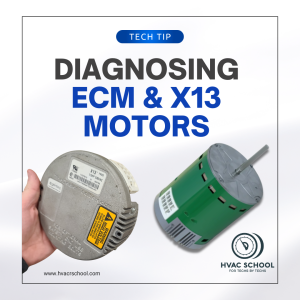
First, let’s give proper credit. Most of the best practices and tools for diagnosing ECM and X13 motors come from Regal/Genteq and their site, thedealertoolbox.com, and their app, The Dealer Toolbelt (available on the App Store and Google Play). Your best bet is to follow the practices shown there and use their TECInspect diagnostic tool […]
Read more

❶ Understand What a Run Capacitor Does The run capacitor provides continuous phase-shifted current to the motor start winding, allowing the motor to run: With the design efficiency In the right direction With the appropriate torque With near “unity” power factor (power factor near 1.0) If the run capacitor is failed, the motor often won’t […]
Read more

I have spent most of my career being afraid of hard start kits; I heard too many horror stories of start caps exploding and sales technicians telling every customer they need one. It dawned on me recently that it may be time for me to take a more mature look at start capacitors, potential relays, […]
Read more

Go to your truck, pick up a contactor, and look at it closely. You may find some interesting ratings you never noticed—things like terminal ambient temperature ratings and torque specs. One reading you may overlook is the RES AMPACITY of the contactor or relay. The RES rating is the RESISTIVE LOAD AMPACITY (amperage capacity) or rating. […]
Read more