
Refrigeration Circuit, Charging & Diagnosis

The suction line accumulator is designed to keep liquid refrigerant from entering the compressor while still allowing for oil return. The trouble is that if the oil return port/screen clogs, the accumulator can fill with oil and actually cause the compressor to fail. In addition to that, it can hold contaminated oil in a burnout. […]
Read more

Suction pressure, head pressure, subcooling, superheat, delta T. Taking all five of these calculations into account on every service call is critical. Even if you must do further diagnostic tests to pinpoint the problem, these five factors are the groundwork before more effective diagnostics can be done. I would also add static pressure as an […]
Read more

Every year when outdoor temperatures rise, there is a rash of news stories and articles about air conditioning. We had an early heatwave this year, and many people have come out and referred to the idea of a rule of thumb of what temperature you can achieve indoors based on the outdoor temperature; most commonly […]
Read more
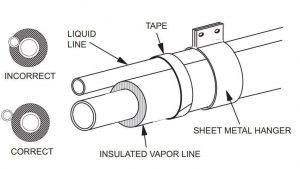
The primary role of setting an appropriate level of subcooling is to ensure that we deliver a full line of liquid refrigerant to the metering device. We want to do this at: A pressure differential required by the metering device At a temperature and pressure no higher than required for maximum capacity and efficiency But […]
Read more

What should the delta T (ΔT) be? What do you mean!? 20 degrees, of course! We are referring to the air temperature drop across an air handling unit or evaporator coil in cooling mode. Actually, depending on who you ask, the answer will range between 18-22 degrees Fahrenheit. Heck, I’ve heard some insist that the […]
Read more

This is an internal guide we use at Kalos, and it works for our climate and the type of HVAC equipment we work on. Consult with your company leadership before implementing this or any process. Keep in mind that some of these guidelines are “made up” by me and are only useful in the absence […]
Read more
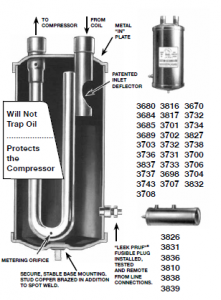
Suction Accumulators A suction accumulator is used to prevent liquid refrigerant floodback to the compressor. A compressor is designed to move vapor refrigerant, NOT liquid, and the accumulator can really help us win that battle. Accumulators are commonly used on heat pumps, transportation refrigeration systems, low-temp supermarket systems, and any place where liquid refrigerant flooding […]
Read more

In commercial HVAC, you will find several different types of multi-stage evaporator coils: intertwined (shown above), horizontal face split (one coil on top of another), and vertical (side by side). When staging a horizontal evaporator, pay attention to ensure that stage #1 is on the bottom and stage #2 is on the top. If stage […]
Read more

This tip was a COMMENT on the sensible heat ratio tip left by Jim Bergmann. As usual, Jim makes a great point; once you get the “sensible” capacity for a piece of equipment at a set of conditions, you can easily calculate a true target delta T. Another interesting thing you can do is use […]
Read more