
BACK

TXV, Airflow & the Refrigeration Cycle Fundamentals

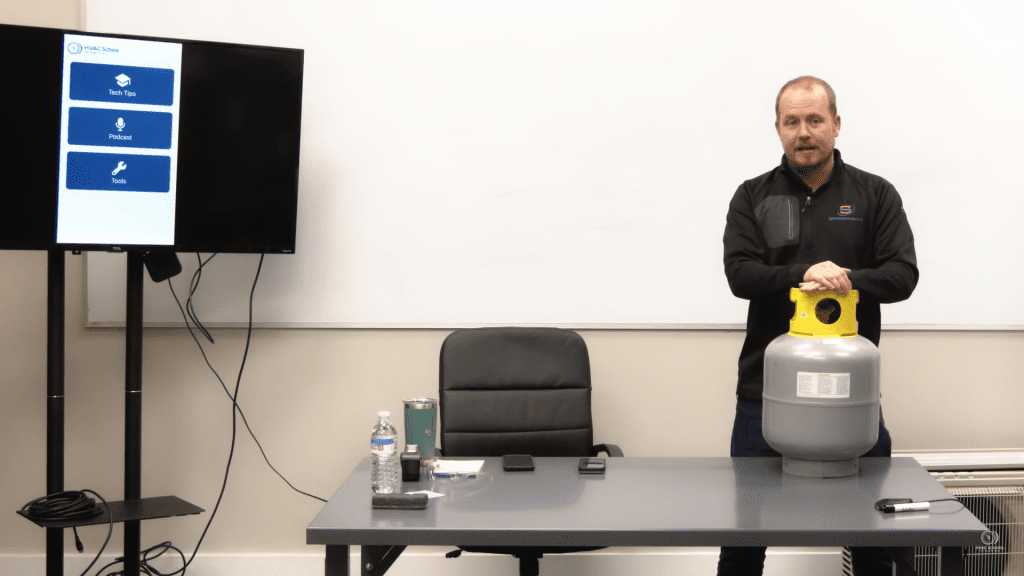
Ty Branaman takes a classroom full of techs back to basics, walking through a full refrigeration cycle review before diving into how a TXV actually earns its keep. This one covers the fundamentals every tech should have locked in — from what's happening at the compressor discharge all the way around to superheat at the suction line — with plenty of back-and-forth Q&A along the way.

Ty breaks down subcooling, flash gas, and why a small percentage of liquid refrigerant has to sacrifice itself (turning to vapor) so the rest of the charge can drop from a hot liquid down to a cold saturated mixture almost instantly. From there, the group gets into how a TXV modulates to hold a constant superheat — and why it does NOT control suction pressure, no matter how often that gets blamed for a low-charge or airflow problem.

What’s covered in this session:

  • Refrigeration cycle review — compressor, condenser, subcooling, metering device, evaporator, superheat
  • Why liquid refrigerant flashes off and absorbs heat at the metering device
  • How boiling refrigerant absorbs heat from the air (and why boiling is a cooling effect)
  • TXV operation, constant superheat, and common misdiagnoses
  • Sensing bulb placement, insulation, and mounting mistakes
  • Airflow measurement tools — Digital TrueFlow® Grid, DG-8 PRESSURE GAUGE, static pressure, and Measure Quick integrations
  • How airflow and humidity affect delta T, subcooling, and superheat
  • Compressor performance, compression ratio, and manufacturer performance data
  • TD vs Delta T vs TDA/CTOA — clearing up the confusion between the terms


This is a great refresher whether you’re new to the trade or you just want to sharpen how you explain the cycle to an apprentice. Understanding airflow, subcooling, and superheat together — instead of chasing one number in isolation — is what separates a real diagnosis from a guess.

Comments

Most popular videos

view all
loading

To continue you need to agree to our terms.

The HVAC School site, podcast and tech tips
made possible by generous support from