
Tech Tips

You may have heard about “swamp coolers” before. Surprisingly, we don’t see too many of them in Florida—even though the state is famous for its swamps. Contrary to their name, swamp coolers are common in arid (dry) climates. They’re also called evaporative coolers because they use the evaporation process to cool the air. This article […]
Read more

This article is based on the January 28th episode of the HVAC School Podcast: “How to Value Engineer Better w/ Alex Meaney,” Which you can listen to HERE. Simply put, value engineering is the process of finding ways to cut costs out of a project WITHOUT creating quality issues. As Alex stated, 2+2 doesn’t always […]
Read more

This article was written by Ryan Findley. Thanks, Ryan! This article will be geared toward HVAC techs who are new to mini-splits. As the mini-split market continues to grow, technicians face more and more challenges with these systems. The most critical challenges would be insufficient training and the lack of proper tools to work on […]
Read more

This article was inspired by an email we received from a viewer of our HVAC School YouTube channel, Jim Holbrook. Thank you, Jim! Disclaimer: This article is written to help educate you and hopefully save lives. We are NOT an authority on the topic. OSHA, as well as company best practices and risk assessments, should […]
Read more

Many HVAC/R technicians (including me) describe the compressor as the heart of the refrigeration cycle. It prepares the refrigerant for the condensing process, which is crucial for heat rejection. However, some refrigeration methods don’t require a compressor. In this article, we’ll look at those methods and their applications. Gas movement without compressors As you […]
Read more
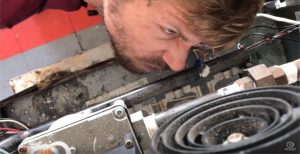
This article is an extension of HVAC School’s “How to Measure Gas Pressure” video. Additional input was provided by Jim Bergmann. Bubble test procedures and standards were provided by Honeywell. Links to source materials are available at the end of this article. If there’s one complaint that HVAC techs should never take lightly, it’s a […]
Read more
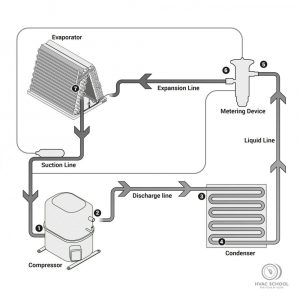
Many in our industry can misunderstand the differences between temperature and heat, although these are related. Substances are composed of many moving molecules that change their speed as they release or gain heat. When we heat a glass of water in a microwave, its molecules start to move more quickly. The velocity increase results in […]
Read more
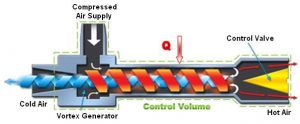
We just wrote about rejecting heat to the atmosphere via radiant cooling. That’s one example of cooling without refrigerants, but there are quite a few others out there. In this article, we’ll look at some other cooling methods that don’t use refrigerants. Vortex tubes Vortex tubes swirl gas in a chamber, separating it into hot […]
Read more

Net refrigeration effect (NRE) is the quantity of heat that each pound of the refrigerant absorbs in the refrigerated space to produce useful cooling. That’s a pretty vague definition. We know that it’s an amount of heat in processes that take place within the evaporator. Still, the phrase “useful cooling” seems rather broad. Even though […]
Read more