Tech Tips

Most controls and thermostats will have some sort of cycle rate per hour setting that kicks in to prevent over-cycling once the setpoint is reached. These cycle settings don't kick in until the system starts achieving setpoint, so don't worry if it will shut off if it's set to 70° in heat mode and it's […]
Read more

I just noticed this portion of the Carrier air handler sticker for the first time the other day. I'm like most techs; it's easy for us to ignore the great info posted right in front of us on the data tag. That's because so many of the notices contain info we are used to seeing. […]
Read more

If you work in refrigeration, you may have heard the term “hot pull down.” This phrase describes a condition where the load on the evaporator is above design due to the box temperature or the temperature of the product in the box being higher than it would normally be. My grandpa called me a few […]
Read more

Imagine a glass of ice sitting on a table. Now, imagine you place a lid on the glass so that all the water and ice are contained in the glass. If the ice and water are well mixed, the water and ice will both be at 32°F because the ice is slowly changing state from […]
Read more
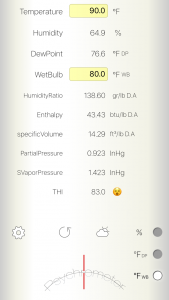
This is the second article in a three-part series where we explore advanced psychrometrics. The source material for each of the articles in this series is ACCA Manual P Sections 3, 4, and 5. This article is based on information found in Section 4. If you followed the previous advanced psychrometrics article, you now know […]
Read more

There has never been a more complicated and confusing time surrounding refrigerants than what we are in right now. We are seeing flammable HC (hydrocarbon) refrigerants with increasing regularity, and EPA rules that just changed appear to be changing again. With all this tumultuous change, it's important to know what to look for in refrigerants […]
Read more
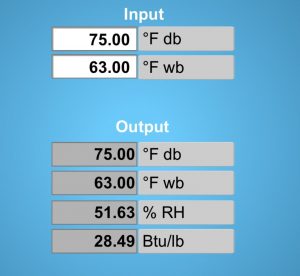
This is the first of a three-part series of articles that will dive deep into advanced psychrometrics. The source material for each of these articles may be found in ACCA Manual P Sections 3, 4, and 5. This article is based on information found in Section 3. Psychrometrics is the study of the physical and […]
Read more
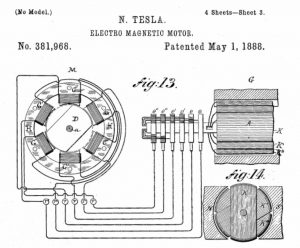
Most motors are designed to a set amount of work, usually rated in either watts or horsepower (746 watts per HP). Watt's law states that watts = volts x amps. If a particular motor needs to do 1 horsepower of work at 120 volts, it will draw about 6.22 amps. And yes, in an inductive […]
Read more

I am like most contractors and techs. I've heard about HEPA for a long time, but I never looked into how it could be integrated into an A/C IAQ strategy until now. First, here's what HEPA is: HEPA (High-Efficiency Particle Arrestance) is an ASME, U.S. DOE standard that specifies a capture rate of 99.97% of […]
Read more