BACK
 Training: Processes or Apprentices?
 Sales: Techniques or Values?
 Troubleshooting with DTD
 Improving Humidity Control on the Cheap
 Equivalent Length Merry-Go-Round
 Plenum Takeoffs Best Practices
 What is Enthalpy?
 What are Dry and Wet Contacts?
 Cooling Capacity Isn’t Always What it Seems
 White Shirt Techs – Manifesto
 Q&A – Double Flares – Short #225
 Can You Coat Fiberglass?
 Redux – The Lost Art of Steam Heating w/ Dan Holohan
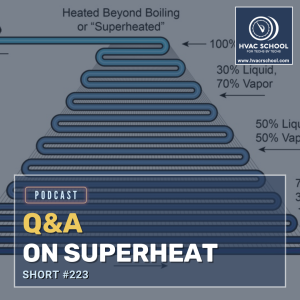 Q&A on Superheat – Short #223
 Duct Cleaning – How Long & How Often?
 Are EVs an Opportunity? – Short #222
Choosing HVAC Cleaners w/ Becca from Viper
Are EVs an Opportunity? – Short #222
Choosing HVAC Cleaners w/ Becca from Viper
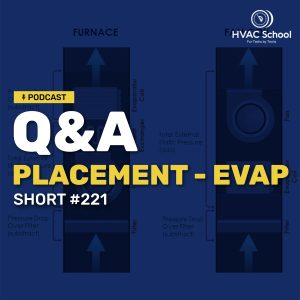 Q&A – Evap Placement – Short #221
#hvac
Tech Tips:
“It is only through the enforced standardization of methods, enforced adoption of the best implements and working conditions, and enforced cooperation that this faster work can be assured. And the duty of enforcing the adoption of standards and enforcing this cooperation rests with management alone.” —Frederick Taylor “The objective of education is not to fit […]
Read more
“The very substance of our existing which has made us leaders in technique, stands as a barrier to any thinking which might be able to comprehend technique from beyond its own dynamism.” -George Grant The odd quote above takes some time to understand but has been rattling around in my brain for weeks now. George […]
Read more
The temperature of the refrigerant in the evaporator coil can really help us with diagnostics, but we need to know the targets we’re aiming for if we want to get the most out of it as a troubleshooting tool. If we take the return air temperature and subtract 35 degrees from that number, we get […]
Read more
This tech tip was submitted by Steve Rogers, the current president of The Energy Conservatory (TEC). Steve has been on the podcast several times in the past and is a valued contributor to HVAC School. Thanks, Steve! As summer approaches, HVAC technicians all over the US are preparing for those difficult conversations with occupants about […]
Read more
I recently read a tech tip by Matt Bruner about using the Manual D process. In the article, he designed a duct system for a small job using a ducted mini-split. One thing I noticed about his design was that the supply and return duct velocity was fairly low compared to the arbitrary 900-feet-per-minute supply […]
Read more
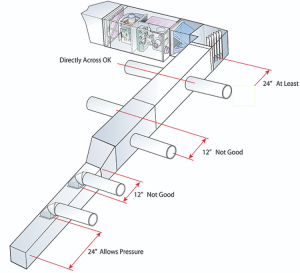
In my second year in HVAC, I went out with a senior technician to install a supply duct for a bathroom in a house. While he ran the duct, I cut a hole in the plenum and attached the collar. He crawled back across the attic and very nicely told me that people don’t typically […]
Read more
Enthalpy is easy. It's just a state function that depends only on the prevailing equilibrium state identified by the system's internal energy, pressure, and volume. It is an extensive quantity. Simple. Like most things, the scientific definition is as clear as mud. In HVAC/R, we use enthalpy measurement to come up with the total heat […]
Read more
I was talking about dry contacts with one of my techs, and he looked at me like I had three heads—and one of them was on fire. So, I figured it would be good to cover the difference between wet and dry contacts in a tech tip. Basically, “dry” contacts are switches with no shared […]
Read more
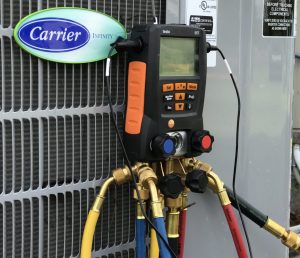
We all learned how to read the tonnage off of a model number within a few weeks of beginning in the trade. What you may (or may not) have learned is that just because something has an 036 in the model number, that does NOT mean it actually produces 36,000 BTU/hr. It doesn't reach the […]
Read more
Videos:



Podcasts:
This unique podcast episode is a commentary on the phenomenon of “white shirt techs” in the HVAC industry – a term that refers to technicians who focus heavily on sales and maintaining a pristine appearance rather than technical expertise. While there’s nothing inherently wrong with having good sales skills or maintaining a professional appearance, […]
Read more
In this short podcast episode, Bryan answers a listener-submitted question about double flares and their application in the HVAC/R industry. Flare connections are common in certain types of equipment, and they connect the copper to the appliance. As a result, when we make a flare, our goal is to make it leak-free. A regular […]
Read more
In this episode of the HVAC School Podcast, Bryan interviews Zach about duct coatings and their applications in HVAC systems, particularly focusing on the Hardcast RE500 product. The discussion delves into the importance of proper duct coating applications and their benefits for both contractors and customers. Zach, who has extensive experience in duct cleaning […]
Read more
In today’s podcast, Bryan talks with legendary Hydronics author and trainer Dan Holohan about the history of steam heating and some practical applications of old ideas. Recently, Dan has been working on more novels, having published two of them over the past few months. Steam heating is a “lost art” nowadays; it has become […]
Read more
In this short Q&A podcast episode, Bryan answers a listener-submitted question about superheat, including what it is and how we measure it. Superheat is the number of degrees a refrigerant is above its saturation point. The saturation point is where you will have a liquid-vapor mix, so superheat only exists when a substance is […]
Read more
In this episode of the HVAC School podcast, Bryan interviews Zach from Southeast Clean Air Solutions about the intricacies of professional duct cleaning. Zach specializes in addressing duct cleaning challenges specific to the Southeastern climate, with a particular focus on fiberglass-lined ducts. The conversation delves into the complexities of cleaning different types of duct […]
Read more
In this short podcast, Bryan talks about electric vehicles and whether EVs present an opportunity for HVAC technicians. The residential sales lead at Kalos recently mentioned that keeping an EV in a conditioned garage is advantageous, and it’s an upgrade we can offer our customers. In hot weather, EV battery performance and health can […]
Read more
The podcast delves into the world of HVAC chemical solutions through an in-depth conversation with Becca Stamey, the marketing director at Refrigeration Technologies. The discussion provides insights into the company’s unique approach to developing cleaning products, rooted in a commitment to safety, effectiveness, and customer feedback. Founded by John Pastorello, a chemist turned HVAC […]
Read more
In this short podcast, Bryan talks about evaporator coil placement based on a question submitted by a listener, John. Evap coil placement differs in furnace applications versus air handlers. When we use air conditioners with furnaces, we usually put evaporator coils on the positive side to protect the heat exchanger from rusting out during […]
Read more