
Electrical Fundamentals & Troubleshooting

Voltage drop is one of those topics we often mention but seldom think about in-depth. From a very basic standpoint, we need to know whether or not the rated voltage is being delivered to the device or appliance while under full load, which is as simple as running the equipment and measuring the voltage at […]
Read more

The easy answer is 32v. Class dismissed. I’m only joking, of course. Finding the difference between 208 and 240v power supplies may sound quite simple, but there are some pretty sharp fundamental differences. Apart from the obvious differences in overall voltage, 208 and 240v power supplies use the electrical company’s power differently. The motors also […]
Read more
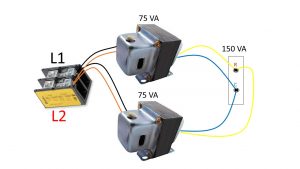
I had an old-timer tell me that you can never connect two transformers together because they will “fight one another.” If you are anything like me (and heaven help you if you are), a cartoon in your head starts playing whenever someone says something like that. In this case, I imagine two transformers with boxing […]
Read more

Capacitors are traditionally tested with a capacitance meter (commonly found as a function within a multimeter), with the component taken entirely out of the circuit. “Bench testing,” as this method is referred to, is hands-down the safest method of checking capacitance in microfarads. All other methods require the capacitor to be wired into the circuit […]
Read more

Connecting more than one wire on or under a single lug or connection point is called “double lugging,” and it is ONLY allowed in line voltage wiring under one condition, according to NEC 110.14: If the terminal, lug, or connector is specifically rated for more than one wire In the case of a conductor splice, […]
Read more
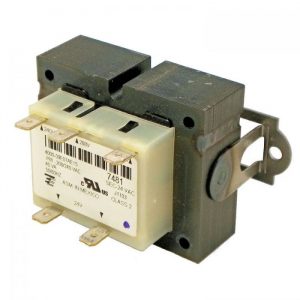
Have you ever seen a low-voltage transformer like the one shown above? It has multiple input (primary) taps for a good reason. It is common to find three-phase and single-phase equipment rated to operate on both 240v and 208v power. That is because three-phase power can either be 208v leg to leg when the building […]
Read more

Erich Vinson is a tech from Colorado and one of the most entertaining people I interact with online. He wrote this quick tech tip on stripping back the outer jacket properly on control wires, and it happens to also be something I preach. Thanks, Erich. In the first picture (above), you can see what happens […]
Read more
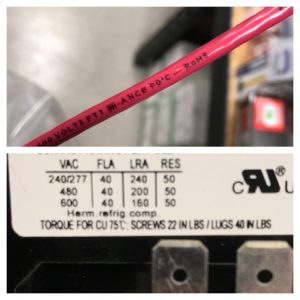
When you are checking a unit of any kind, you should be keeping your eyes open for signs of arcing and melting at all of your wire connections and contact points. We find issues with melting terminals on contactors and in disconnects regularly. Still, We rarely think about the relationship between circuit ampacity, wire size, […]
Read more
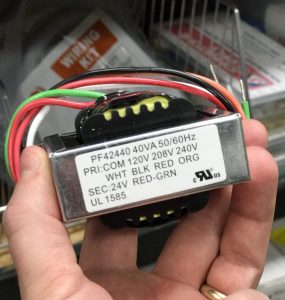
A 40VA transformer is rated for 40 VA or volt-amps on the secondary. For a typical 24 volt secondary, this is simply using Watt's law to calculate amperage. (For more information on Watt's or Ohm's laws, please check out this article HERE.) 40 ÷ 24 = 1.666666 ∞ (round up to 1.67 already) So, you […]
Read more