
BACK
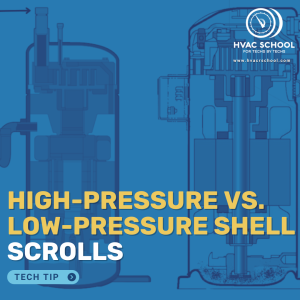 High-Pressure vs. Low-Pressure Shell Scrolls: A Deeper Dive
 Should the Float Switch Break R or Y?
 Don’t Drive Drowsy
 Flex Ducts: Peeling Back the Layers
 Solving Delta T
 Don’t Fall for Unsafe Practices: Heights in HVAC
 Non-Invasive Testing: A Smarter Approach to System Diagnostics
 Solving Superheat
 Living in a World of Acids (and why HVAC coils are secretly crying for help)
 Analyst vs. PM vs. Operations – Short #261
 The Hidden Cost of Killing Radiant Load – Short #260
 Balance Point Explained w/ Jim Fultz
 Dehumidify with a Waterfall? – Short #259
 What are User Requirements? w/ ELK
 Static Pressure is like Blood Pressure – Short #258
 How To Be a REAL Comfort Consultant
 Non-bleed TXVs and Hard Starts – Short #257
 Scroll Compressors & New Refrigerants w/ Copeland
#hvac
Tech Tips:
I want to share something that came up in a recent discussion with Roman Baugh about VRF systems, and it made me realize I might have had a blind spot regarding scroll compressor designs. We were talking specifics, and he brought up high-pressure shell compressors. My immediate thought was, “Hold on, aren't scrolls low-pressure shell […]
Read more
There are three things we never discuss at the dinner table: religion, politics, and which wire to break with your float switch. A float switch fills with water whenever there is a drain backup, and it breaks power to one of the low-voltage wires. We clearly want the HVAC system to stop producing more condensate, […]
Read more
Being in an industry that requires a lot of travel—local or regional—can be a great thing for people who enjoy driving. It also comes with several more risks and opportunities for roadway accidents than someone who just has a round-trip commute to a single location every day. We’re all aware of the issues of texting behind […]
Read more
A few times in the past, we’ve heard the phrase “the house is the biggest duct” because of the way air moves through it. Well, we can take it a step further and see that there are similarities that go just beyond air movement. A building has several layers to keep things like moisture, heat, and […]
Read more
Delta T is the difference in temperature between two points of the same medium. It is commonly used by scientists and engineers to analyze the amount of heat transfer in a system. In general HVAC terms, it is the measurable change in temperature between an air input and air output. However, it could also be […]
Read more
DISCLAIMER: HVAC School is NOT an official OSHA safety training resource! Although we provide safety tips in good faith, neither this tech tip about the hazards of working at heights nor any other training on our website is a substitute for safety training from an authorized OSHA training source. Many things may deter people from […]
Read more
This tech tip about non-invasive testing comes from a post in the HVAC School Facebook group by Ed Janowiak. Ed is the Manager of HVAC Design Education at ACCA, a longtime friend of HVAC School, and an educator who does a lot of great work for the industry. Thanks, Ed! This past Thursday, I taught […]
Read more
In this article, we’ll discuss solving superheat using this diagnostic sheet to help us better understand how it is calculated and from where it is derived. I want to thank Ty Branaman for helping me develop these sheets that will hopefully aid in a better understanding of some of the basic HVAC measurements that both […]
Read more
Imagine a small IT room packed with servers, monitors, and humans. CO₂ levels easily spike to over 3000 PPM since the room lacks fresh air ventilation. Two overworked mini-split units churn away, cooling the space and unknowingly creating the perfect acidic environment. Fast forward a few months, and those shiny coils now resemble something pulled […]
Read more
Videos:


Podcasts:
In this short business-oriented podcast, Bryan breaks down the differences between three commonly confused positions/roles: analyst vs. PM (project management) vs. operations. When you own or work in a small business, you might wear a lot of hats: estimating, writing proposals, troubleshooting, being a customer or coworker’s therapist, etc. This work can be organized, […]
Read more
In this short podcast, Bryan talks about the hidden cost of killing radiant load, especially when it comes to installing radiant barriers in attics. We sometimes get service calls about ducts sweating when they never used to sweat. If there are no problems with the system (i.e., the refrigerant charge, static pressure, airflow, supply […]
Read more
This comprehensive episode dives deep into one of the most critical yet misunderstood concepts in HVAC: balance point calculations for heat pump systems. Jim and Bryan break down the complexities of dual fuel systems, explaining why proper sizing and balance point calculations are essential for both comfort and efficiency. The discussion moves beyond basic […]
Read more
In this short podcast episode, Bryan talks about history and HVAC science: how to dehumidify the air with a waterfall and how cold water became the first air conditioner. In 1902, Willis Carrier worked for a printing company in Brooklyn, New York. There was a huge humidity problem during the summer: the printing plant […]
Read more
In this comprehensive session, Eric Kaiser walks through the critical importance of establishing proper user requirements before making equipment purchases. Drawing from real-world experiences in the HVAC industry, he demonstrates how poor upfront planning leads to costly mistakes, buyer’s remorse, and multiple equipment purchases. The discussion covers everything from selecting simple tools like screwdrivers […]
Read more
In this short podcast episode, Bryan explains the science behind a common HVAC simile: static pressure is like blood pressure. He covers the similarities and differences between measuring static pressure during a service call or maintenance and a doctor measuring your blood pressure at a checkup. Total external static pressure (TESP) should be measured […]
Read more
In this comprehensive episode, Bryan Orr sits down with Tim De Stasio to explore the world of comfort consulting and performance contracting in HVAC. Tim, who sold his contracting company to focus on this specialized field, shares his methodical approach to diagnosing home performance issues that go far beyond traditional HVAC troubleshooting. Working primarily […]
Read more
In this short podcast episode, Bryan talks about non-bleed TXVs and whether they need hard starts. A non-bleed (hard shutoff) TXV is a metering device that shuts off during the off cycle; it closes shut when there is no superheat. This strategy prevents refrigerant migration, especially in cases where we have long line sets. […]
Read more
In this essential episode, Bryan sits down with Jeff and Tom from Copeland to dive deep into the world of scroll compressors and the critical topic of refrigerant compatibility. As the HVAC industry navigates new refrigerant standards and regulations, understanding how compressors are specifically designed and optimized for different refrigerants has never been more […]
Read more